Fishing Line Memory Life Calculator
Estimate how long a fishing line setup should stay manageable before coil memory, twist, heat, UV, salt, and spool set make it ready for replacement.
📌Line-memory presets
⚙Storage, line, and water inputs
Line memory forecast
Calculation breakdown
🧵Line material comparison grid
Nylon mono
Fluorocarbon
Copolymer
Braided PE
Fused line
Fly line
Coated wire
Memory target
📋Reference tables
| Storage profile | Temperature band | UV exposure | Memory effect |
|---|---|---|---|
| Closet spool | 50-75 F / 10-24 C | Dark | Slow set and best life |
| Garage shelf | 75-90 F / 24-32 C | Indirect light | Moderate set on nylon and fluoro |
| Boat locker | 80-100 F / 27-38 C | Intermittent sun | Fast stiffness gain |
| Window or deck | 90 F+ / 32 C+ | Direct sun | High UV aging and coil lock |
| Spool diameter | Typical reel or storage | Memory pressure | Best material fit |
|---|---|---|---|
| Under 1.25 in / 32 mm | Ice reel or small spare coil | Very high | Braid or soft mono |
| 1.25-2.0 in / 32-51 mm | Ultralight and 1000-2500 spinning | High | Copolymer or braid |
| 2.0-3.5 in / 51-89 mm | General spinning and baitcast | Medium | Mono, copolymer, fluoro |
| 3.5 in+ / 89 mm+ | Bulk spool or large arbor | Low | Any line with low UV |
| Line class | Typical diameter | Memory note | Replacement clue |
|---|---|---|---|
| 2-6 lb / 1-3 kg | 0.10-0.22 mm | Fine line coils less but twists fast | Loops jump from spool |
| 8-14 lb / 4-6 kg | 0.23-0.35 mm | Balanced line set | Cast distance falls |
| 15-30 lb / 7-14 kg | 0.36-0.55 mm | Stiffer coils form faster | Line springs after pull |
| 40 lb+ / 18 kg+ | 0.56 mm+ | Leader memory dominates | Knots and rigs kink |
| Water and use | Wear factor | Memory factor | Practical read |
|---|---|---|---|
| Freshwater, 1-3 days/month | Low | Storage matters most | Age before abrasion |
| Freshwater, weekly | Medium | Twist matters most | Flip line or stretch |
| Saltwater, rinsed | Medium-high | UV plus salt cycles | Inspect leader zone |
| Saltwater, not rinsed | High | Surface roughness rises | Shorten interval |
💡Memory management tips
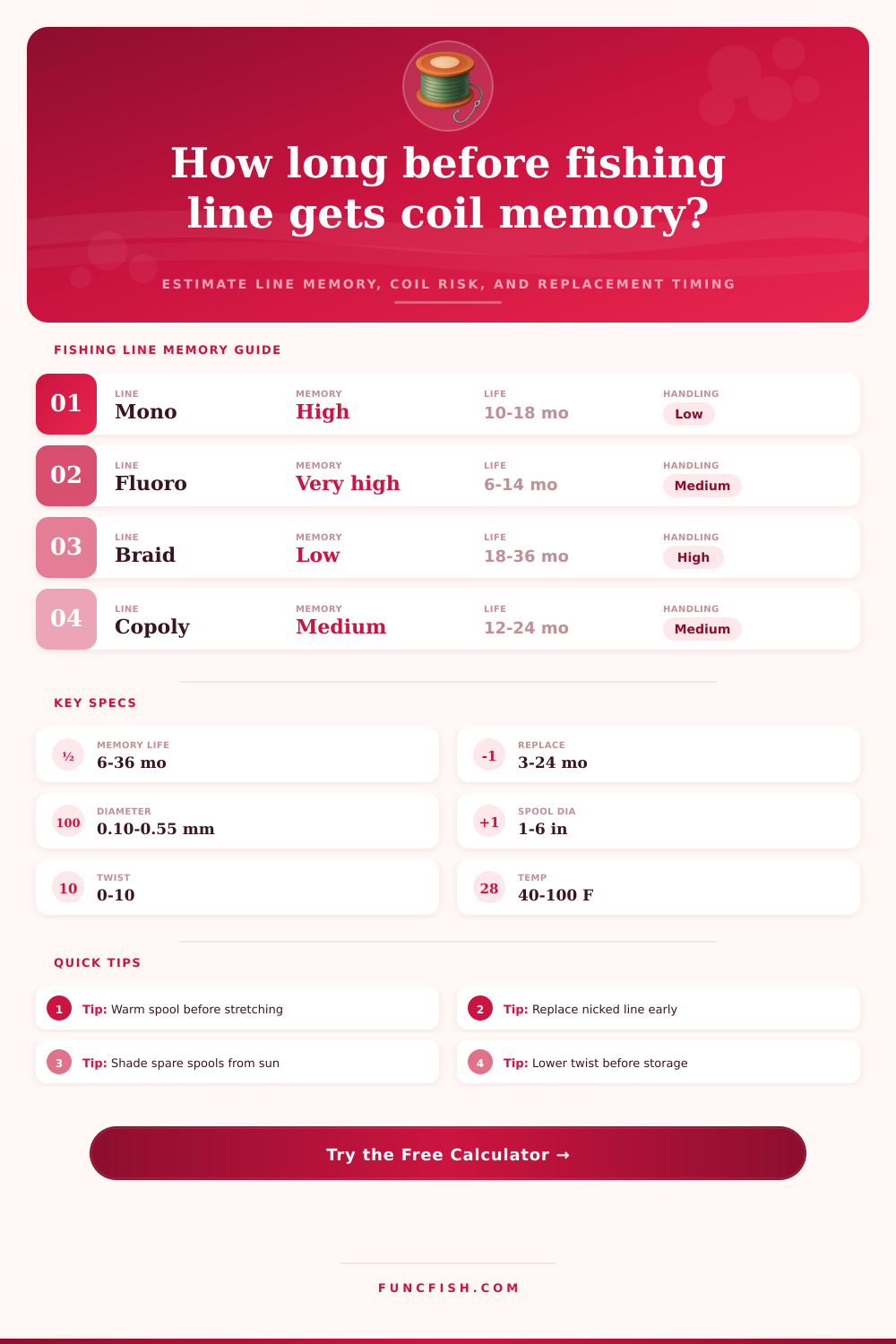
Storage tip: Move spare spools into a dark, stable-temperature box and avoid leaving fluorocarbon or mono on small reel spools through hot months.
Handling tip: A line can be inside its age window but still need replacement if twist, salt roughness, flat spots, or kinks make the coil risk score climb.
Fishing line has a physical property known as memory. The memory of fishing line allow the fishing line to retain the shape that it has previously held. The memory of fishing line creates coils, loops, and knot within the line itself.
These coils, loops, and knots within the fishing line can cause the fishing line to become tangle or to prevent the fishing line from casting correct from the fishing rod. Fishing lines that are in good condition when stored in the garage may become wind knot along the line or may refuse to lay flat when the fishing line is cast into the water and under tension. The conditions in which the fishing line is stored will determine at what rate the memory of the fishing line develops.
Why Fishing Line Keeps Its Shape and When to Replace It
Each of the environmental factor will alter the rate at which the line develops memory. For instance, changes in the temperature within which the fishing line is stored will lead the polymer of the fishing line to stretching and contract. Additionally, those changes in temperature will contribute to the development of the memory of the fishing line.
Ultraviolet light from the sun will break down the surface of the fishing line over time. As a result, the fishing line will develop memory due to the effect of the ultraviolet light on the fishing line. Fishing lines on small diameter spools will experience more pressure on the fishing line than those on large diameter spools.
This pressure on the line will force the fishing line into coils and loops. As a result, fishing line on small spools ages more faster than that on large spools. Additionally, salt can leave on the fishing line will create friction on that fishing line.
This friction will contribute to the development of flat spot on the fishing line, which will prevent it from straightening out. Finally, the fishing line will experience a twist with each cast of the fishing line. The twist on the fishing line contribute to the memory of the line.
Not all fishing lines has the same reaction to these environmental factors. For instance, lines made from different materials will have different levels of memory. Fishing lines made from nylon monofilament are supple when new, but lock into the curves that they experience over time.
Fluorocarbon lines are stiffer than nylon lines, and hold memory of the shape of the line more quicker. Braided lines do not have memory of coils on it own, but the coating on the line may flatten due to friction with the spool. Finally, copolymer lines have a memory and durability of the line that is within the range of both nylon and braided lines.
The calculator that is provided on this page requires that you enter various data related to the fishing line that you would like to assess. Specifically, you will need to enter the material of the fishing line, the length of time that the fishing line was in storage, the diameter of the spool on which the line is cast, the temperature of the line, the amount of exposure of the fishing line to ultraviolet light, the amount of twist that the line develops while being cast, and the type of water that the line will be cast into. Each of these parameter will impact the memory of the fishing line.
For instance, fishing line that is stored in a location that does not expose it to ultraviolet light will last longer than fishing line stored in a location that is exposed to ultraviolet light. Similarly, fishing line on a large diameter spool will experience less pressure along the length of the line than fishing line on a small diameter spool, which will allow it to last longer. The determination of when to change a fishing line is not based off a single measurement.
For example, a fishing line may be strong enough to pass a strength test. However, due to memory, the fishing line may have a low handling score. Additionally, the frustration caused by the line getting tangled may be enough to cause an angler to decide to replace the fishing line with a fresh line on a spool.
Thus, the calculator will suggest that the fishing line be change at an interval that is prior to the strength test results that indicate that the fishing line should be replaced. There are other factors that contribute to the development of memory of the fishing line. These factors cannot be measured by the calculator, but they do impact the fishing line.
For instance, if the fishing line experiences a snag, it may contribute to the creation of a flat spot along the length of the fishing line. Additionally, wind knot may form along the fishing line, which will shorten the life of the fishing line. However, fishing line stored under ideal conditions and with no exposure to twist or ultraviolet light will last longer than the calculation provided.
The reference tables located on this page provide information about the conditions of the fishing line and how they interact with the variables that is considered by the calculator. For instance, a 40 pound test fishing line on a small diameter will age differently than a 40 pound test line on a large diameter. Additionally, fluorocarbon lines used in ice fishing will need to be replaced more often than fluorocarbon lines used in open water.
These tables can help anglers understand how the calculator’s variables relate to their fishing experience. Many anglers will change their fishing lines based on a calendar schedule. Such a schedule may not account for factors like a hot summer season, or a period in which the fishing line develops a high degree of twist.
For example, anglers can check their fishing line by pulling on the line to check for spring-back, checking for loops in the line when the fishing line is opened, or by noting when the distance that the fishing line casts out into the water decreases. Each of these indicators can be quantified by the calculator, providing anglers with a means of basing their decision to change their fishing line upon a measurement of the line. Thus, the tools provided on this page will allow anglers to ensure that the fishing line that they use has the same behavior as the material from which it is make.