Pollock Weight Calculator
Estimate Atlantic pollock weight from fork or total length, girth, body depth, pollock class, inshore or offshore habitat, water temperature band, maturity, condition, confidence, and units.
📌Named pollock presets
⚙Pollock measurements and modifiers
Pollock model: this calculator blends a length-weight curve for Atlantic pollock with a girth-and-depth body-volume estimate, then applies habitat, temperature, maturity, condition, and confidence adjustments.
Pollock weight estimate
Results appear after calculation.
Full calculation breakdown
📊Pollock data grid
Young coast fish
Inshore adult
Bank adult
Large offshore
Numbers in this grid are inches for quick field comparison. Use the unit toggle in the calculator for centimeter entry and kilogram output.
📘Pollock reference tables
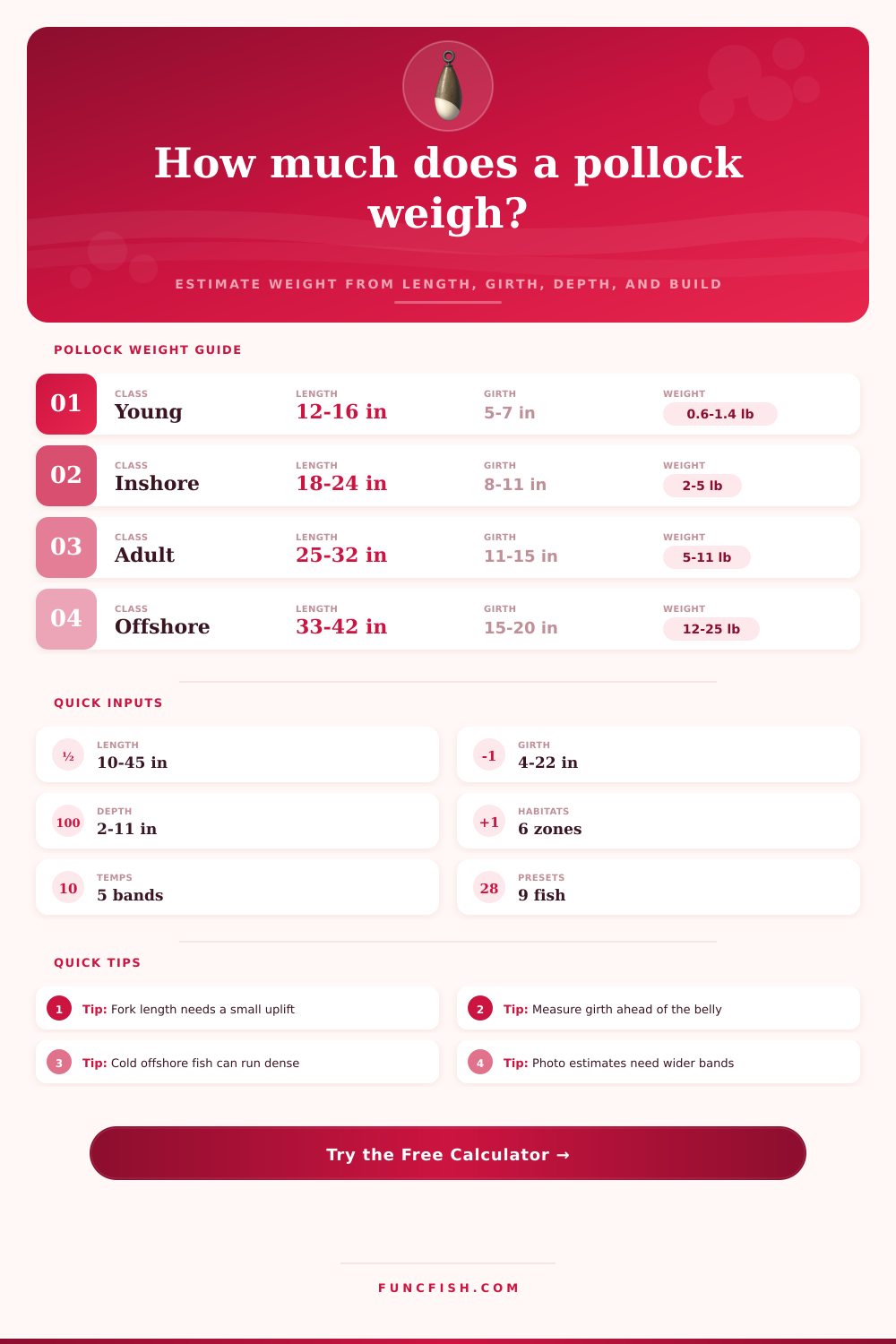
| Pollock class | Total length | Typical girth | Typical depth | Estimated weight |
|---|---|---|---|---|
| Young coastal pollock | 10-16 in / 25-41 cm | 4.5-7 in / 11-18 cm | 2-3.4 in / 5-9 cm | 0.4-1.5 lb / 0.2-0.7 kg |
| Subadult inshore pollock | 17-23 in / 43-58 cm | 7.5-10.5 in / 19-27 cm | 3.5-5.2 in / 9-13 cm | 1.7-4.4 lb / 0.8-2.0 kg |
| Mature ledge pollock | 24-31 in / 61-79 cm | 10.5-14.5 in / 27-37 cm | 5.1-7.4 in / 13-19 cm | 4.5-10.3 lb / 2.0-4.7 kg |
| Offshore bank pollock | 32-39 in / 81-99 cm | 14.5-19 in / 37-48 cm | 7.2-9.6 in / 18-24 cm | 10.5-21 lb / 4.8-9.5 kg |
| Large deep-water pollock | 40-45 in / 102-114 cm | 18-22 in / 46-56 cm | 9-11 in / 23-28 cm | 20-31 lb / 9.1-14.1 kg |
| Habitat setting | Model effect | Body note | Best input emphasis | Range effect |
|---|---|---|---|---|
| Harbor or protected bay | 0.96 multiplier | Often younger, slimmer fish | Fork length plus girth | Moderate range |
| Kelp edge or rocky ledge | 1.02 multiplier | Balanced inshore adults | Total length plus depth | Normal range |
| Tide rip or nearshore shoal | 1.04 multiplier | Fast-current shoulders | Girth at deepest body | Normal range |
| Offshore bank edge | 1.08 multiplier | Dense, forage-ready adult fish | All three measurements | Slightly wide |
| Deep basin or wreck edge | 1.10 multiplier | Heavy deep-water form | Depth cross-check | Wide range |
| Survey tow average | 1.00 multiplier | Population-style average | Measured length class | Broad range |
| Temperature band | Model effect | Pollock interpretation | Use when | Confidence note |
|---|---|---|---|---|
| Under 40°F / 4°C | 1.03 multiplier | Cold, dense body condition | Winter or deep water | Add uncertainty if photo-based |
| 40-48°F / 4-9°C | 1.01 multiplier | Cool-water standard | Spring and offshore trips | Good baseline band |
| 49-55°F / 9-13°C | 1.04 multiplier | Prime feeding temperature | Fall ledge or bank fish | Strong girth signal |
| 56-62°F / 13-17°C | 0.99 multiplier | Mild inshore water | Summer inshore fish | Watch for lean fish |
| Over 62°F / 17°C | 0.95 multiplier | Warm edge, lighter feeding | Late summer shallows | Use a wider range |
| Maturity or condition | Multiplier | Length signal | Girth signal | Depth signal |
|---|---|---|---|---|
| Juvenile or immature | 0.94-0.98 | Shorter fork length | Narrow body | Shallow back |
| Subadult transition | 0.98-1.00 | Fast length growth | Developing girth | Moderate depth |
| Mature adult | 1.00-1.03 | Stable total length | Balanced fullness | Firm shoulder |
| Pre-spawn adult | 1.07-1.12 | Length unchanged | Full belly | Deep lower body |
| Post-spawn adult | 0.90-0.96 | Length unchanged | Reduced girth | Flatter profile |
🗂Pollock and cod-family comparison grid
Atlantic Pollock
Sleek, fork-tailed gadid with strong shoulders and a more tapered body than cod at similar length.
Atlantic Cod
Broader head and deeper trunk make cod usually heavier than pollock at the same total length.
Haddock
Typically smaller, with a more compact body and lower girth than a bank pollock of similar length.
Silver Hake
More slender and soft-bodied; weight estimates rely strongly on length and less on deep girth.
💡Pollock measurement tips
Pollock have a forked tail, so fork length usually needs a small conversion before comparing to total-length weight charts. Select the measured basis instead of manually adjusting the number.
A pollock can look deceptively slim in photos. Girth catches roundness, while body depth catches shoulder height; together they keep the estimate from leaning too hard on length alone.
A pollock can be difficultly to weigh based off its appearance. A pollock may look thinner then one actualy is. Pollocks may appears to be longer than they are due to the forked shape of there tails.
Because of this, using only the length of the fish to calculate its weight will results in an incorrect measurement of the pollock weight. The calculator can more accurate determine the weight of the pollock, since it take into account the length, girth, and depth of the pollock. Additional parameter that can be selected on the calculator are those relating to the habitat, temperature, and maturity of the pollock, as each of these factor can impact the weight of that individual pollock.
How to Estimate Pollock Weight
The habitat in which the pollock live can impact the weight of that fish. For instance, pollocks that live in areas with kelp and rock may have differently shaped bodies than those that live in deep sea basins. While the difference in body shape may seem small, it is important to account for this parameter when comparing pollock weight to other survey data.
Additionally, the water temperature impact the weight of the fish; pollock in cooler water may have denser muscles than pollock that live in warmer water. Therefore, water temperature is another factor that the calculator can account for. The maturity of the fish and its feeding history can also have an impact upon its total weight.
Pollock that are about to spawn will have more mass in the bellies of their bodies than pollock that has just spawned. Therefore, accounting for the maturity of the pollock allows for an more accurate calculation of the weight of the species. In addition to displaying the estimated weight of the pollock, the calculator also displays the range of possible weights for the pollock.
It is always better to use measurements rather than descriptions to determine the weight of a pollock. For instance, people may use the word “average” or “heavy” to describe the pollock, but this is subjective; different people will use different terminology to describe the same pollock. Instead, using the girth and depth of the pollock allow people to be specific in their descriptions.
Additionally, using these two measurement will ensure that the weight estimate for the fish is honest and accurate. These measurements can be entered into the calculator, which will account for the pollock’s weight, rather than remembering the conversion table. Because of the shape of the pollock, the species will weigh differently than a cod of the same length.
Cod species is typically heavier than pollock of the same length; they have deeper bodies and broad heads. Additionally, haddock have more compact bodies than pollock, and silver hake have more slenderly bodies than pollock. When comparing the weights of these species, it is important to use the same measurement method for each species.
While the calculator is not a measuring tool that should replace a scale, it is a helpful tool to calculate the weight of a pollock without access to a scale. In order to obtain the best measurement of the pollock using the calculator, it is important to make sure that the pollock is correctly measure. The length of the fish from the tip of its tail can be used, as well as the measurement of the fish from the nose to the fork in the tail.
The calculator will account for either type of measurement. Additionally, the girth of the fish should be measured at the widest part of its belly, as should the depth of the pollock. Each of these measurements can be entered into the calculator, along with the habitat, temperature, condition, and maturity of the pollock.
These parameters will help to determine the range of the weight of the pollock.