Haddock Weight Calculator
Estimate haddock weight from fork or total length, maximum girth, body depth, offshore bank habitat, condition, maturity, temperature band, measurement confidence, and unit system.
📌Haddock presets
⚙Length, girth, body depth, and bank habitat
Model: haddock are cod-family fish with a slimmer body than cod. This calculator blends fork length x girth squared with a body-depth check, then adjusts for offshore bank habitat, condition, maturity, water temperature, and confidence.
Haddock weight estimate
Calculation breakdown
📊Haddock profile cards
Standard adult
Heavy bank fish
Long lean fish
Photo backup
🔀Cod-family comparison grid
Haddock
Slender cod-family body with moderate girth and a dark lateral line.
Atlantic cod
Deeper and broader through the shoulder, usually heavier at equal length.
Pollock
Longer, leaner profile with lower belly mass than bank haddock.
Whiting
Small, slim gadid profile with lighter weight for length.
Cusk
Elongated body; girth can be decent but depth stays lower.
📘Reference tables
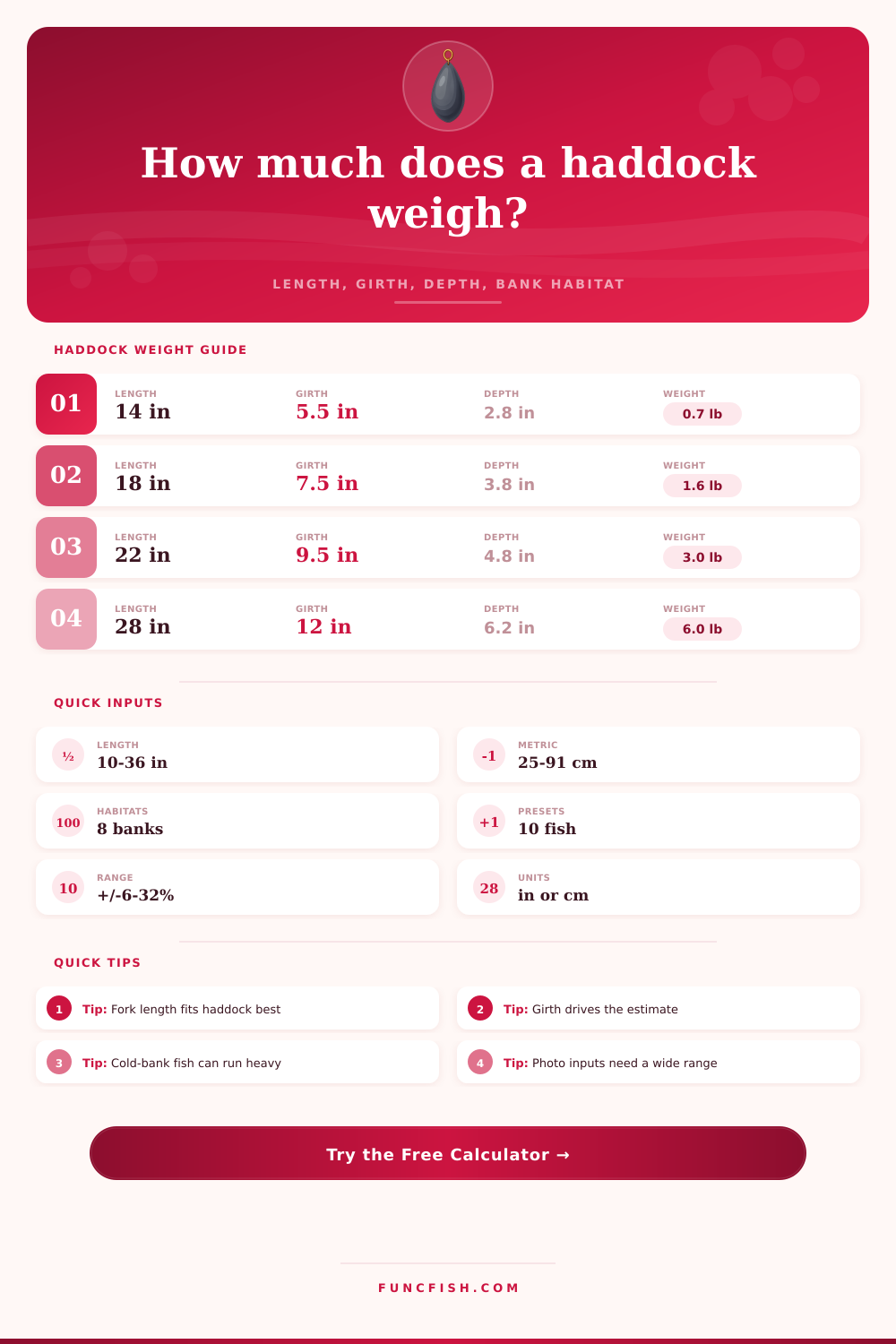
| Fork length | Typical girth | Typical depth | Likely weight | Field read |
|---|---|---|---|---|
| 12 in / 30 cm | 4.6-5.4 in | 2.4-2.9 in | 0.4-0.8 lb | Small haddock |
| 16 in / 41 cm | 6.0-7.0 in | 3.2-3.8 in | 1.0-1.8 lb | Keeper-size class |
| 20 in / 51 cm | 7.8-9.0 in | 4.0-4.7 in | 2.0-3.2 lb | Common adult |
| 24 in / 61 cm | 9.5-11.2 in | 4.9-5.8 in | 3.5-5.4 lb | Strong bank fish |
| 30 in / 76 cm | 12.0-14.0 in | 6.2-7.4 in | 6.5-10.5 lb | Large offshore fish |
| Offshore bank habitat | Expected profile | Factor | Range behavior | Use when |
|---|---|---|---|---|
| Georges Bank gravel | Baseline adult haddock | 1.00 | Tight to moderate | Classic gravel bank fish |
| Gulf of Maine mud/gravel | Slightly variable body | 0.98 | Moderate | Mixed mud and gravel drifts |
| Scotian Shelf bank | Good adult fullness | 1.03 | Moderate | Cool shelf fish |
| Deep channel edge | Longer and leaner | 0.97 | Wider | Channel edge or deeper tow |
| Cold winter bank | Heavy cold-water class | 1.06 | Moderate | Winter or early spring banks |
| Temperature band | Imperial | Metric | Body cue | Calculator effect |
|---|---|---|---|---|
| Very cold bank water | 34-38°F | 1-3°C | Slow but dense habitat | Slight range widening |
| Cold | 39-43°F | 4-6°C | Typical northern bank water | Small fullness lift |
| Prime haddock band | 44-49°F | 7-9°C | Strong feeding condition | Best baseline |
| Cool edge | 50-55°F | 10-13°C | Mixed movement zone | Neutral to wider range |
| Warm edge | 56-60°F | 13-16°C | Less typical bank cue | Lower condition factor |
| Confidence setting | Best input | Expected error | Profile blend | Range behavior |
|---|---|---|---|---|
| Excellent | Board, tape, and girth | About 6-8% | None | Tightest band |
| Good | Careful deck measurement | About 9-12% | Very low | Standard band |
| Standard | Quick field estimate | About 13-18% | Light | Moderate band |
| Rough | Curved fish or loose tape | About 20-25% | Medium | Wide band |
| Photo | Photo or memory only | About 25-32% | High | Widest band |
💡Measurement tips
Haddock estimates are cleaner with fork length. If you only have total length, choose total length and the calculator converts it before applying the weight model.
Girth changes the estimate fastest, while body depth checks whether the fish is unusually slender, heavy shouldered, or distorted by photo angle.
Field estimates are approximate. Use a certified scale for records, surveys, tournaments, or official reporting.
Haddock does not always weigh the same amount even if they is the same length. The weight of a haddock can range from 2 pound to 3.5 pounds because the weight of the fish depend upon the location at which it was caught, the diet of the haddock, and whether it is about to spawn. Knowing the weight of a haddock may be necessary in the reporting of fishing tournament catches, or to understand the weight of the fish populations in certain areas.
The haddock weight calculator utilize three primary measurements to calculate the weight of a haddock: the length of the fish, the girth of the fish, and the depth of the fish. The user must enter these three measurements into the calculator. In addition to these three measurements, the calculator also requires that the user enter information regarding the offshore bank at which the haddock was caught, the apparent condition of the haddock, the maturity stage of the haddock, and the water temperature band in which the haddock was caught, as well as the confidence level with the measurements of the haddock.
How to Estimate a Haddock’s Weight
Information regarding the bank at which the haddock was caught allows for adjustments to the weight estimates since haddock caught in areas like Georges Bank on gravel are typically stockier than those caught in deeper channels. Furthermore, haddock that were measured directly will typically result in a narrower weight range than haddock whose measurements was taken from a photograph. The length of the haddock is typically measured with fork length being the default since this removes the tail from the equation.
Total length could also be entered by the calculator, but the calculator will first convert the length to fork length. Girth is a measurement that will quickly adjust the weight estimate of the haddock, so the user should enter the maximum girth of the haddock at the shoulder. Depth is another measurement that may be used as a second check on the weight of the haddock to ensure that the depth is not unusually thin or deep for the length of the fish.
The bank at which the haddock was caught can impact the weight estimate calculations. For instance, some offshore bank will result in more haddock with heavier weights than other banks. The weight estimate calculation adjusts for this so that users dont have to guess as to the weight of the haddock.
Finally, the condition of the haddock or its maturity stage can impact the weight of the fish. For instance, a haddock that is about to spawn will have more mass than a juvenile haddock of the same length. Water temperature is another signal for the habitat since the band of temperatures indicates the feeding conditions at that location.
The calculator use the water temperature to adjust the weight range. The calculator contains several pieces of information within its output. Most importantly, the calculator will give you an estimated weight for the haddock, a weight range, a condition index, and a bank class.
The weight range is important because it tells you how certain the calculator is of the estimated weight. A more precise measurement will produce a narrower range of weights, while a measurement taken from a photograph may produce a wider range. While many people may believe that the length and girth of the haddock are the only measurements that is necessary to calculate the weight of a haddock, such measurements are not enough to determine the weight of a haddock.
Other factors contribute to the weight of the haddock, and the calculator accounts for those factors. For instance, if the condition of the haddock is changed to “post-spawn,” the calculator will adjust the weight. Similarly, if the habitat of the haddock is changed to a deeper channel, the calculator will adjust the weight.
The reference tables located on the calculators page indicate the tradeoffs in the weight of a haddock based on the length of the haddock. These tables are not meant to be a replacement for the calculator, but they do allow individuals to become familiar with the weight of a normal haddock. If the girth or depth of the haddock is outside of the normal band for that length, the calculator will use the condition index and weight range to indicate that the haddock is abnormal.
In order to use the calculator correctly, there are specific techniques for measuring the haddock. The length of the haddock should be measured from the tip of the snout to the fork of the tail. The girth of the haddock should be measured at the widest part of the haddock, which is behind the pectoral fin.
The depth of the haddock should be measured from the back of the haddock to the belly of the haddock. These measurements can be taken from a photograph of the haddock using the profile backup option; however, this will widen the weight range. The results of the calculator can be used in different ways.
For instance, the weights of haddock from the same bank can be compared to each other to determine if there is some change in the weight of the fish in that population. A lowered condition index for the population may indicate some change in feeding opportunities for those fish or the spawning of a season. Finally, while the calculator is not a means of replacing a certified scale for weighing the fish, it can provide an estimate to the weight of the haddock that is respectful of the biology of that species.
It could of been more accurate if we used more data. Its actually hard to get the exact weight, but the calculator helps alot.