Cod Weight Calculator
Estimate Atlantic cod or Pacific cod weight from total length, maximum girth, body depth, bank or reef habitat, condition, maturity, temperature band, measurement confidence, and unit system.
📌Cod presets
⚙Species, bank habitat, and body measurements
Model: this calculator blends a cod-specific length x girth squared estimate with a body-depth cross-check, then adjusts for Atlantic or Pacific species profile, bank or reef habitat, body condition, maturity, water temperature, and measurement confidence.
Estimated cod weight
Enter cod measurements to estimate weight.
Calculation breakdown
📊Cod body profile cards
Atlantic cod
Pacific cod
Heavy bank cod
Lean reef cod
🧬Cod-family comparison grid
Atlantic cod
Deep-bodied gadid from cool banks, ledges, wrecks, and shelf edges.
Pacific cod
Longer, lower-bodied cod from Pacific shelves, reefs, and gravel flats.
Haddock
Related gadid with a slimmer frame and usually smaller maximum size.
Pollock
Streamlined cod-family fish; weight is often lower at the same length.
Ling
Long-bodied member of the cod family with lower girth-to-length ratios.
Cusk
Deeper-bodied cod relative that can feel dense for its measured length.
📘Cod reference tables
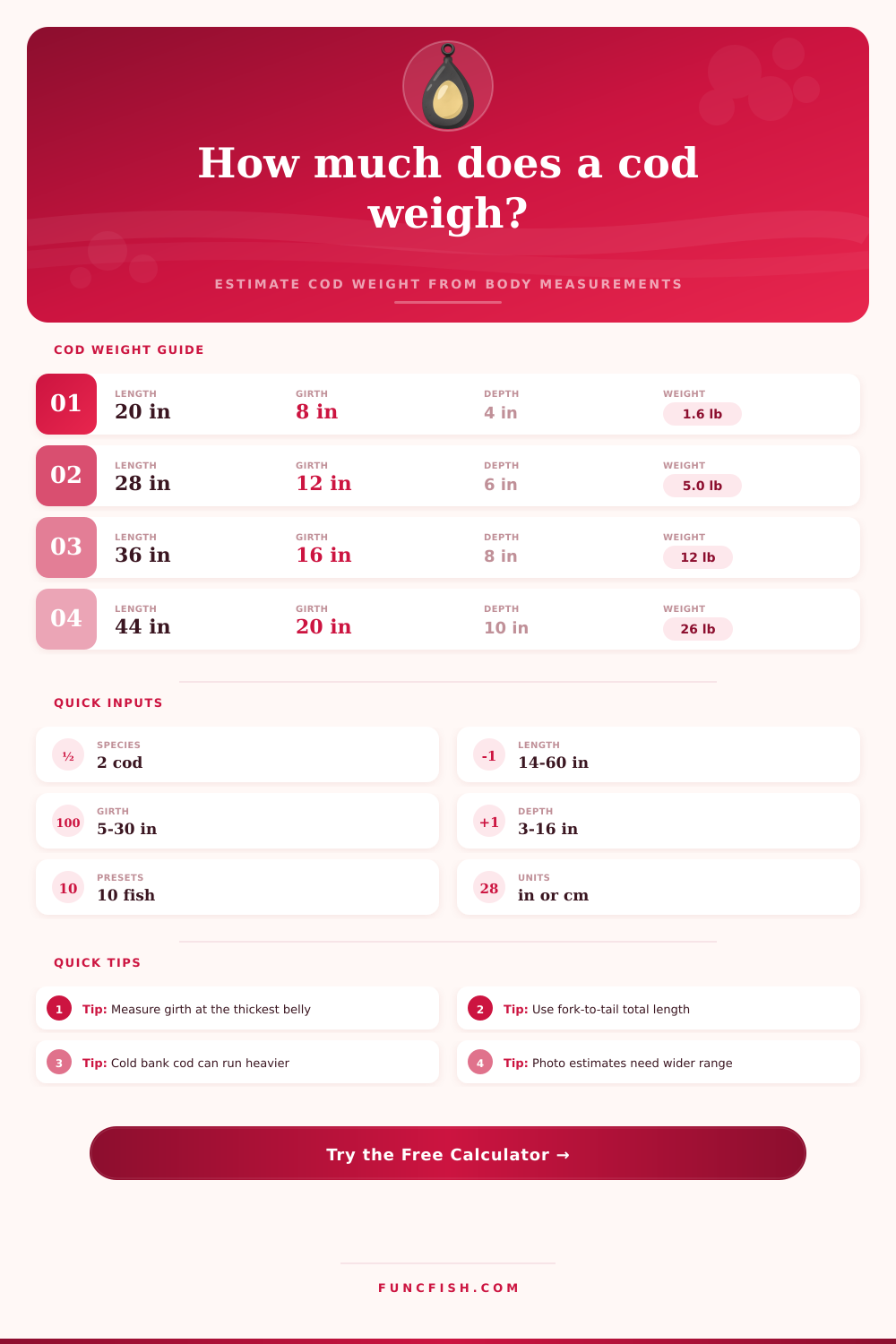
| Total length | Typical girth | Typical depth | Estimated weight window |
|---|---|---|---|
| 18 in / 46 cm | 7 to 8 in / 18 to 20 cm | 3.4 to 4.1 in / 9 to 10 cm | 1.1 to 1.8 lb / 0.5 to 0.8 kg |
| 24 in / 61 cm | 9.5 to 11 in / 24 to 28 cm | 4.8 to 5.8 in / 12 to 15 cm | 2.7 to 4.3 lb / 1.2 to 2.0 kg |
| 30 in / 76 cm | 12 to 14 in / 30 to 36 cm | 6.0 to 7.2 in / 15 to 18 cm | 5.3 to 8.7 lb / 2.4 to 3.9 kg |
| 36 in / 91 cm | 15 to 17 in / 38 to 43 cm | 7.5 to 8.8 in / 19 to 22 cm | 10.5 to 16.5 lb / 4.8 to 7.5 kg |
| 42 in / 107 cm | 18 to 20 in / 46 to 51 cm | 9.0 to 10.5 in / 23 to 27 cm | 19 to 31 lb / 8.6 to 14.1 kg |
| 50 in / 127 cm | 22 to 25 in / 56 to 64 cm | 11 to 13 in / 28 to 33 cm | 38 to 62 lb / 17.2 to 28.1 kg |
| Bank or reef habitat | Habitat factor | Common cod shape | Measurement note |
|---|---|---|---|
| Georges or offshore bank | 1.03 | Full shoulder, steady forage | Good baseline for Atlantic cod |
| Grand Banks cold shelf | 1.08 | Dense, cold-water body | Girth has strong influence |
| Gulf ledge and gravel | 0.99 | Mixed adult condition | Use measured depth |
| North Sea wreck or reef | 1.02 | Broad adult frame | Confidence can be moderate |
| Pacific reef edge | 0.96 | Longer, leaner Pacific profile | Use species profile carefully |
| Bering shelf flat | 1.01 | Cold Pacific shelf cod | Temperature factor matters |
| Temperature band | Typical condition effect | Best paired habitat | Calculator role |
|---|---|---|---|
| Icy shelf: 30-35 F / -1-2 C | Dense body, slower feeding windows | Arctic shelf or Barents grounds | Adds small cold-water fullness |
| Cold bank: 36-43 F / 2-6 C | Classic cod bank condition | Georges, Grand Banks, Bering shelf | Baseline heavy-water setting |
| Cool reef: 44-50 F / 7-10 C | Balanced feeding condition | Gulf ledges, fjords, North Sea | Neutral to slight plus |
| Mild edge: 51-57 F / 11-14 C | More variable condition | Shallow reefs and edge water | Widens the range |
| Warm fringe: 58-63 F / 14-17 C | Often leaner or transitional | Warm-season fringe habitat | Reduces estimate slightly |
| Confidence setting | Range width | Best use | Result behavior |
|---|---|---|---|
| High: board, girth, and depth | About 7% | Careful dock, deck, or lab measurement | Tightest range |
| Standard: dock or deck tape | About 12% | Normal field measurement | Normal range |
| Rough: curved tape or moving fish | About 20% | Awkward angle or moving fish | Wider range |
| Photo or memory estimate | About 30% | No direct girth or depth measurement | Broad estimate |
Reference ratios are field-estimation aids, not certified scale records. A certified weight needs direct weighing on a calibrated scale.
💡Measurement tips
Cod weight rises quickly when girth increases because the main field formula squares girth. Measure the thickest belly and shoulder point instead of the narrow tail end.
Atlantic and Pacific cod do not carry weight the same way. Pair the species profile with bank, reef, and temperature settings that match where the fish was measured.
Cod weight are determined by more than just the length of the cod. The weight of the cod is dependent upon the shape of the cod and the environment in which the cod lives. Two cods of the same length may contain different weights due to the shape of the cods or the different environments in which they lives.
The weight of the cod is a factor in determining whether the cod meet the slot limits for the cod species. Additionally, the weight of the cod is a factor in determining how much ice is required for the cod. The shape of the cod is a primary factor in determining the weight of the cod, and is more important than the length of the cod.
What Affects Cod Weight
The formula for calculating the weight of the cod require that the girth of the cod be squared. The volume of the cods body grows at a greater rate than straight lines, thus, the girth has a more greater impact upon the weight calculation than the length. To calculate the weight of the cod, the user enters the total length, the maximum girth, and the body depth of the cod into the calculator.
Other factor that the calculator automatically accounts for are the species of cod, the habitat in which it lives, the maturity of the cod, and the temperature range of the cods habitat. These factors are necessary to account for differences in cod from different locations. For instance, cod from Georges Bank may have different weights than cod from the Pacific Ocean.
The habitat in which the cod lives may impact the weight of the cod. Cod from cold banks of the ocean may have greater weights for their length than cod from the warmer reef in the ocean. The temperature setting within the cod weight calculator is set up to account for these different temperatures so that the weight calculation is not based upon memorized table of the weight of cod from various temperature zones.
The maturity of the cod may also have an impact upon the weight of the cod. Cod of greater maturity will have more shoulder mass than cod that are subadults of the same length. Thus, selecting the appropriate maturity class will shift the estimated weight of the cod to a correct value.
Finally, cod may have different weights during different seasons of the year due to the availability of food or the water temperature during those seasons. The condition options permit for these seasonal changes in cod to be accounted for in the cod weight calculation. The depth of the cod provides a means of confirming the calculated weight of the cod.
If the cod has a wide body but a shallow depth, the cod may be slab sided rather than round. The depth measurement accounts for this. If the girth or depth of the cod was obtained from a photograph rather than a tape measurement, the user can place the cod into one of the shape-mode categories in the cod weight calculation.
This blend of the cods actual measurements with the expected cod profile creates a wider range of possible weight for the cod; the depth of the cod contributes to the widening of this range. The tables located on the page provide the expected girth and depth ranges of cod of a given length. These tables allow an individual to verify whether the girth and depth of the cod are within the normal range of a healthy cod species.
These tables also list the habitat and the temperature factors of cods of different weights. These factors are automatically accounted for in the cod weight calculation. Thus, an individual does not have to memorize these ranges, but they may use the information to understand whether the cod has an unusually high or low weight.
The confidence in the measurement of the cod can create errors in the weight calculation. For instance, it is more difficult to obtain the girth of the cod if it is moving about on the deck of a fishing boat. The girth measurement will be more precise if the cook lays the cod flat on a measuring board.
Thus, the confidence in the measurement of the cod can help to widen or narrow the range of the calculated weight of the cod. This range can be useful in determining whether the cod meet the slot limits for the cod species. Additionally, the weight range can help to determine the number of fillets that the cod will have when prepared for consumption.
Many individuals may make mistakes when measuring the cod for weight. For instance, mistakes may be made in taking the girth measurement. The girth should be measured at the thickest part of the cods belly and shoulder; it should not be measured behind its head or tail.
Additionally, the length of the cod should be measured from the nose to the tip of the tail; it should not be the length of the tail divided in half. Once the length and the girth are correctly measured, the other variable will provide a more refined estimate of the cod weight. These additional variables are displayed within the calculation of the cods weight.
The final estimate of the cod will provide three different pieces of information. The first is the weight of the cod. The second is the range of the weight of the cod.
The third is the condition index. The condition index is a comparison of the weight of the cod to the expected cod profile for the cod species and the habitat in which it lives. If the condition index is high, the cod is carrying a significant amount of extra mass.
If the index is low, the cod is relatively lean. High condition indices are seen in cod from cold banks, confirming the settings for the cod habitat and temperature. Low condition indices may also be seen in cod species from cold banks, but indicate either a post-spawn season for the cod or an error in the measurement of the cod.
You should of used the correct settings to avoid this. It isnt easy to get it right every time.