Snell Knot Length Calculator
Estimate finished snell wrap span, line consumed on the hook, tag allowance, bait clearance, and shank fit from hook size, hook family, line material, diameter, test, and wrap count.
📌Named snell knot presets
⚙Hook, line, and snell inputs
Snell knot length results
Balanced snell setup for the selected hook and line.
Full breakdown
🧵Line material behavior grid
Mono
Fluoro
Braid
Wire
🪝Snell and hook comparison grid
Octopus
92Compact eye, short shank, and live bait pull make it one of the easiest hooks to snell cleanly.
Circle
89Works best when the snell leaves the eye straight, supporting corner-of-mouth pressure.
Baitholder
76Barbs and bait slices reduce open shank room, so shorter wraps often fit better.
Aberdeen
84Long shank gives generous wrap room, but light wire benefits from modest tag length.
Siwash
80Open-eye salmon hooks can be snelled well when wraps stay below the eye gap.
Carp
82Hair-rig geometry needs bait clearance more than maximum wraps on the shank.
Straight Shank
86Excellent for flipping and worm hooks when the line exits cleanly through the eye.
Classic J
74A usable general hook, but eye angle and bait position matter more than with octopus hooks.
📊Reference tables
| Snell setup | Typical hook | Wrap range | Shank use target |
|---|---|---|---|
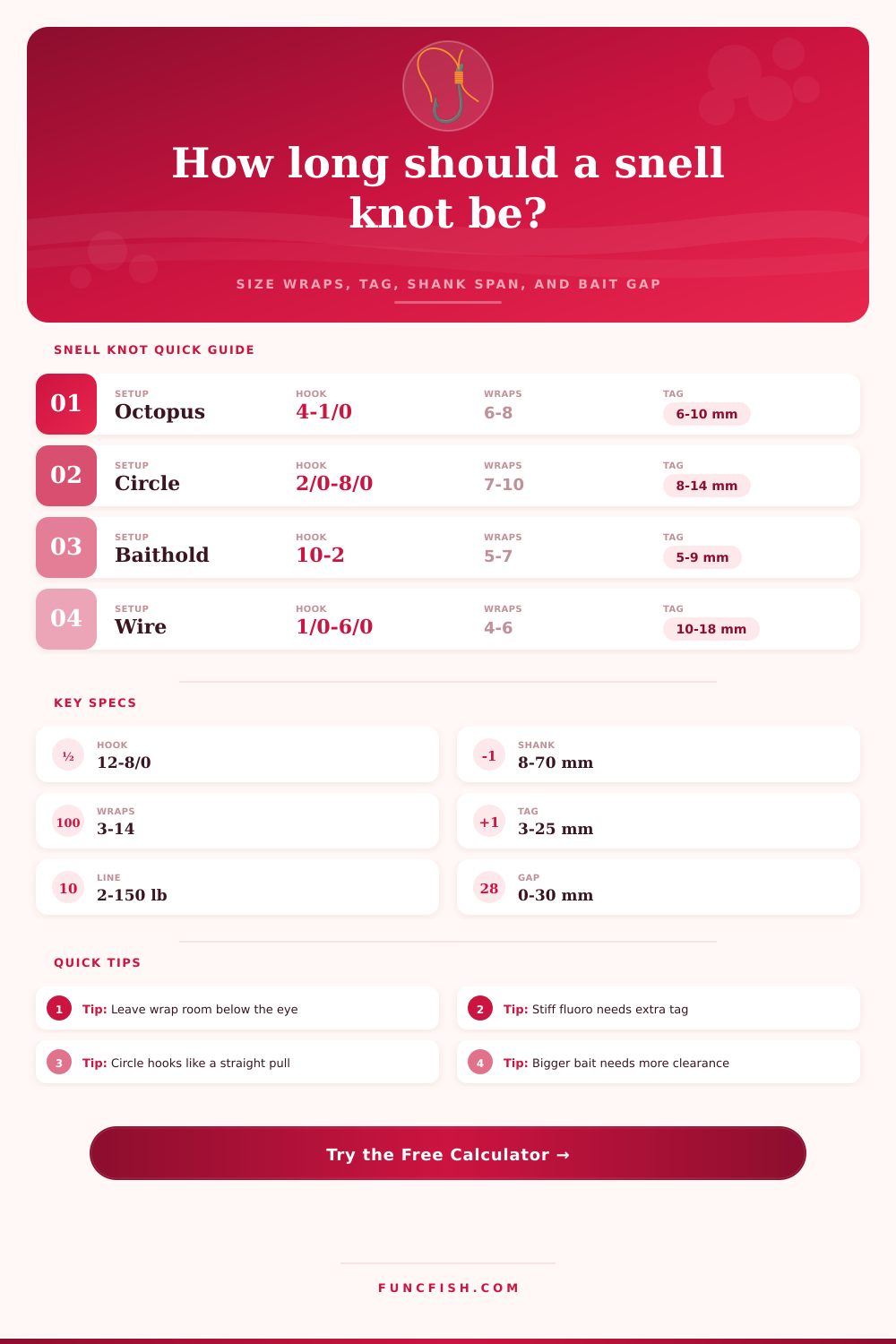
| Octopus live bait snell | Size 4 to 2/0 | 6-8 wraps | 45-65% of shank |
| Circle hook catfish snell | 2/0 to 8/0 | 7-10 wraps | 40-60% of shank |
| Baitholder bait snell | Size 10 to 2 | 5-7 wraps | 35-55% of shank |
| Aberdeen worm snell | Size 8 to 1 | 5-7 wraps | 30-50% of shank |
| Wire leader snell | 1/0 to 6/0 | 4-6 wraps | 30-45% of shank |
| Hook size | Approx shank length | Common use | Starting wraps |
|---|---|---|---|
| 12 to 8 | 8-14 mm / 0.31-0.55 in | Panfish, trout bait | 4-6 wraps |
| 6 to 2 | 15-24 mm / 0.59-0.94 in | Bass, walleye, carp | 6-8 wraps |
| 1 to 2/0 | 24-36 mm / 0.94-1.42 in | Live bait, inshore | 6-9 wraps |
| 3/0 to 5/0 | 35-52 mm / 1.38-2.05 in | Catfish, surf, salmon | 7-10 wraps |
| 6/0 to 8/0 | 50-70 mm / 1.97-2.76 in | Big bait, offshore | 8-11 wraps |
| Line material | Snell behavior | Tag guideline | Wrap adjustment |
|---|---|---|---|
| Monofilament | Seats easily and cushions shock | 5-10 mm / 0.20-0.39 in | Baseline wraps |
| Fluorocarbon | Stiffer, harder to cinch fully | 7-14 mm / 0.28-0.55 in | Add 1 wrap if room allows |
| Braided line | Slick fibers can creep under shock | 8-16 mm / 0.31-0.63 in | Add 1-2 wraps |
| Dacron backing | Soft and bulky on small hooks | 8-15 mm / 0.31-0.59 in | Use fewer bulky wraps |
| Coated wire | Rigid, abrasion focused, limited bend | 10-25 mm / 0.39-0.98 in | Use fewer controlled wraps |
| Hook family | Snell compatibility | Bait clearance need | Watch point |
|---|---|---|---|
| Octopus | Excellent | Medium | Keep wraps just below the eye. |
| Circle | Excellent | Medium-high | Line should pull in line with the hook point. |
| Baitholder | Good | High | Bait barbs can crowd the lower wraps. |
| Aberdeen | Good | Low-medium | Fine wire can be overpowered by heavy line. |
| Carp hair hook | Good | Very high | Hair and bait gap matter more than wrap count. |
💡Snell fit checks
Wrap room: Leave a small clean space below the hook eye and enough bait clearance below the final wrap. A perfect-looking snell that crowds the bait can still fish poorly.
Tag margin: Fluorocarbon, braid, and coated wire are less forgiving than mono. Seat the knot wet when possible, pull test it, then trim to the calculated tag length.
A snell knot has to work correct to ensure that the bait can move natural. The snell knot will only work correct if the wrap dont slip and if the tag end is the right length to prevent the snell knot from loosening. If the wraps slip or if the tag end is too short, the snell knot will fail.
If the wraps take up too much space on the hook, the bait wont be able to move natural and will not look good to the fish. The type of hook will affect the way that you tie your snell knot. For instance, if you use an octopus hook, you have to place the wraps such that they doesnt take up too much space on the hook.
How to Use the Snell Knot Calculator
Circle hooks has a different geometry than octopus hooks as they are made such that the fishing line exit the hook in a straight line so that the hook can easily catch a fishs mouth. Baitholder hooks and Aberdeen hooks have barbs or are made of lighter wire than fishing lines so there is less space for the wraps around the hook. The material that your fishing line is made of will also change the way that you tie the snell knot.
With monofilament lines, there is more flexibility in the line so the wraps will stretch. This type of line work well with live bait. Fluorocarbon lines are stiffer than monofilament lines and will transfer more of the load on the line to the wraps.
Because of the stiffness of fluorocarbon lines, you will need a longer tag end. Braided lines are more slippery than fluorocarbon or monofilament lines, so you will need to use more wraps and have a longer tag end on the line. Wire leaders will require fewer wraps but will require a longer tag end on the line.
The calculator will show mathematical data after you input information about the hook, the shank length of the hook, the diameter of the fishing line, and the number of wraps. Based off the information you entered, the calculator will show you the space that the wraps will take up on the hook, the length of the line that will be used in the snell knot in making the spiral of the line around the hook, and if there will be enough clearance for the bait to enter the mouth of the fish. This information is important to see if there will be too many wraps or if the tag end of the line is too short.
This calculator will help you to avoid guessing what the best parameters will be for your snell knot so that it will work correct. In the real world, there will be different stresses put upon the snell knot. Currents in the water, the head shakes of the fish, and the force of the hook and line when the fish is caught will all put stress on the snell knot.
The load style that you select in the calculator will allow for these different stresses on the knot. For example, if you are using your snell knot for a finesse fishing style, the line will experience less drag so there can be fewer wraps on the hook. For fish that tend to surge and have teeth, the snell knot must account for that extra force so there will have to be more wraps.
The calculator does not replace experience but will help to ensure that the number that you use for your snell knot are logical and correct before you tie the knot. Many people make mistake with snell knots because they treat it like an overhand knot. People will use the same number of wraps for every size of hook.
Smaller hooks have less space on the shank for the wraps. People also will tie in the tag end too close to the snell knot which will cause the wraps to loosen when the fish begins to pull on the line. Using the reference table on this page will allow people to find the typical number of wraps that should be used for each size of hook so that they will not have to memorize these measurement.
It is also important for the snell knot to leave enough space for the bait to move. Bait such as minnow or bait that has been cut needs space beneath the wraps of the snell knot. If there is no space for the bait, it will not be able to move natural in the fishs mouth.
This will also cover the point of the hook and will prevent it from catching the fish. The calculator will tell you if there is enough space for the bait before you cut your fishing line. This calculator can also be used to test the effect of changing one variable of the snell knot.
For example, you can change the wrap count and observe the effect on the shank length of the hook. You can change the type of line from monofilament to fluorocarbon and see the effect on the length of the tag end. These different variable can be tested so that you can understand the effect that they will have on your snell knot.
Eventually, the calculator will allow you to test your fishing habits and ensure that they will work well with your snell knot. A snell knot must be able to transmit the force of the hook and the line to the fish and it must allow for the bait to move natural. When the number that are entered into the calculator match the conditions of your fishing environment, the snell knot will perform both of these job effectively.