Boat Trailer Bunk Length Calculator
Estimate trailer bunk length, transom support, bunk angle fit, and bunk load from hull length, hull type, beam, deadrise, loaded weight, weight distribution, and roller-to-bunk mix.
📌Named trailer bunk presets
⚙Hull, bunk, roller, and support inputs
Model: bunk length is estimated from hull contact ratio, stern weight bias, requested transom support, roller load share, bunk count, bunk width, and the angle match between bunk boards and hull deadrise.
Trailer bunk length results
Enter hull and trailer details to estimate bunk support.
Calculation breakdown
🛠Bunk support data grid
Flat and skiff hulls
Moderate V hulls
Deep V hulls
Pontoon cradles
📊Trailer bunk/hull comparison grid
Short main bunks
Best for light flat hulls when the aft bunk end sits close to the transom and keel support is steady.
Long carpeted bunks
Best all-around support for V fishing hulls that carry outboards, batteries, fuel, and stern gear.
Hybrid roller bunks
Useful for difficult launches, but the continuous bunk area should still control stern alignment.
Pontoon log bunks
Run long fore-aft support under each log or cradle point, with little angle unless the bunks are contoured.
📐Reference tables
| Boat and hull style | Typical supported length | Starting bunk length | Transom support note |
|---|---|---|---|
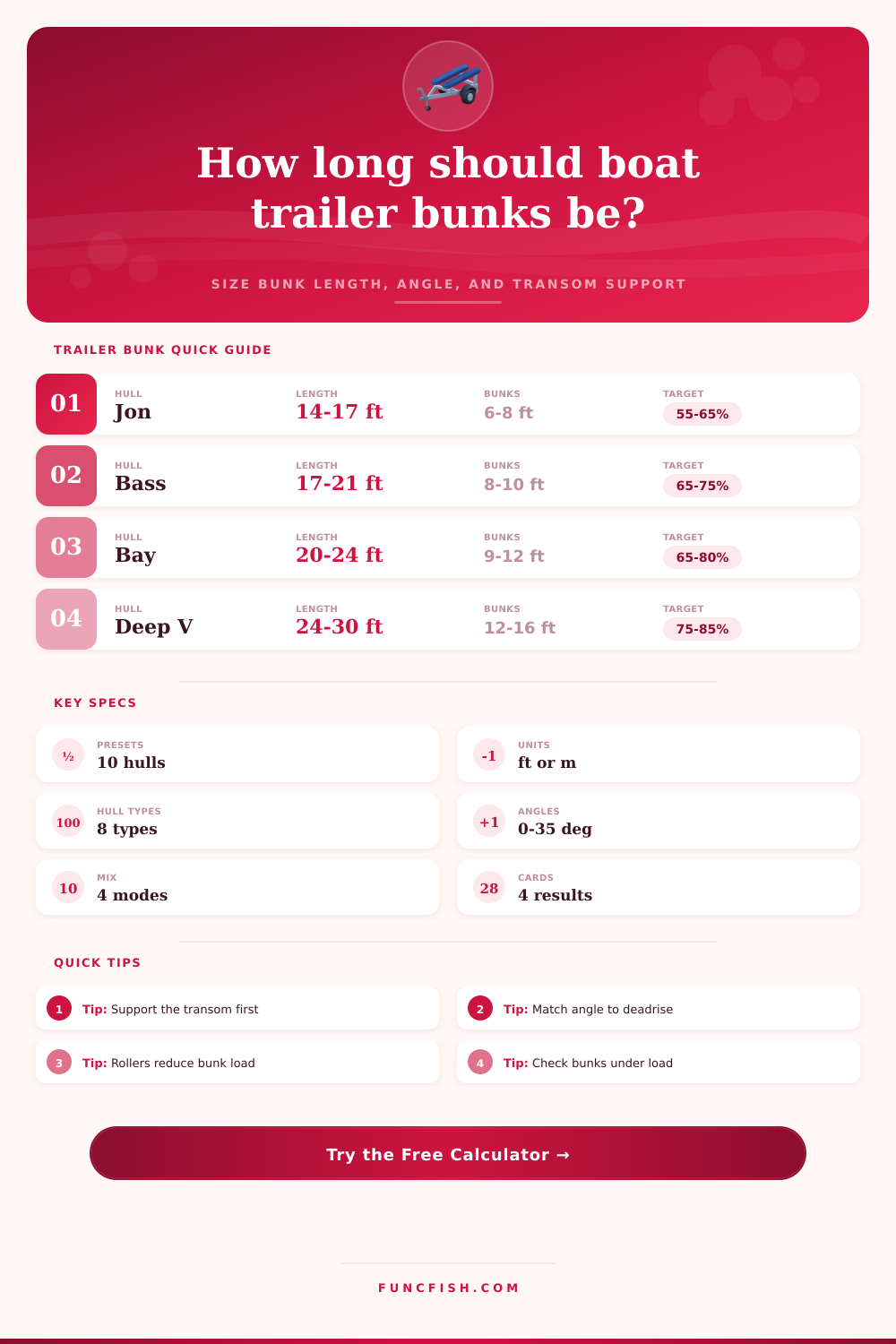
| Jon boat or flat utility hull | 12 to 18 ft / 3.7 to 5.5 m | 5 to 8 ft / 1.5 to 2.4 m | Aft end should sit close to the flat transom. |
| Bass or aluminum fishing boat | 16 to 21 ft / 4.9 to 6.4 m | 7 to 10 ft / 2.1 to 3.0 m | Stern-heavy layouts usually need longer bunks. |
| Bay boat or center console | 20 to 25 ft / 6.1 to 7.6 m | 9 to 13 ft / 2.7 to 4.0 m | Keep the aft bunk end under the transom corner. |
| Offshore deep-V trailer boat | 24 to 32 ft / 7.3 to 9.8 m | 12 to 17 ft / 3.7 to 5.2 m | Longer bunks spread load on the running surface. |
| Pontoon or tritoon | 18 to 28 ft / 5.5 to 8.5 m | 12 to 20 ft / 3.7 to 6.1 m | Use long log support, not short point contact. |
| Hull type | Guide contact ratio | Angle behavior | Bunk placement priority |
|---|---|---|---|
| Flat bottom | 45 to 52 percent of hull length | Near level or slight inward tilt | Broad support and straight tracking. |
| Shallow-V | 50 to 58 percent of hull length | Low to moderate bunk angle | Support aft chines without pinching. |
| Moderate-V | 55 to 64 percent of hull length | Match the aft deadrise zone | Long stern support and even carpet contact. |
| Deep-V | 60 to 70 percent of hull length | Steeper angle and careful spread | Reduce point load near strakes and steps. |
| Catamaran | 48 to 60 percent per sponson | Match each sponson pad separately | Mirror contact on both hulls. |
| Roller and bunk mix | Bunk load share | Length effect | Best use |
|---|---|---|---|
| Full bunk trailer | 90 to 100 percent | Longest continuous support | Most fishing boats and long highway towing. |
| Bunks with keel rollers | 75 to 90 percent | Normal length with easier centering | V hulls that still rest mainly on bunks. |
| Hybrid roller and bunk support | 55 to 75 percent | Slightly shorter but needs aft support | Shallow ramps and frequent launching. |
| Roller-heavy guide bunks | 35 to 55 percent | Bunks guide more than carry | Only if roller placement supports the stern. |
| Deadrise at bunk zone | Typical bunk angle | Angle fit warning | Adjustment note |
|---|---|---|---|
| 0 to 6 degrees | 0 to 5 degrees | Too much angle creates edge contact | Keep broad flat contact and use wider boards. |
| 7 to 14 degrees | 5 to 12 degrees | Low angle can load inner edges | Raise or shim brackets evenly. |
| 15 to 22 degrees | 10 to 18 degrees | Mismatch shows as carpet wear lines | Check both port and starboard contact marks. |
| 23 to 32 degrees | 16 to 28 degrees | Small errors concentrate load quickly | Use long bunks and avoid strake point contact. |
These references are estimating aids for trailer setup. Confirm final bunk height, bracket strength, axle load, tongue weight, hull clearance, and transom support with the trailer and boat builder guidance where available.
💡Trailer bunk calculation tips
The aft end of the bunk should land close enough to the transom that the motor, batteries, and stern gear are not hanging behind the support point. The calculator treats stern weight bias as a direct reason to lengthen bunks or reduce overhang.
A long bunk that touches only one carpet edge can create more pressure than a shorter bunk with full face contact. After loading the boat, inspect wet carpet marks or hull contact lines and adjust bracket angle evenly.
To ensure that a boat sit correctly on a trailer when towing it behind a truck, the trailer bunks need to be the correct size and an angle. If the trailer bunks are too short, the stern of the boat will extend beyond the trailer, making it uncomfortably for individuals to step into the boat. If the trailer bunks are too long, the boat will have clearance issues with ramps, and the extra weight will also negatively impact the boats bow.
The size of the trailer bunks needs to be establish based off how the boat will sit on the trailer. Factors like the boat hull and the even distribution of the boats weight will have an impact on the size of the trailer bunks that is needed to appropriately tow the boat. The hull of the boat will determine the length and angle of the trailer bunks.
How to Choose the Right Trailer Bunks for Your Boat
Flat-bottom boats will require trailer bunks that has fewer inches of length and will have fewer degrees of angle then deep-V hull boats. Deep-V hull boats will need trailer bunks that are steeper than those with a flat hull that will have an even angle to the water. Boat trailer bunk dimension calculators will ask for the type of hull that the trailer have.
Additionally, other factors for the boat, such as length, beam, deadrise, and the evenness of the boats weight will be asked for so that the calculator can determine the size and angle of the trailer bunks correctly. Using this calculator will eliminate the guesswork when determining the size and angle of the trailer bunks. The weight of the boat will also play a crucial role in determining the size and angle of the trailer bunks.
Because boats with outboard motors, batteries, and full fuel tanks will tend to have more weight towards the rear of the boat, the rear of the trailer bunks will have to be able to support that weight. Adding a jack plate to an outboard motor will add to the weight towards the rear of the boat. The trailer bunk calculator will ask for the distribution of the boats weight when it is being entered into the calculator.
If the weight is even for the boat, shorter trailer bunks will be suggested. If the weight is more towards the back of the boat, the calculator will suggest that the trailer bunks have longer area designated for the boat. Another critical factor in setting trailer bunks on a trailer is the angle of the trailer bunks.
If the trailer bunks are too flat in comparison to the boat hull, the inner edges of the trailer bunks will make contact with the boat hull. If the trailer bunks are too steep in comparison to the boat hull, the outer edges of the trailer bunks will make contact with the boat hull. For even weight distribution on a boat hull, the trailer bunks should have the same angle as the deadrise of the hull.
This will ensure that the boat will not sit in one part of the trailer bunks but will remain even on all trailer bunks at once. Rollers can be added to the boat trailer bunks to assist in the boats centering on boat ramps. Using rollers will even out the weight that is distributed on the trailer bunks but will also reduce the area of the trailer bunks that is in contact with the boat.
Boat trailer bunk calculators will recognize that rollers are used and will indicate a reduction of the length of the trailer bunks. However, the position of the rollers must be correct so that the stern of the trailer does not sag between the trailer bunks. The transom overhang is the distance between the boat trailer bunks and the boats rear end.
If the trailer bunks are too short, the stern of the boat will add to the weight of the trailer. If the trailer bunks are too long, they may interfere with the trim tabs on the boat. Based on the type of trailer bunks that you select for the trailer, a calculator will provide an indication as to the maximum overhang that is safe for the boat trailer bunks to have.
In addition to the specifications for trailer bunks, there are also some recommendations for long-term trailer setups. When travelling long distance on the highway, boats tend to vibrate. To accommodate for this vibration, trailer bunks are typically provided with extra inches of length so that the trailer bunks will provide some insurance against the vibrations of the boat.
In addition, shallow boat ramps may require trailer bunks that is longer than those calculated for the boat trailer setup since they will assist in the loading of the boat onto the trailer ramps. Additionally, if the trailer bunks are to be used on uneven pavement, then the trailer bunks should be provided with more even widths so that the trailer will be able to lower the contact pressure between the trailer bunks and the boat hull. Reference tables exist for trailer bunks that provide information about the lengths and angles of trailer bunks according to the style of hull of the boat.
These tables provide information about the typical ratios of contact of the trailer bunks with the boat hull and the angles of the trailer bunks provided by boat trailer bunk builders. These tables are not rules but instead provide information that may be used in conjunction with the information provided by the trailer bunk calculator. The goal in establishing the size and angle of the trailer bunks is to establish a boat that is even when in operation and even when being launch into the water.
If the trailer bunks are properly matched with the features of the boat hull, the boat will not shift when the truck in which it is towed encounters a seam in the road.