Kicker Motor Size Calculator
Estimate auxiliary outboard horsepower, static thrust, shaft length, and boat match from loaded displacement, hull length, target trolling speed, main use, wind, current, hull type, prop efficiency, bracket height, and units.
📌Named kicker motor presets
⚙Boat, use, water, prop, bracket, and units
Model: kicker sizing starts with loaded displacement, hull speed, and intended use. It then adjusts for target trolling speed, wind, current, hull drag, load level, prop efficiency, and bracket immersion.
Kicker motor match
The calculator sizes the auxiliary outboard for your boat and conditions.
Calculation breakdown
🛠Kicker motor preset data grid
Compact 4 HP
General 8 HP
High-Thrust 15 HP
Heavy 25 HP
Grid values are generic low-speed estimating anchors, not brand specifications. Actual thrust depends on gear ratio, prop diameter, prop pitch, lower-unit depth, hull drag, and mounting height.
📊Kicker and boat comparison grid
12-16 ft skiff
Light flat or shallow-V hull used on lakes, ponds, and protected creeks.
17-21 ft aluminum V
Common lake fishing hull with livewell, batteries, and changing trip loads.
22-26 ft coastal boat
Moderate-V, cuddy, bay, or center-console hull carrying heavier fuel and gear.
27-34 ft heavy hull
Pilothouse, catamaran, semi-displacement, or work-style fishing hull.
📘Kicker motor reference tables
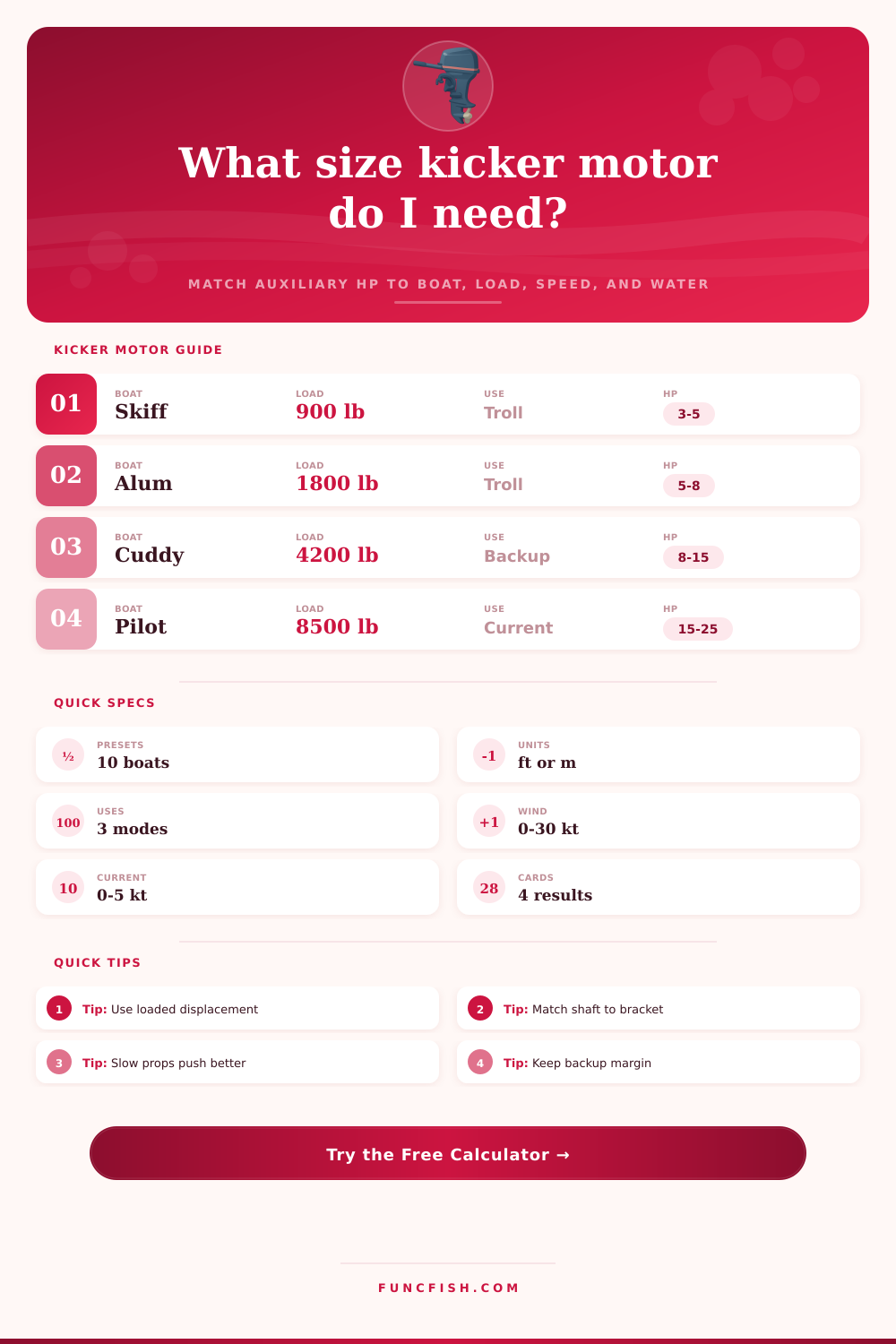
| Loaded displacement | Calm trolling HP | Backup HP | Current or wind reserve |
|---|---|---|---|
| 600 to 1200 lb | 3 to 5 HP | 5 to 6 HP | 6 to 8 HP if exposed |
| 1200 to 2500 lb | 5 to 6 HP | 6 to 9.9 HP | 8 to 15 HP with tide |
| 2500 to 5500 lb | 8 to 9.9 HP | 9.9 to 15 HP | 15 to 20 HP for reserve |
| 5500 to 12000 lb | 9.9 to 15 HP | 15 to 25 HP | 20 to 30 HP for exposed water |
| Main use | Power emphasis | Best prop profile | Result interpretation |
|---|---|---|---|
| Trolling speed control | Smooth low-speed hold | High-thrust slow prop | Exact speed matters more than top speed |
| Backup get-home motor | Reserve against wind | Large-diameter push prop | Size for control, not planing speed |
| Current or steering reserve | Extra thrust margin | High-thrust or work prop | Current penalty can dominate HP need |
| Fine autopilot trolling | Response and trim | Efficient low-slip prop | Mount depth and steering linkage matter |
| Bracket height above waterline | Likely shaft call | Mounting note | Penalty if short |
|---|---|---|---|
| 8 to 13 in | 15 in short shaft | Small skiffs and low transoms | Low if prop stays buried |
| 13 to 18 in | 20 in long shaft | Common fishing boat kicker bracket | Moderate in chop |
| 18 to 24 in | 25 in extra-long shaft | High transom, swim platform, or set-back mount | High if prop ventilates |
| 24 to 31 in | 30 in ultra-long shaft | Heavy brackets and tall sterns | Very high without depth |
| Wind and current input | Low-speed effect | Typical reserve add | Calculator response |
|---|---|---|---|
| 0 to 5 kt wind, no current | Easy trolling control | 0 to 10% | Stays near base HP |
| 10 to 15 kt wind | More bow drift and yaw | 15 to 30% | Raises HP and score demand |
| 1 to 2 kt adverse current | Large speed-over-water change | 25 to 55% | Can move up one HP class |
| Chop plus 2+ kt current | Ventilation and steering load | 50% or more | Favors long shaft and high thrust |
💡Kicker sizing tips
A kicker pushes the boat as it actually fishes. Add fuel, batteries, people, ice, livewell water, tackle, safety gear, and expected catch before sizing the auxiliary motor.
A powerful kicker with a ventilating prop can steer worse than a smaller motor mounted deeper. Bracket height, set-back, and chop deserve the same attention as horsepower.
When choosing a kicker motor for your boat, you should look beyond the horsepower rating of the motor brands because the kicker motor must be able to perform under specific condition. The conditions of the boat include how the boat sit in the water with the boat loaded, the effect of the wind upon the boat, and the effect of the current upon the boat. For example, a kicker motor may work good with the boat when the boat is traveling in calm waters with two occupants on board.
However, if the livewell is often filled with water and if the fuel tanks is often filled with gas, the increased weight of the boat will make it so that the kicker motor must work harder to move the boat. Thus, if the kicker motor is too small relative to the total weight of the boat when loaded with fish, live bait, and other items, it may feel underpowered when attempting to move the boat. In order to calculate the appropriate size for a kicker motor, several factor must be considered.
How to Choose the Right Kicker Motor for Your Boat
For example, the loaded displacement of the boat is one factor that must be considered. The displacement of the boat is a representation of the total weight that the kicker motor must move when the boat is traveling at low speed. Additionally, the length of the boat is another factor to consider, as the length of the boat impact how easily the boat can move through the water.
Other factors include the strength of the wind and the current, the total load on the boat, the type of propeller that will be used with the kicker motor, and the height of the motors mounting bracket above the waterline. Factors such as the rule of five horsepower for every thousand pounds of boat weight is a simple rule that does not account for these different factor. One of the most common mistake that boaters make in selecting a kicker motor is to only size the kicker motor for situations in which the boat is traveling under calm conditions and with few occupants.
However, the kicker motor must often act as a backup motor for the boat, and that backup motor must be able to overcome the force of the wind and tide. The calculator includes a factor that accounts for the difference between trolling and backup use of the motor. This factor prevents the kicker motor from being undersized for the boat, which would be detrimental to the safety of the occupants of that boat.
Another of the most important factor to consider is the length of the shaft of the kicker motor. The motor will be ineffective if the propeller of the motor is not submerged in the water. Factors to consider in determining the appropriate length of the shaft of the motor include the height of the motor’s mounting bracket above the waterline and the lift of the stern of the boat.
Maintaining the propeller in a submerged state will improve the effectiveness of the kicker motor relative to keeping the propeller in a state of ventilation (when it is exposed to the air in choppy waters). In addition to the length of the shaft, another factor to consider is the type of propeller that is to be used with the kicker motor. Propellers with high thrust and low pitching are more efficient than standard propeller models when trolling at low speeds.
Standard propellers are often manufactured for boats that travel at higher speeds. Thus, the thrust and pitching efficiencies of propellers impact the amount of throttle that must be applied to maintain a trolling speed. Such efficiency is more noticeable in the presence of the wind or the current.
Another critical factor is the load that will be on the boat. The load can vary from day to day. For instance, the boat may be light with a few passenger on a weekday, but may be heavy on the weekends with additional fuel, ice, live bait, and fish box on the boat.
Such extra weight in the stern of the boat will increase the displacement of the boat and the effort required of the kicker motor to maintain the position of the boat. The calculator accounts for this variable to ensure that the kicker motor can handle both light day and heavy day with the boat. Another factor to consider includes the strength of the wind and the current in which the boat will be traveling.
The force of the wind and the current compound each other. Thus, a ten knot breeze can create the same resistance as a kicker motor traveling at ten knots, but if there is a ten knot breeze in the opposite direction of the tide, the resistance of the water upon the boat will be much more greater than either of those variables alone. Thus, an environment multiplier can be used to calculate the combined effect of the wind and the current upon the boat.
The goal is to purchase a kicker motor that works within the specification of the boat, but with some margin for error. The calculator for kicker motors produces a match score to display whether the horsepower of the motor, the length of the shaft, and the profile of the propeller are working correctly together. A high score indicates that the kicker motor will work well without needing to use excessive throttle or creating the risk of ventilation of the propeller.
A low score to the match score indicates that the requirements of the boat may need to be met by increasing the horsepower of the kicker motor, deepening the shaft, or the kicker motor will need to be used in conditions that are more mild than the boat may encounter. Your decision regarding the purchase of a kicker motor also includes your plans for the boat. If you are willing to accept a smaller kicker motor, you may plan your trips to include only mild conditions relative to the capabilities of that kicker motor.
Alternatively, you may wish to purchase a kicker motor that is larger in size so that it can provide some reserve capacity for the boat relative to the main motor. The kicker motor can then provide a true second source of power for the boat. Each decision is a valid one.
However, the kicker motor should of been chosen according to the conditions in which the boat will actualy be encountered.