Fish Poaching Time Calculator
Estimate gentle poaching time from fish thickness, cut style, starting temperature, liquid heat, batch load, and target doneness.
📌Scenario presets
⚙Poaching settings
Measure the thickest section, not the average.
Used for whole fish and batch load adjustment.
Poaching time estimate
Full breakdown
📋Fish timing reference grid
Cod
Salmon
Halibut
Sole
Trout
Monkfish
Shrimp
Scallop
📐Thickness and cut timing table
| Cut style | Thickness or weight | Gentle liquid band | Typical time window |
|---|---|---|---|
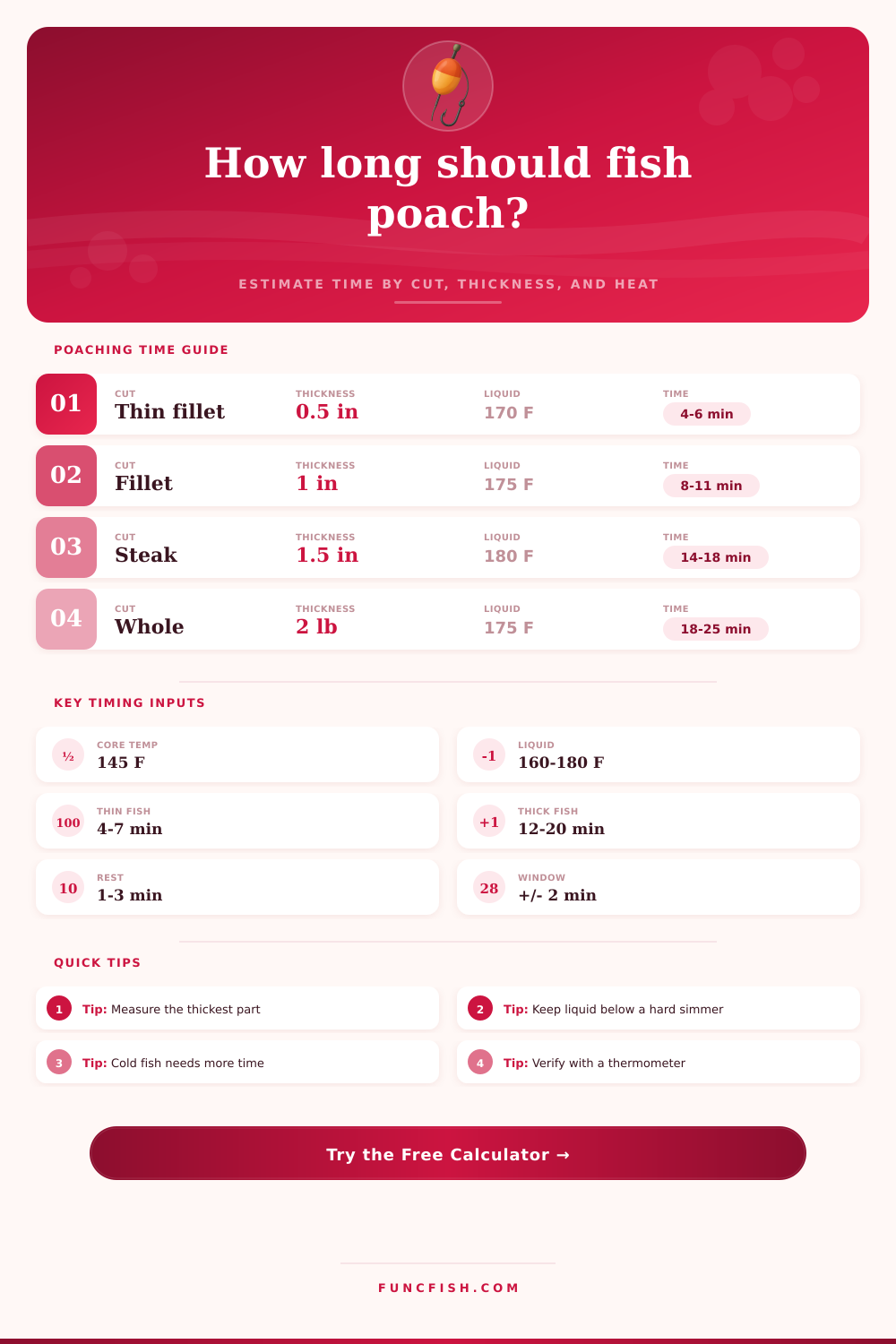
| Delicate thin fillet | 0.4-0.6 in / 1.0-1.5 cm | 155-165 F / 68-74 C | 3-6 min |
| Standard white fillet | 0.8-1.1 in / 2.0-2.8 cm | 165-175 F / 74-79 C | 7-12 min |
| Rich salmon fillet | 1.0-1.4 in / 2.5-3.6 cm | 160-170 F / 71-77 C | 9-15 min |
| Dense steak or loin | 1.3-2.0 in / 3.3-5.1 cm | 170-180 F / 77-82 C | 13-24 min |
| Small whole fish | 12-24 oz / 340-680 g | 165-178 F / 74-81 C | 16-28 min |
| Shrimp or scallop | 0.5-1.2 in / 1.3-3.0 cm | 165-175 F / 74-79 C | 2-7 min |
| Adjustment | Timing effect | Use when | Calculator factor |
|---|---|---|---|
| Refrigerator cold fish | Add time | Fish starts near 38 F / 3 C | Up to +18% |
| Room-tempered fish | Reduce time | Fish starts near 55 F / 13 C | Up to -8% |
| Low liquid temperature | Add time | Liquid below 165 F / 74 C | Up to +22% |
| Covered pan | Reduce time | Even heat around fish | About -10% |
| Crowded pan | Add time | Four or more pieces | Up to +16% |
| Whole fish cavity | Add time | Bone and cavity slow heat | +25% to +55% |
🌡Temperature reference table
| Target choice | Pull temperature | Result cue | Thermometer note |
|---|---|---|---|
| Silky and just set | 125-130 F / 52-54 C | Soft center | Quality target only |
| Medium set | 135-140 F / 57-60 C | Moist flakes | Check thickest part |
| Fully cooked | 145 F / 63 C | Opaque and flakes | USDA and FDA baseline |
| Firm flake | 150 F / 66 C | Firm throughout | Useful for dense fish |
💡Poaching checks
Tip: The timer estimates heat transfer, but a thin probe thermometer is the final check. Measure the thickest part before serving.
Tip: If the poaching liquid boils hard, lower the heat and start checking early. Hard boiling tightens delicate fish quickly.
Fish poach is a cooking method that involve cooking fish using low heat and liquids. You poach fish by exposing the fishes to steady heat rather than direct contact with a hot pan. The heat moves through the fish over a time to poach the fish.
The time that the fish is poached depends upon the thick of the fish, the starting temperature of the fish, and the temperature of the cooking liquid. If the fish is poached for the wrong amount of times the texture of the fish may be rubbery or the fish may be undercooked or overcooked. The calculator can help you to determine the amount of time that your fish should be poached.
How to Use the Fish Poaching Time Calculator
To use the calculator, you must enter certain variable into the calculator. The calculator calculates the time that the fish should be poached using these variables. Some of the variables that the chef must enter include the thickness of the fish, the type of fish and the cut of the fish, the starting temperature of the fish, and how active the liquid is moving.
Each of these variables impact the time that the fish should be poached. For instance, the thicker the fish, the more long the fish will be cooked. Additionally, if the fish is dense, such as halibut, it will take longer to cook through than an thin fillet of a different type of fish.
Similarly, the batch size and the depth of the liquid in which the fish is being poached will impact the amount of time that the fish need to be cooked through. Fish poaching require that the cooking liquid maintains a temperature that is below a hard simmer. A simmer is a temperature at which the cooking liquid is moving slightly but not boiling.
If the cooking liquid simmers too vigorously, the outer part of the fish will cook faster than the middle part of the fish. The low simmer ensures that the fish retains its moisture; otherwise, the delicate fish may dry out during the cooking process. The time that the calculator calculates can change if you choose a different simmer for the liquid or if you use a covered pan to cook the fish.
The starting temperature of the fish can impact cooking time. For instance, if the fish that is to be poached comes straight from the refrigerator, there will be a cold center to the fish. A cold center will require longer cooking time to reach the target temperature for doneness than a fish that begins cooking at room temperature.
However, if the fish is allowed to sit out for ten or fifteen minutes prior to poaching, this temperature difference will be reduced and the exterior of the fish will not cook too quick. The calculator incorporates cooking time for such situations when the temperature of the fish is entered as a value that is lower than the standard starting temperature. The style of the fish to be poached may also impact cooking time.
For instance, a whole fish will contain bones and a cavity that will slow the cooking of the fish. The thickest part of the fish will take longer to cook than a fillet of the same thickness. Additionally, steaks and loins will require a different time to cook than fillets.
Finally, pieces of shellfish will cook more quickly than other types of fish because shellfish pieces are smaller and do not have the same density as other fishes. These different types of cuts have different time requirements for poaching. Additionally, the depth of the liquid over the fish may also impact cooking time.
If there is too little liquid over the fish, the top part of the fish will be exposed to steam instead of the liquid. Steam transfers heat differently than liquid transfers heat. If there is too much liquid in the pot, the temperature of the entire pot may rise more slow.
These factors are considered in the calculator so that if the depth of the liquid is entered accurately, the time that is calculated will be accurate as well. A thermometer is necessary to ensure that the fish is cooked correctly. The calculator provides the target temperature range for doneness of the fish.
However, you should use a thermometer to measure the internal temperature of the fish. Due to carryover heat, the internal temperature of the fish will continue to rise after the fish is removed from the liquid. To avoid undercooking the fish, the fish should be removed from the liquid a minute or two prior to reach the target temperature.
By allowing the fish to rest for a brief amount of time, the heat will even out throughout the fish and the texture wont be overcooked. By understanding the effect that thickness, starting temperature, and the activity of the cooking liquid can have upon cooking time, it is possible to correctly cook the same piece of fish on different days. By entering all of the variable into the calculator, the chef no longer has to perform the mental arithmetic to calculate the time that the fish should be poached.
Instead, the chef can focus on the temperature of the fish to ensure that it is cooked correctly.