Crappie Length Girth Weight Calculator
Estimate black, white, or hybrid crappie weight from total length and maximum girth, then compare condition, range, and total catch weight.
📌Scenario presets
⚙Crappie measurements
Crappie weight estimate
Full breakdown
📋Crappie condition data grid
Thin
Average
Plump
Roe slab
📐Reference tables
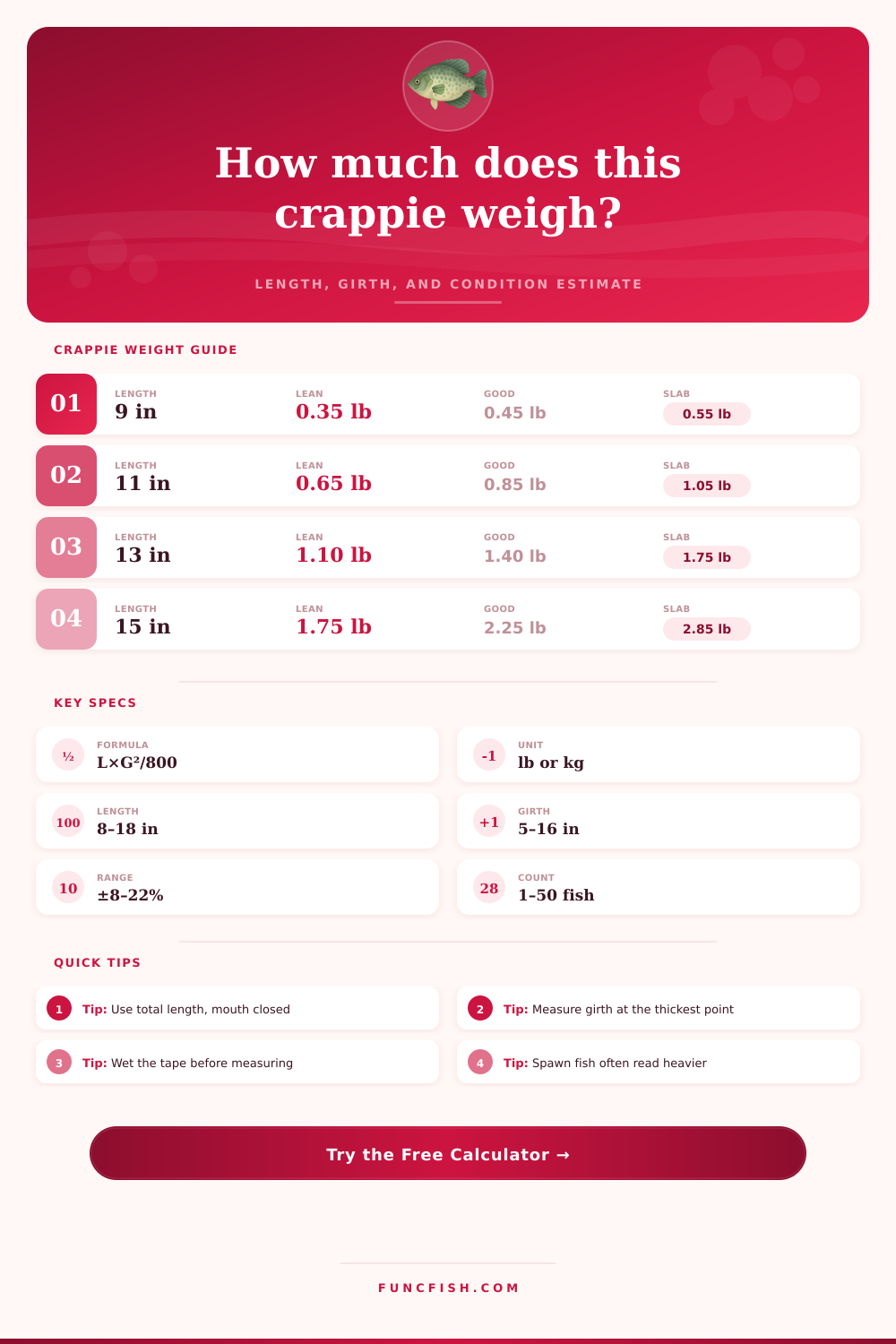
| Length | Lean girth | Good girth | Slab girth | Typical weight band |
|---|---|---|---|---|
| 9 in / 22.9 cm | 5.4 in | 6.1 in | 6.7 in | 0.34-0.51 lb |
| 10 in / 25.4 cm | 6.0 in | 6.8 in | 7.4 in | 0.45-0.69 lb |
| 11 in / 27.9 cm | 6.6 in | 7.5 in | 8.1 in | 0.60-0.91 lb |
| 12 in / 30.5 cm | 7.2 in | 8.2 in | 8.9 in | 0.78-1.18 lb |
| 13 in / 33.0 cm | 7.8 in | 8.8 in | 9.6 in | 0.99-1.51 lb |
| 14 in / 35.6 cm | 8.4 in | 9.5 in | 10.4 in | 1.23-1.90 lb |
| 15 in / 38.1 cm | 9.0 in | 10.2 in | 11.1 in | 1.52-2.35 lb |
| 16 in / 40.6 cm | 9.6 in | 10.9 in | 11.8 in | 1.84-2.87 lb |
| Method | Length bias | Girth bias | Uncertainty | Best use |
|---|---|---|---|---|
| Wet flexible tape | 0.00 in | 0.00 in | 8% | Fresh single fish |
| Bump board plus tape | 0.00 in | +0.05 in | 9% | Best-five checks |
| Board and string wrap | -0.05 in | +0.10 in | 12% | Careful field estimate |
| Soft sewing tape | +0.03 in | +0.15 in | 13% | Quick dock measure |
| Photo estimate | +0.10 in | -0.25 in | 22% | Rough memory check |
| Scale verified check | 0.00 in | 0.00 in | 6% | Known scale comparison |
| Fast livewell measure | +0.06 in | -0.12 in | 16% | Moving fish in boat |
| Crappie type | Build note | Formula factor | Typical slab length | Weight tendency |
|---|---|---|---|---|
| Black crappie | Deeper body | 0.990 | 13-15 in | Plump at girth |
| White crappie | Longer body | 1.015 | 13-16 in | Slightly longer |
| Natural hybrid | Mixed frame | 1.005 | 13-16 in | Balanced |
| Unknown crappie | Neutral average | 1.000 | 12-15 in | Baseline |
| Season | Adjustment | Range effect | Condition cue | Measurement note |
|---|---|---|---|---|
| Pre-spawn feeding | +6% | normal | Thick shoulders | Girth changes fast |
| Spawn / egg-heavy | +10% | normal | Round belly | Do not squeeze tape |
| Post-spawn recovery | -7% | wider | Loose belly | Measure girth gently |
| Summer neutral | 0% | normal | Stable body | Good baseline |
| Fall shad-fed | +8% | tight | Heavy belly | Check max girth |
| Winter deep water | -3% | normal | Firm and lean | Measure quickly |
💡Measurement checks
Tip: Length-girth formulas are sensitive to girth because girth is squared. A quarter inch can move a slab estimate noticeably.
Tip: For a best-five or livewell total, measure each fish when possible. Multiplying one big fish can overstate the whole catch.
Crappie fishing can be difficult due to the fact that a crappie may appear to be light when lift out of the water, but may feel heavy when in a net. Crappies may appear to shrink in the persons hand when removed from the water. Furthermore, the difference between a keeper and a slab crappie may be only a few ounce, and only measurable once the crappie is removed from the water.
Both length and girth are important measurements of the crappie, and provide a better overall picture of the crappie than measuring length alone would provide. The shape of the crappie is another important measurement, as it provide an indication of how much mass the crappie possesses relative to the length measurement. The calculator provided above use the length and girth of the crappie to calculate its weight, as well as uses the season during which the crappie was caught, the condition of the crappie, and the method in which the crappie was measured to provide an accurate estimate of the crappie’s total weight.
How to Measure Crappie Weight
Each of the inputs that are required to calculate the crappie’s weight are important in that they allow for the consideration of various factors in relation to the crappie while it is on the water. For instance, the species of crappie is important in that black crappies are deeper than white crappies, thus leading to differences in the weight of crappies with the same girth. The season during which the crappie was caught and the stage of the spawn are important variables in that crappies will weigh more when engaging in feeding behaviors prior to spawning then they will when they have finished guarding their nest.
The body condition of the crappie is another important factor in that crappies can be measured for whether they are carrying roe or not, or if the crappie has dropped its eggs. Finally, the method by which the crappie was measured is important in that methods may change according to whether the crappie was measured while in a rocking boat or in a photo. Each of these settings does not replace the need to carefully measure the crappie, but may help in providing for an accurate estimate of the crappie’s weight when the conditions is not perfect.
The girth of the crappie is an important variable in the formula because the girth are squared in calculating the crappie’s weight. The girth will have the most impact on the crappie’s weight if there is a difference in only a quarter-inch in the widest point of the crappie, so the tool ask for the thickest part of the crappie rather than the average measurement. The length of the crappie is another important measurement.
While length is a steadier measurement of the crappie, the method used to measure length may add or subtract a fraction of an inch. Furthermore, length measurements may be required for sorting a stringer of crappies, so accuracy is critical. The crappie weight calculator will provide for each crappie entered an estimated weight, a likely range of the crappie’s weight, the relative condition of the crappie as a percentage of the expected weight for a crappie of that length, and the total weight of many crappies.
The calculator will display the total weight of the crappies with a range of likely weights, the condition percentage (of a crappie that is thick relative to its length), and the total weight of all crappies entered into the calculator. The weight range makes clear that the estimation of the crappie’s weight is subject to a certain range of uncertainty, while the condition percentage indicates to the crappie fisherman if the crappie is thick relative to its length. Many crappie anglers will use only the length of the crappie as a means of estimating the crappie’s weight.
However, the weight of a deep-bodied crappie will be significantly more than that of a skinny crappie of the same length. Furthermore, the girth of the crappie will change the way in which the crappie is measured. For instance, the tape measure should be wetted to avoid dragging on the crappies scales, the crappie’s mouth should be closed to determine the total length of the crappie, and the widest point of the crappie (rather than the crappie’s belly) should be measured.
These habits will ensure repeatability of the measurement of the crappie during each fishing trip. The same logic apply when managing a livewell of crappies or when sorting a tournament bag of fish. One heavy crappie can drastically impact the total weight of a group of crappies.
Thus, the weight of each crappie must be measured individually. Additionally, the crappie weight calculator allow for a person to enter a count of many crappies in the livewell or tournament bag, and immediately display the total weight of the crappies in the bag. This is helpful for understanding the total weight of the catch in relation to fishing regulations.
Furthermore, the condition of the crappies can also be determined from the crappie weight calculator, which is helpful in understanding the feeding or spawning activity of the crappies. Though the crappie weight calculator include features to account for some of the most common conditions of crappies, there are still additional variables that may impact the weight of crappies. For instance, crappies that have been iced for an hour may measure less than crappies that have been lifted directly from the water.
A female crappie that is carrying roe may weigh more than the weight formula indicates for that species and length of crappie, but will weigh less once it release its eggs. Furthermore, crappies measured in a livewell move may measure less than crappies measured in a calm body of water. While the crappie weight calculator includes these variables in the range of possible weights displayed, the best practice is to measure each crappie in a calm body of water and with a wet tape measure.
While not perfect, a careful measurement of each crappie will always provide better results than a rushed attempt to measure the crappies length and girth. By measuring crappies for both length and girth, fishermen will gain an understanding of the lake where they catch their crappies. For instance, they will understand that certain areas of the lake will reveal deeper crappies than others in their lake, and that certain months will reveal crappies in better condition than other months of the year.
Thus, each of these measurements of the crappies provide a way of reading the lake, as well as logging each of the crappies’ weights while on the water. Even after fishing trips, the measurements of the crappies will remain helpful. For instance, the length, girth, and calculated weights can indicate to each crappie fisherman that the crappies they caught during that fishing trip were average or exceptional crappie weights, and that such a record can be logged for future fishing trips.
Thus, each of the length and girth measurements of each crappie will provide a clear picture of each crappie and it’s weight.