Soft Plastic Sink Rate Calculator
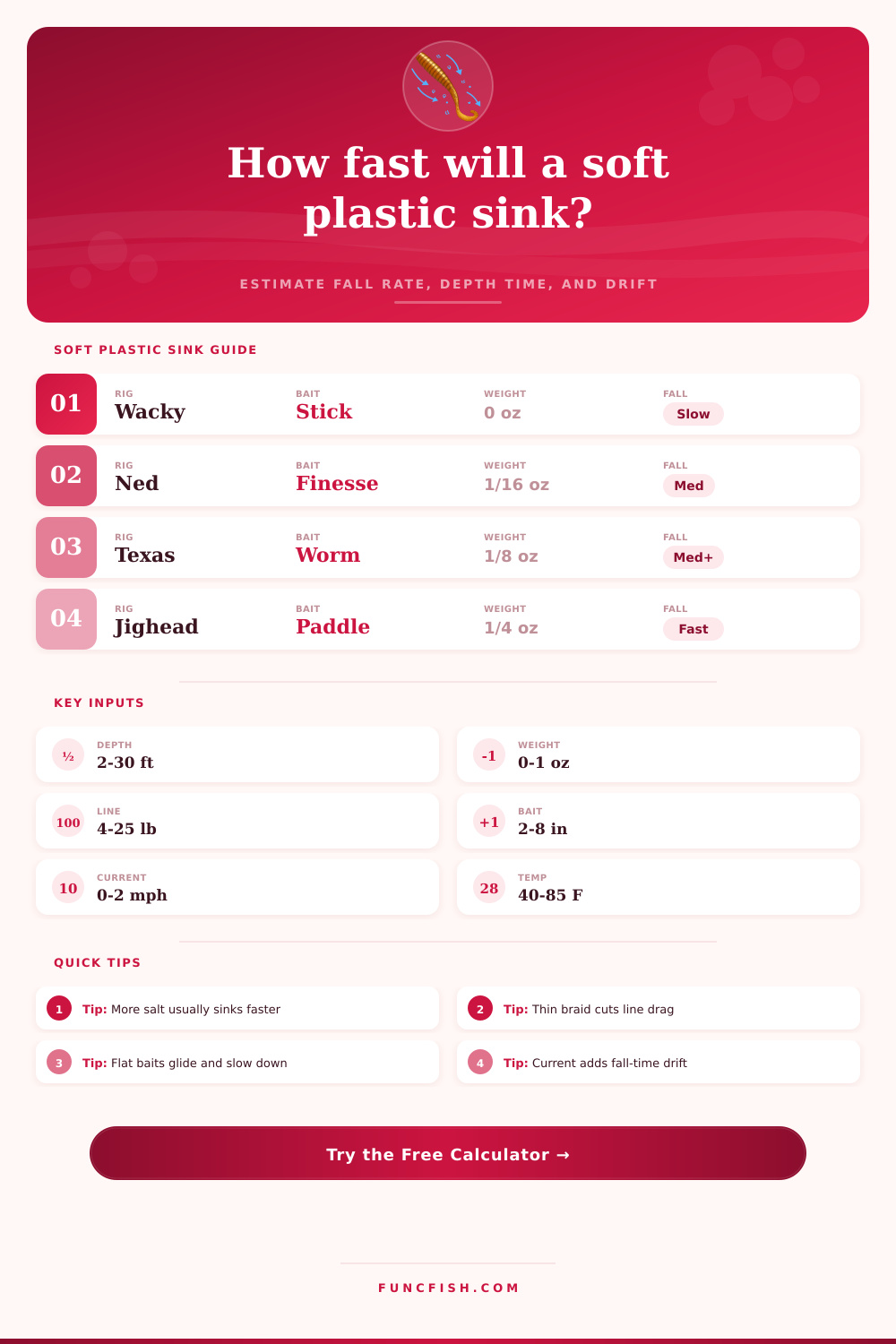
Estimate fall speed, time to target depth, and drift for worms, paddletails, tubes, craws, and other soft baits by combining rig weight, bait buoyancy, line drag, current, and water temperature.
📌Scenario presets
⚙Sink rate inputs
Soft plastic fall estimate
Full breakdown
📋Soft plastic profile data
Salted Stick
Finesse Worm
Ribbon Worm
Paddletail
Fluke
Tube
Craw
Creature
📏Reference tables
| Rig style | Typical weight | Fall attitude | Drag effect |
|---|---|---|---|
| Weightless wacky | 0 oz / 0 g | Horizontal shimmy | Very slow |
| Weightless Texas | 0 oz / 0 g | Nose first | Slow |
| Ned head | 1/16-1/10 oz | Head down | Medium |
| Texas bullet | 1/8-3/8 oz | Nose down | Medium-fast |
| Jighead | 1/8-1/2 oz | Point forward | Fast |
| Drop shot | 1/8-1/2 oz | Weight leads | Fast to weight |
| Carolina rig | 1/4-1 oz | Weight leads | Fast to weight |
| Neko rig | 1/32-1/8 oz | Nose first | Medium |
| Line type | Water behavior | Drag factor | Sink note |
|---|---|---|---|
| Braid | Floats, thin diameter | 0.82-0.95 | Low drag but bowed slack |
| Fluorocarbon | Sinks, denser | 1.00-1.12 | Keeps contact deeper |
| Monofilament | Floats, stretches | 1.12-1.28 | Slows fall on long casts |
| Copolymer | Near neutral | 1.04-1.18 | Moderate line bow |
| Species / technique | Common bait | Depth window | Useful fall rate |
|---|---|---|---|
| Panfish finesse | 2 in worm | 3-8 ft | 0.4-1.0 ft/s |
| Trout soft jerkbait | 3 in fluke | 2-10 ft | 0.5-1.2 ft/s |
| Smallmouth tube | 3.5 in tube | 8-25 ft | 1.0-2.0 ft/s |
| Largemouth worm | 5-7 in worm | 2-18 ft | 0.6-1.8 ft/s |
| Walleye paddletail | 3-4 in shad | 8-30 ft | 1.2-2.5 ft/s |
| Inshore swimbait | 4-5 in tail | 4-20 ft | 1.0-2.2 ft/s |
| Added weight | Grams | Typical use | Fall change |
|---|---|---|---|
| 1/32 oz | 0.9 g | Neko / tiny nail | Small boost |
| 1/16 oz | 1.8 g | Ned / finesse | Noticeable |
| 1/8 oz | 3.5 g | Shallow Texas | Medium |
| 3/16 oz | 5.3 g | Grass edge | Medium-fast |
| 1/4 oz | 7.1 g | Jighead / dock | Fast |
| 3/8 oz | 10.6 g | Deep cover | Very fast |
💡Calculation checks
Tip: A soft plastic that barely sinks in a bucket may still fall faster on fluorocarbon because the line pulls the nose down and reduces planing.
Tip: For weightless baits, the biggest uncertainties are true bait weight and salt content. Weigh one dry bait when you need tighter numbers.
A sink rate tools allows an angler to determine how fast the bait will travel through a water. Most anglers will guess at the rate at which the bait will travel through the water. However, many factor will change the sink rate of the bait.
These factors includes the weight of the bait, the type of fishing line used, and the temperature of the water in which the bait is being cast. The sink rate tool is helpful in that it allows anglers to account for these different factor and to determine how long it will take for the bait to reach the bottom of the lake or river. The density of the soft plastic bait will determine the rate at which the bait will sink.
How a sink rate tool shows how fast bait sinks
The salt content and the shape of the soft plastic bait create the density of the bait. Additionally, a bait like a ribbon tail worm Texas rigged with a bullet weight will travel quick through the water. In contrast, a weightless wacky rigged worm will travel more slow through the water.
Thus, the change in the sink rate of the bait will change the time it takes for the bait to reach the bottom of the water. The type of fishing line that is used also impact the sink rate of the bait. Braided line is thin and have low drag.
However, braid lines will float on the water. This can create a belly in the line that will slow the sink rate of the bait. Fluorocarbon will sink in the water and will carry the bait to the bottom of the water more quickly.
Monofilament lines will stretch and will float on the water, thus adding to the delay of the baits sink rate. The sink rate tool also account for these different type of fishing lines. The temperature of the water and the current in that water will also change the sink rate of the bait.
Cold water is more viscous than water that is warmed to the touch. Thus, the bait will fall more slow in colder water than in warm water. Additionally, the current in the water will push the bait to the side as it falls.
The current will also create a drift in the baits path. If the angler knows the speed of the current in the water, he or she can account for this in the sink rate tool and adjust the weight of the bait to maintain control over the movement of the bait. Using the information from the sink rate tool, anglers can adjust the sink rate of the bait to match the preferences of the fish in the water.
For instance, some fish prefers slower falling bait than others. If the sink rate tool determine that the fall rate of the bait is too slow, the angler can add weight to the bait or use a different type of soft plastic bait with a higher rate of sink. If the rate at which the bait will fall is too fast, the angler can remove some of the weight of the bait or use a bait with more surface area.
Many people will make mistake when they dont account for all of the variables involved in the sink rate of the bait. For instance, both a small finesse worm and a bulky creature bait may be the same length. However, because of the different rate at which the two types of bait will sink, they will travel at different rates through the water.
Additionally, the angler may make a mistake if he or she does not input the correct diameter of the fishing line in the sink rate tool. The angler may also make a mistake if the sink rate tool does not account for the weight of the soft plastic bait. Finally, the angle at which the bait is cast into the water can also impact the sink rate of the bait.
A long cast may create a line bow that slow the baits descent through the water. A sink rate tool will provide three specific piece of information to the angler. First, the sink rate will determine the vertical speed of the bait.
Second, time to depth will provide information to the angler about how long the bait will take to reach the depth of the fish in the water. Third, drift distance will help the angler understand how far the current will move the bait in the water. These three rates will provide the angler with an understanding of the path that the bait will take through the water.
By using a sink rate tool, anglers can begin to see pattern in the way that the fish in the water respond to the bait. For instance, anglers can learn that certain fishing rig require more weight when the water is cold than when it is warm to the touch. Additionally, anglers can learn that fluorocarbon has a faster sink rate than braid when they use the same type of bait.
These type of observations can help anglers to make decisions in the field. A sink rate tool will not necessarily replace an angler’s experience in the water. However, by using this tool, anglers can determine where to place their bait in relation to the fish more effective than they should of been able to.