🐟 Amberjack Weight Calculator
Estimate greater amberjack weight from length & girth measurements — imperial & metric
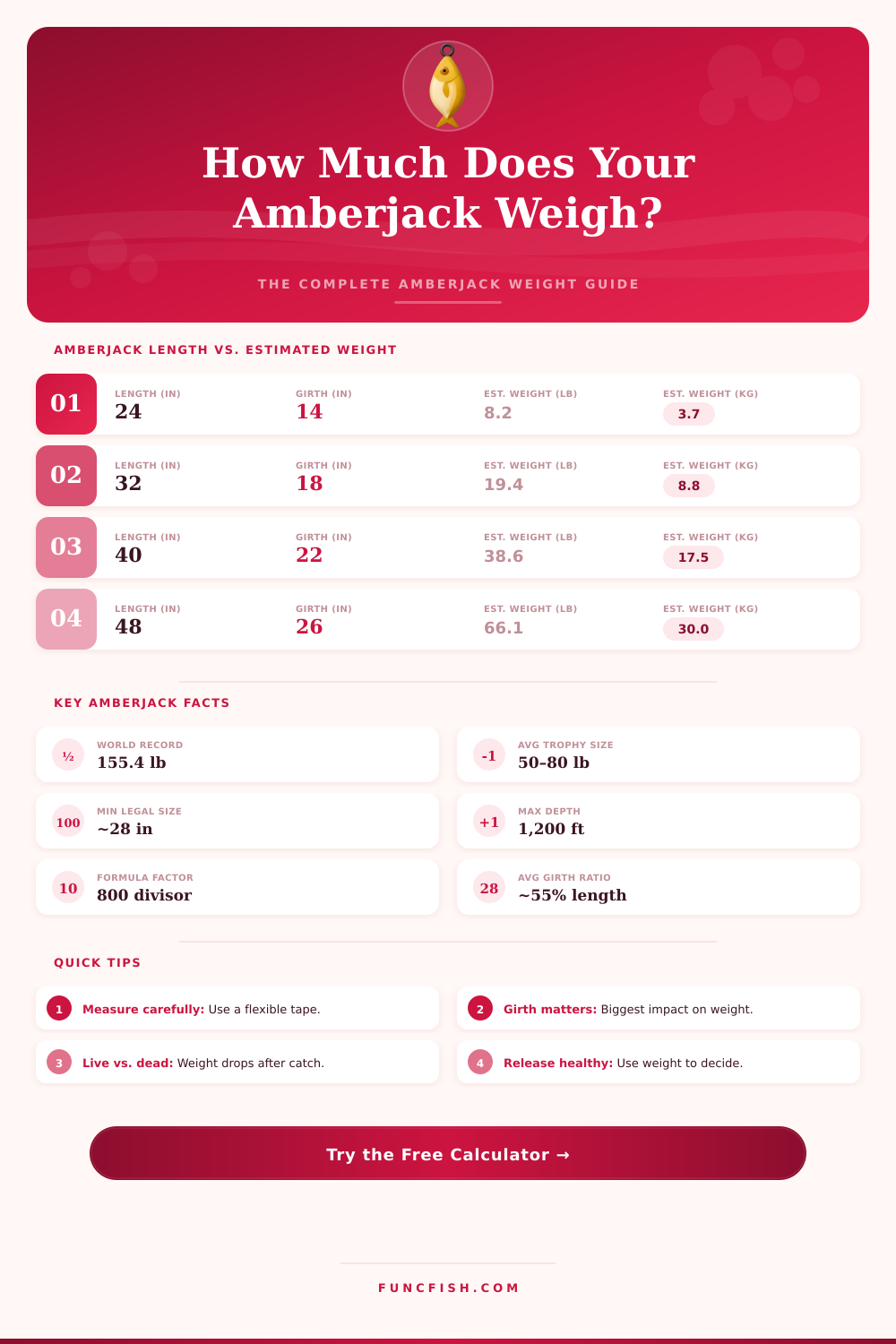
| Fork Length (in) | Girth Est. (in) | Est. Weight (lb) | Est. Weight (kg) |
|---|---|---|---|
| 20 | 11.0 | 3.0 | 1.4 |
| 24 | 13.2 | 5.2 | 2.4 |
| 28 | 15.4 | 8.3 | 3.8 |
| 32 | 17.6 | 12.3 | 5.6 |
| 36 | 19.8 | 17.6 | 8.0 |
| 40 | 22.0 | 24.2 | 11.0 |
| 44 | 24.2 | 32.2 | 14.6 |
| 48 | 26.4 | 41.8 | 19.0 |
| 52 | 28.6 | 53.2 | 24.1 |
| 56 | 30.8 | 66.6 | 30.2 |
| 60 | 33.0 | 82.1 | 37.2 |
| Species | Typical Weight (lb) | Max Length (in) | Formula Divisor |
|---|---|---|---|
| Greater Amberjack | 10–80 lb | 67" | 800 |
| Lesser Amberjack | 1–10 lb | 35" | 850 |
| Banded Rudderfish | 1–8 lb | 24" | 875 |
| Almaco Jack | 5–60 lb | 55" | 820 |
| Yellowtail Amberjack | 10–100 lb | 70" | 790 |
| Est. Weight | Rod Power | Line (lb braid) | Hook Size |
|---|---|---|---|
| Under 15 lb | Medium-Heavy | 30–50 lb | 5/0–7/0 |
| 15–30 lb | Heavy | 50–65 lb | 7/0–9/0 |
| 30–60 lb | Extra Heavy | 65–80 lb | 9/0–11/0 |
| 60–100 lb | Extra Heavy | 80–100 lb | 11/0–13/0 |
| 100+ lb | Stand-Up / Bent Butt | 100–130 lb | 14/0+ |
To estimate the weight of an amberjack, you must measure certain part of the amberjack. You must measure the length of the amberjack, as well as the girth of the amberjack. The weight of the amberjack will depend on both the length of the fish and the girth of the fish.
If you didnt measure the girth of the amberjack, but only the length of the amberjack, you would likely not obtain an accurat measurement of the weight of the amberjack. To measure the weight of the amberjack, you should begin by measuring the fork-length of the amberjack. Scientists measure the fork length from the snout of the fish to the fork of the tail of the amberjack.
How to Measure an Amberjack’s Weight
Scientists use the fork length of the amberjack to determine the relationship between the weight and length of the amberjack. Alternatively, you can also use the total length of the amberjack. However, measuring the total length of the amberjack may result in an overestimation of it’s weight.
Once you have measured the length of the amberjack, you must also measure the girth of the amberjack. You should measure the girth of the fish at the widest part of the body of the amberjack, which is usually located just in front of its dorsal fin. Measuring the girth of the amberjack will allow you to determine its condition, which will impact the total weight of the fish.
For instance, if the amberjack has eaten recently, its girth will be larger, and the amberjack will weigh more then an amberjack with a smaller girth. In addition to measuring the length and girth of the amberjack, you can also determine the weight of the amberjack by considering the body shape of the amberjack. Many amberjack have lean body.
Amberjack with lean bodies has smaller girth measurements. Other amberjack may have more food within their bodies, which results in a larger girth of the body. The body shape can also change according to the time of year in which you are measuring the amberjack.
For instance, amberjack may lose weight during the spring when they spawn egg. In the fall, however, amberjack eat more food, leading to a larger girth of their bodies. In order to accurately measure the length and girth of the amberjack, it is important that you utilize the apropriate measuring tools.
You can use a soft measuring tape to measure the curves of the amberjacks body. A soft measuring tape will easily wrap around the girth of the amberjack. However, different measuring tools have different levels of accuracy.
For instance, a dock scale may be very accurate when measuring the weight of an amberjack, but a lip gripper may not be as accurate. Furthermore, ensure the amberjack is lying flat on a deck. If the amberjack is curved over the gunnel of a boat, you will incorrectly measure your weight.
When estimating the weight of the amberjack, there is some common error that you should of avoided. For instance, one common error is measuring the weight of an amberjack while the fish is still moving or pumping blood after a fight. The amberjack should be still so you can accurately measure its weight.
Another common error is utilizing different type of length measurements. For instance, if you use fork length and total length measurements in measuring the weight of the amberjack, the measurement will be inaccurate. Finally, it is also important that you dont forget to measure the girth of the amberjack.
If you fail to measure the girth, you will have only measured the length of the amberjack. If you only measure the length of the amberjack, the weight will be inaccurately measured. Thus, if you measure both the length and the girth of the amberjack correctly, you will have a better understanding of the weight of the amberjack.