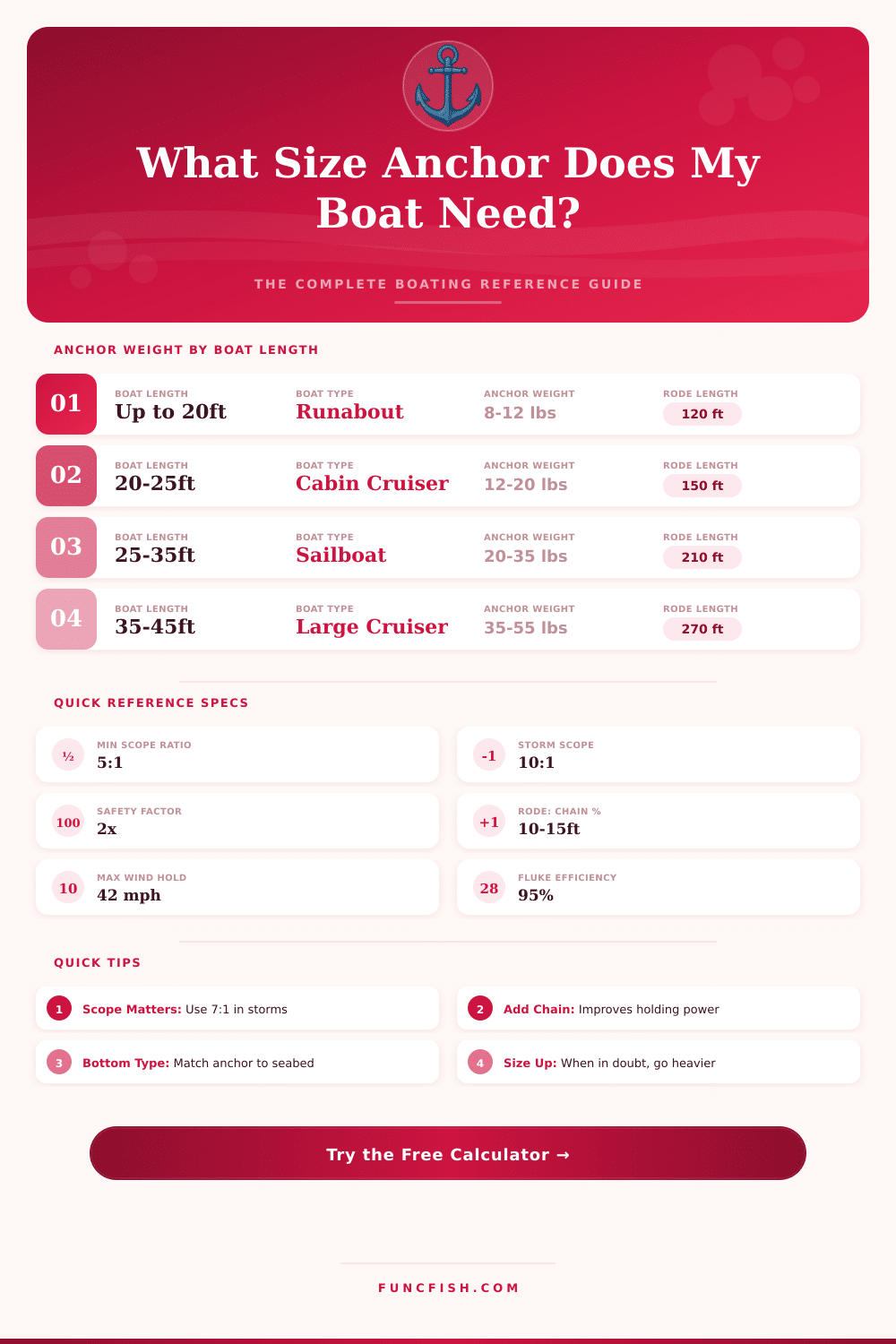
⚓ Boat Anchor Size Calculator
Find the correct anchor weight, rode length & scope for your vessel and conditions
| Boat Length (ft) | Boat Length (m) | Danforth/Fluke (lb / kg) | Plow/CQR (lb / kg) | Bruce/Claw (lb / kg) | Mushroom (lb / kg) |
|---|---|---|---|---|---|
| Up to 14 | Up to 4.3 | 4–8 / 1.8–3.6 | — | 4–6 / 1.8–2.7 | 10–15 / 4.5–6.8 |
| 15–20 | 4.6–6.1 | 8–12 / 3.6–5.4 | 10 / 4.5 | 11 / 5 | 15–25 / 6.8–11.3 |
| 21–25 | 6.4–7.6 | 12–15 / 5.4–6.8 | 15 / 6.8 | 16.5 / 7.5 | 25–40 / 11.3–18.1 |
| 26–30 | 7.9–9.1 | 15–20 / 6.8–9.1 | 20 / 9.1 | 22 / 10 | 40–65 / 18.1–29.5 |
| 31–35 | 9.4–10.7 | 20–25 / 9.1–11.3 | 25 / 11.3 | 33 / 15 | 65–100 / 29.5–45.4 |
| 36–40 | 11–12.2 | 25–35 / 11.3–15.9 | 35 / 15.9 | 44 / 20 | 100–150 / 45.4–68 |
| 41–50 | 12.5–15.2 | 35–50 / 15.9–22.7 | 45–55 / 20.4–25 | 55–66 / 25–30 | 150–200 / 68–90.7 |
| 51–65 | 15.5–19.8 | 50–80 / 22.7–36.3 | 55–75 / 25–34 | 66–110 / 30–50 | 200+ / 90.7+ |
| Conditions | Scope Ratio | 10ft Depth Rode | 20ft Depth Rode | 30ft Depth Rode | Chain Lead Rec. |
|---|---|---|---|---|---|
| Lunch Hook (calm) | 5:1 | 50 ft / 15.2 m | 100 ft / 30.5 m | 150 ft / 45.7 m | 6–8 ft / 1.8–2.4 m |
| Overnight (light wind) | 7:1 | 70 ft / 21.3 m | 140 ft / 42.7 m | 210 ft / 64 m | 8–10 ft / 2.4–3 m |
| Moderate Conditions | 7:1 | 70 ft / 21.3 m | 140 ft / 42.7 m | 210 ft / 64 m | 10–15 ft / 3–4.6 m |
| Heavy Weather | 8:1 | 80 ft / 24.4 m | 160 ft / 48.8 m | 240 ft / 73.2 m | 15–20 ft / 4.6–6.1 m |
| Storm Anchoring | 10:1 | 100 ft / 30.5 m | 200 ft / 61 m | 300 ft / 91.4 m | 20+ ft / 6.1+ m |
| Boat Type | 15 mph Wind (lb / kg) | 25 mph Wind (lb / kg) | 40 mph Wind (lb / kg) | Holding Power Needed (lb / kg) |
|---|---|---|---|---|
| Kayak / 12ft | 15–25 / 7–11 | 40–70 / 18–32 | 100–175 / 45–79 | 50–175 / 23–79 |
| Runabout / 18ft | 40–80 / 18–36 | 100–200 / 45–91 | 250–500 / 113–227 | 100–500 / 45–227 |
| Bowrider / 22ft | 80–150 / 36–68 | 200–380 / 91–172 | 500–950 / 227–431 | 200–950 / 91–431 |
| Cabin Cruiser / 32ft | 200–400 / 91–181 | 500–1000 / 227–454 | 1250–2500 / 567–1134 | 500–2500 / 227–1134 |
| Sailboat / 38ft | 350–600 / 159–272 | 875–1500 / 397–680 | 2200–3750 / 998–1701 | 875–3750 / 397–1701 |
| Houseboat / 45ft | 600–1000 / 272–454 | 1500–2500 / 680–1134 | 3750–6250 / 1701–2835 | 1500–6250 / 680–2835 |
| Anchor Type | Best Bottom | Worst Bottom | Holding/Weight Ratio | Re-sets After Swing |
|---|---|---|---|---|
| Danforth / Fluke | Sand, Mud | Rock, Coral | Very High (10:1) | Good |
| Plow (Delta) | Sand, Mud, Clay | Thick Grass | High (7:1) | Very Good |
| CQR (Swing Plow) | Sand, Mud, Gravel | Hard Rock | High (7:1) | Excellent |
| Bruce / Claw | Rock, Weed, Mixed | Soft Mud | Moderate (6:1) | Excellent |
| Mushroom | Soft Mud (permanent) | Rock, Sand | Low–Moderate (3:1) | Poor |
| Grapnel | Rock, Coral, Weed | Sand, Mud | Moderate (5:1) | Poor |
| Navy / Admiralty | Mixed, Hard | Soft Mud | High (8:1) | Poor |
Count the right weight of anchor do not need to be truly hard. Here basic rule that operates very well: around one pound of anchor for every foot of the length of your boat. For an 18-foot boat, aim for about 18 pounds, more or less.
Even so, the weight alone do not settle everything; many other parts play a big role.
How to Pick the Right Anchor, Chain and Rope
The most common kinds of anchors come with charts of sizes from the maker, and from my experience this works best: follow the chart, but choose a bit bigger. For a 20-foot boat, for instance, a Bruce anchor could be 6, 11 or 16 pounds. Skip the smallest and go to 11 or 16.
With a Danforth type, for the same boat you need 9 or 14 pounds. Those labels on store anchors sometimes suggest that smaller will be enough, but often they undercount what you truly need. Changing from an 8-pound Boat Anchor to a 13-pound one on a 22-foot boat?
It gives clearly better results.
When bad weather comes, climbing one or two sizes more in hieght is a wise decision. For a multi-hull boat, start at the suggested size in the chart and then move to the next bigger.
Chain causes also matter here. The basic rule is one foot of chain for every foot of the boat, so a 24-foot boat would carry around 24 feet, although some captains insist that 12 feet of thicker chain in 3/8 inches or more do the task. A 5/16-inch chain weighs around one pound per foot, so 8 feet reach about 8 pounds.
Mixing chain with three-strand nylon rope gives more freedom. The hard part is that almost only rope means less protection against wear through the whole length, short chain tied to the anchor with long nylon line settles the most common cases, but not across the board.
The scope is more important than many think. It is the ratio of your anchor line to the depth of the water. The most common sailors aim for at least 5:1, but 7:1 usually holds more steady.
If you set anchor in 40 feet depth at 8:1, you kneed 320 feet of rope. Typical cruisers carry around 100 to 150 feet. Truly, fill your anchor locker to the max that it holds, is a good strategy, with 150 feet as a good minimum.
The type of bottom below also matters a lot… Sand, mud, rocks and weeds all change the result. Some sailors keep two or three different types of anchors to fit anything below.
For instance, a 13-pound Mantus with 15 feet of chain keeps a 24-foot boat steady on good soil. Different thicknesses ofchain. Quarter, three-eighths or half-inch, work, if you build anchors for various sizes of boats.