⚡ Boat Battery Cable Size Calculator
Find the correct AWG wire gauge for your marine electrical system — prevent voltage drop and ensure safe, reliable power
Engine Starters
Large Motors
Mid Engines
Trolling Motors
Accessories
Pumps/Winches
Bilge/Lights
Electronics
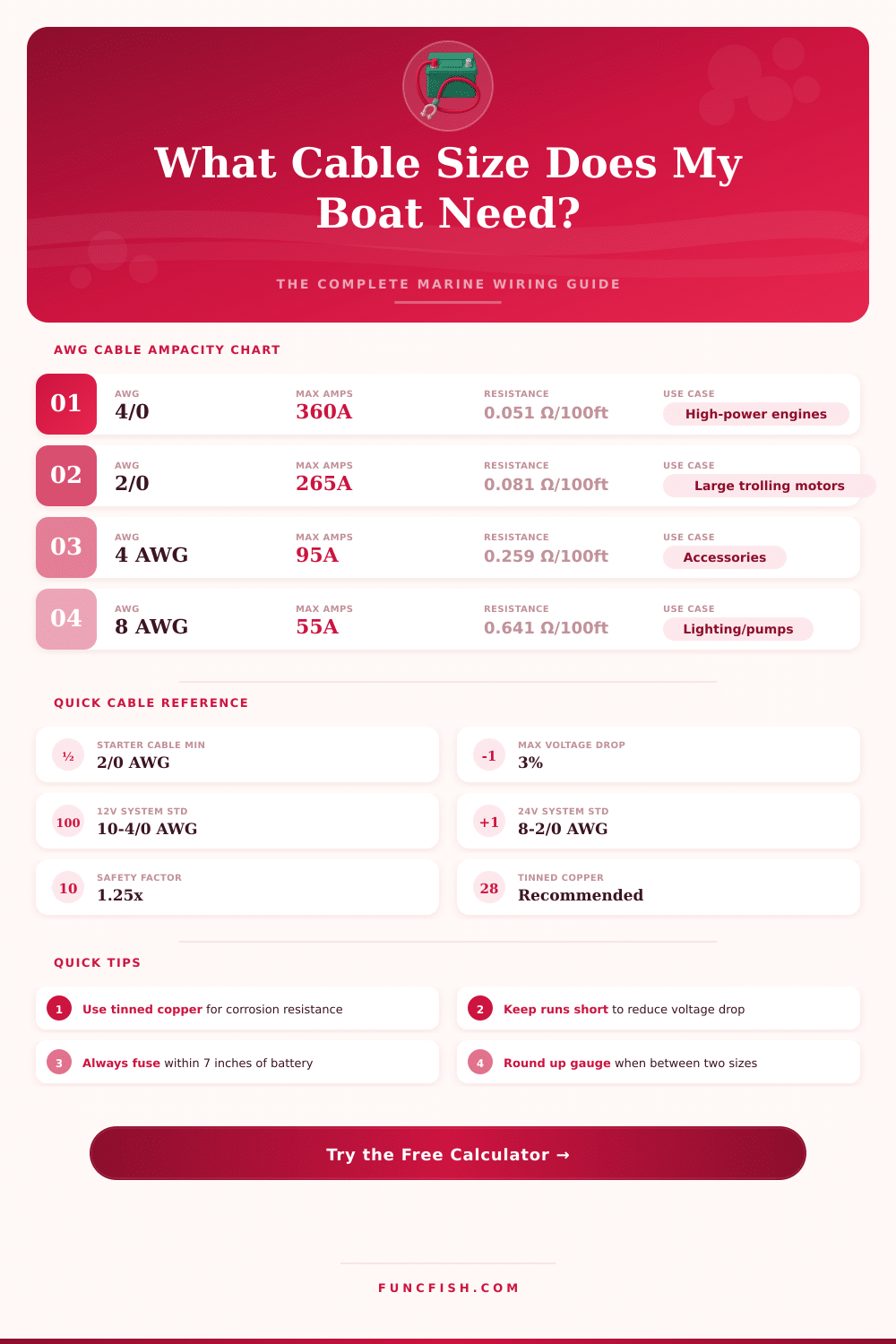
| AWG Size | Max Amps (Marine) | Resistance (Ω/100ft) | Diameter (mm) | Typical Use |
|---|---|---|---|---|
| 4/0 AWG | 360A | 0.051 | 11.68 | Large engine starter, heavy battery bank |
| 3/0 AWG | 310A | 0.064 | 10.40 | Engine starter, large inverter |
| 2/0 AWG | 265A | 0.081 | 9.27 | Engine starter, 80–112 lb thrust trolling |
| 1/0 AWG | 210A | 0.102 | 8.25 | Mid-size engine starter, heavy accessory |
| 2 AWG | 130A | 0.162 | 6.54 | 55–80 lb thrust trolling motor |
| 4 AWG | 95A | 0.259 | 5.19 | 30–55 lb thrust, anchor winch |
| 6 AWG | 75A | 0.410 | 4.11 | Livewell pump, windlass, bilge |
| 8 AWG | 55A | 0.641 | 3.26 | Bilge pump, cabin lights, horn |
| 10 AWG | 30A | 1.018 | 2.59 | Fish finder, VHF radio, small electronics |
| 12 AWG | 20A | 1.619 | 2.05 | Navigation lights, USB chargers |
| 14 AWG | 15A | 2.575 | 1.63 | Interior lighting, small pumps |
| 16 AWG | 10A | 4.094 | 1.29 | Courtesy lights, bilge float switch |
| 18 AWG | 7A | 6.385 | 1.02 | Sensors, trim gauges, alarm circuits |
| Application | Typical Amps | Min. AWG (12V) | Min. AWG (24V) | ABYC Class |
|---|---|---|---|---|
| Outboard Engine Starter | 100–300A | 4/0 – 2/0 | 2/0 – 1/0 | D |
| Inboard Engine Starter | 150–400A | 4/0 | 3/0 – 4/0 | D |
| 80–112 lb Trolling Motor | 50–80A | 4 – 2 AWG | 6 – 4 AWG | B |
| 30–55 lb Trolling Motor | 25–50A | 6 – 4 AWG | 8 – 6 AWG | B |
| Bilge Pump (1500 GPH) | 5–10A | 12 – 10 AWG | 14 – 12 AWG | A |
| VHF Radio | 5–7A | 12 AWG | 14 AWG | A |
| Chart Plotter / GPS | 1–3A | 16 – 14 AWG | 18 – 16 AWG | A |
| Anchor Winch / Windlass | 40–80A | 4 – 2 AWG | 6 – 4 AWG | B |
| Livewell Pump | 8–20A | 12 – 10 AWG | 14 – 12 AWG | A |
| Navigation Lights | 3–8A | 14 – 12 AWG | 16 – 14 AWG | A |
| AWG | 5 ft Run | 10 ft Run | 15 ft Run | 20 ft Run |
|---|---|---|---|---|
| 8 AWG | 0.64V (5.3%) | 1.28V (10.7%) | 1.92V (16%) | 2.56V (21%) |
| 6 AWG | 0.41V (3.4%) | 0.82V (6.8%) | 1.23V (10.3%) | 1.64V (13.7%) |
| 4 AWG | 0.26V (2.2%) | 0.52V (4.3%) | 0.78V (6.5%) | 1.04V (8.7%) |
| 2 AWG | 0.16V (1.3%) | 0.32V (2.7%) | 0.49V (4%) | 0.65V (5.4%) |
| 1/0 AWG | 0.10V (0.8%) | 0.20V (1.7%) | 0.31V (2.5%) | 0.41V (3.4%) |
Choosing the right thickness for boat battery cable size is very important. The size of cable simply points to its width. To send energy through long ways without losing voltage, it matters to choose the right size.
Safety of boat electrical setup depends on doing this correctly.
How to Choose the Right Boat Battery Cable Size
Thickness of cable must consider two main spots: how much flow it can bear and how long the cable way is. The longer the cable, the thicker wire it requires. AWG charts show different ratings for current in various lengths, what helps in choice of the right thickness.
For instance, for needs of 70-80 amps and ways of 7-10 feet, one should use 16 AWG cable.
One must recall, that a run of 10 feet from the battery indeed matches to a 20-foot way in those charts. Here is the reason: there are 10 feet also from the lesser pole of the battery. In ships commonly happen more complex setups than in cars, plus causes like starting of drained batteries, that cars do not usually have.
So, use at least 25 mm² or more liekly 35 mm² cable, regardless of the length.
System AWG bases on a scale and can convert to cross area in square millimeters. Wire of 10 AWG has around 5.26 mm², while 2 AWG reaches nearly 33.6 mm². Cable of 35 mm fits to 240 amps.
The most used thicknesses for batteries in ships are 2/0 and 4/0. Many folks bind all battery cables to the switch by means of 1/0 or 2/0. Links between batteries commonly use 1/0.
Sometimes the battery bank helps to start the engine, so it matters to choose a bit bigger size.
For ships one must use wire fit for boat surroundings. Avoid welding cable, OFC or CCA in such cases. Maritime cable of 4-rating is made to handle heavy boat conditions.
Salt water causes corrosion on every wire, so choosing one rating bigger is a wise decision. Color checking of cable ends buy means of heat shrink tubing helps to easily follow the wires over more time.
Wire of 10 AWG answers for 30 amps, what well works for ways to blocks of batteries, that feed steering, horns, navigation lights, bilge pumps, radios and chart plotters. For heavier loads one uses 4-rated cable for ways of the motor console and start batteries, while 6-rated well serves for longer ways to trolling motors. No one wants that you use too little boat battery cable size.
Usually thicker ismore good, when dealing about wires.