⛵ Boat Fuel Consumption Calculator
Estimate fuel usage, range, and tank requirements for any boating trip
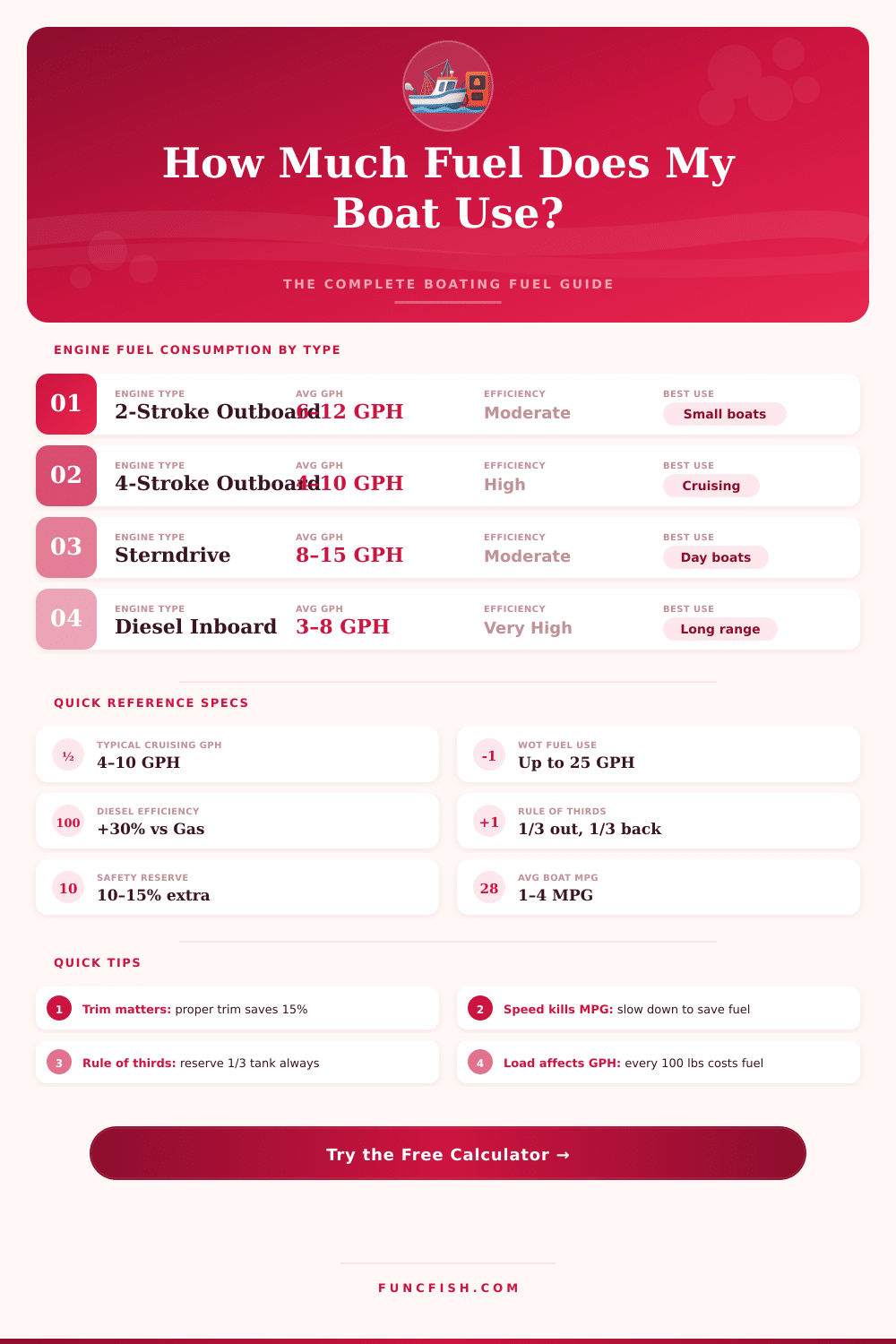
| Engine Type | HP Range | Avg GPH (Cruise) | GPH at WOT | Efficiency Rating | Metric L/hr |
|---|---|---|---|---|---|
| 2-Stroke Outboard | 2 – 250 HP | 6 – 12 GPH | 15 – 30 GPH | Moderate | 22 – 45 L/hr |
| 4-Stroke Outboard | 2.5 – 600 HP | 4 – 10 GPH | 10 – 25 GPH | High | 15 – 38 L/hr |
| Diesel Inboard | 50 – 1000 HP | 3 – 8 GPH | 8 – 20 GPH | Very High | 11 – 30 L/hr |
| Gas Sterndrive | 135 – 600 HP | 8 – 15 GPH | 20 – 40 GPH | Moderate | 30 – 57 L/hr |
| Personal Watercraft | 60 – 310 HP | 5 – 10 GPH | 12 – 20 GPH | Low–Mod | 19 – 38 L/hr |
| Electric Trolling | 0.5 – 5 HP | N/A (Ah-based) | N/A | Very High | N/A |
| Boat Type | Typical Range | Avg Speed | Fuel Use (GPH) | Tank Size (gal) | Usable Range |
|---|---|---|---|---|---|
| Pontoon Boat | Inland lakes | 18–25 mph | 4–8 GPH | 24–50 gal | 60–120 mi |
| Bass Boat | Lakes / rivers | 25–45 mph | 5–12 GPH | 16–35 gal | 50–100 mi |
| Offshore Fisher | Coastal / offshore | 25–35 mph | 15–30 GPH | 100–400 gal | 200–500 mi |
| Center Console | Inshore/nearshore | 25–40 mph | 8–20 GPH | 50–150 gal | 100–300 mi |
| Ski / Wake Boat | Lakes | 20–40 mph | 8–16 GPH | 35–75 gal | 80–150 mi |
| Sailboat (motor) | Coastal / bay | 6–10 mph | 0.5–2 GPH | 10–40 gal | 100–300 mi |
| Trawler / Cruiser | Long range | 7–12 mph | 2–8 GPH | 100–800 gal | 500–2000 mi |
| Houseboat | Inland waterways | 6–12 mph | 3–10 GPH | 50–200 gal | 100–400 mi |
| Throttle Setting | % of WOT | Relative GPH | Relative MPG | Efficiency |
|---|---|---|---|---|
| Trolling / Idle | 10–20% | 0.5–1x base | Varies widely | Poor (anchored use) |
| Displacement Speed | 20–40% | 0.4–0.6x base | Best MPG zone | Very Good |
| Planing Transition | 40–60% | 1.0–1.4x base | Worst MPG | Poor |
| Cruising Speed | 60–75% | 0.7–0.9x base | Good MPG | Good |
| Wide Open Throttle | 100% | 1.0x base (max) | Lowest MPG | Poor |
Fuel consumption of a boat is not set by one number, it depends on many factors. Size of the boat, its weight and wanted speed seriously affect how thirsty the engine gets heavier ship exhausts the fuel more quickly than lightweight. Although the engine can use the same amount of gallons per hour, the extra weight means you cover less distance for every gallon.
When dealing with kind of engine, the differences are clear. Well-set four-stroke gasoline engine consumes around 0.50 pounds of fuel per horsepower hour. Diesel engines do better (they use around 0).4 pounds per horsepower hour when they run well.
What Affects a Boat’s Fuel Use
Gasoline engines are much more thirsty, consuming at least 33% more than diesel engines. Situation fails even more with big gasoline engine that does not work hard. Under light load it can burn double amount compared to moderately loaded diesel engine in same setuaption.
Speed alters everything entirely. However the relation between speed and economy is not always what you expect. Journey of 75 nautical miles at 15 knots lasts 5 hours and swallows around 117 gallons.
At 25 knots it ends in 3 hours, but surprisingly the consumption worsens. Slow ships struggle because of high resistance in water where they sit low. But when they reach planing speed, efficiency grows dramatically.
One owner found that cruising at 2000 rpm consumes almost double compared to 4000 rpm, because the ship then genuinely hovers and gets real speed.
Bass boats you can use as base for comparison. That usual consumes around 4 gallons for hour. Bigger 35-foot diesel ship at 6 knots uses between 0.6 and 1.2 gallons for hour.
Worth noting is how different the efficiency is between idle, cruise and full gas, that is almost a different world.
Horsepower plays a big role also. More power eats more fuel, without exception. 100-horsepower engine at full gas uses less than 150-horsepower adjusted to 70%.
If smaller engine gives enough power, it spares fuel. Reduce the throttle and you save. It is simply like this.
Control of fuelcosts depends on some elements. Propellers with low pitch help to raise the ship and reach top speed with less gas (ideal when you carry folks and gear). Sea states alter a lot.
Waves genuinely affect things, because against them you can reach only 5 nautical miles per hour, while with them, 15. Some folks changed from two-stroke to four-stroke engines and noticed big improvements, one ship went from 1.5 mile per gallon to 3 mile per gallon after the change.