⛵ Boat Trailer Size Calculator
Find the right trailer capacity, axle rating, and tongue weight for your boat
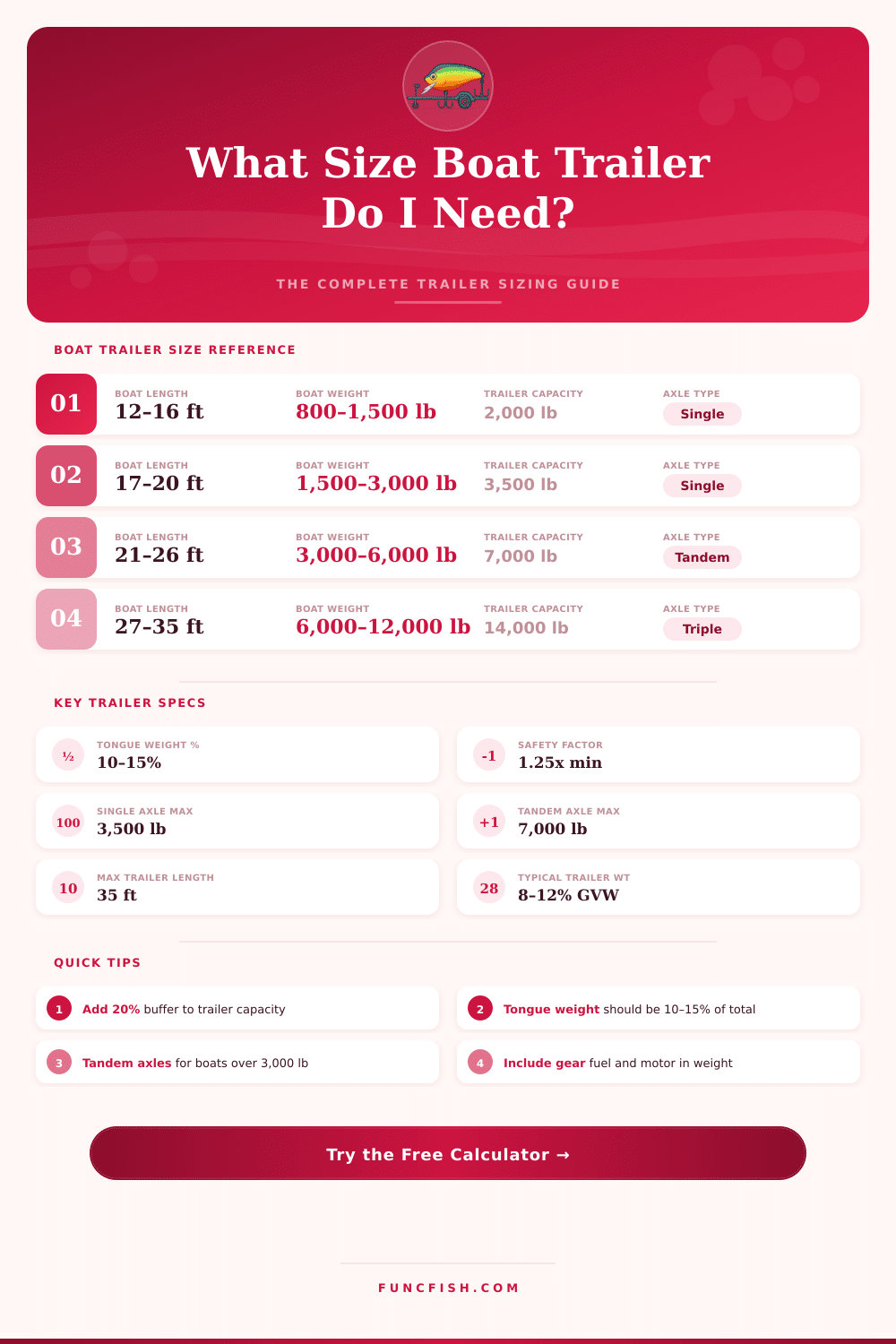
| Boat Length (ft / m) | Typical Hull Weight | Recommended GVWR | Axle Config | Tongue Weight Range |
|---|---|---|---|---|
| 8–12 ft / 2.4–3.7 m | 300–700 lb / 136–318 kg | 1,500 lb / 680 kg | Single | 150–225 lb |
| 12–16 ft / 3.7–4.9 m | 700–1,500 lb / 318–680 kg | 2,000 lb / 907 kg | Single | 200–300 lb |
| 17–19 ft / 5.2–5.8 m | 1,500–2,500 lb / 680–1,134 kg | 3,500 lb / 1,588 kg | Single | 350–525 lb |
| 20–23 ft / 6.1–7.0 m | 2,500–4,500 lb / 1,134–2,041 kg | 5,000 lb / 2,268 kg | Tandem | 500–750 lb |
| 24–27 ft / 7.3–8.2 m | 4,500–7,000 lb / 2,041–3,175 kg | 8,000 lb / 3,629 kg | Tandem | 800–1,200 lb |
| 28–32 ft / 8.5–9.8 m | 7,000–11,000 lb / 3,175–4,990 kg | 12,000 lb / 5,443 kg | Tandem/Triple | 1,200–1,800 lb |
| 33–40 ft / 10–12 m | 11,000–18,000 lb / 4,990–8,165 kg | 20,000 lb / 9,072 kg | Triple | 2,000–3,000 lb |
| Hull Material | Typical Weight Factor | Durability | Saltwater Suitability | Notes |
|---|---|---|---|---|
| Aluminum | 1.0x (baseline) | High | Good (anodized) | Lightest common option |
| Fiberglass | 1.3–1.5x | Very High | Excellent | Most popular material |
| Steel | 1.6–2.0x | Excellent | Needs coating | Heaviest, very strong |
| Inflatable (RIB) | 0.4–0.7x | Medium | Excellent | Very lightweight |
| Wood / Composite | 1.4–1.8x | Medium | Poor (untreated) | Heaviest when wet |
| Carbon Fiber | 0.7–0.9x | High | Excellent | Lightest premium option |
| Pontoon / Tritoon | 1.2–1.6x | High | Fair | Deck adds extra weight |
| PWC (Jet Ski) | 0.5–0.8x | High | Excellent | Uses special PWC trailers |
| Trailer GVWR | Axle Type | Min Tow Vehicle Rating | Trailer Frame | Brake Requirement |
|---|---|---|---|---|
| Up to 2,000 lb / 907 kg | Single | Mid-size SUV / Pickup | 1.5" sq. tube | None (most states) |
| 2,001–3,500 lb / 907–1,588 kg | Single | Full-size SUV / 1/2-ton | 2" sq. tube | Check local laws |
| 3,501–5,000 lb / 1,588–2,268 kg | Tandem | 3/4-ton pickup | 2" sq. tube | Required in most states |
| 5,001–8,000 lb / 2,268–3,629 kg | Tandem | 3/4-ton or 1-ton | 3" channel | Required |
| 8,001–12,000 lb / 3,629–5,443 kg | Tandem | 1-ton pickup or HD | 4" channel | Required |
| 12,001–20,000 lb / 5,443–9,072 kg | Triple | Heavy-duty truck | I-beam / Heavy channel | Required — surge/electric |
Find the right size for the boat trailer are one of those tasks that seems easy, but can become complex. Right size of the boat trailer we determine according to the length of the boat, that is between the main factors. Big part depends from the bow until the back, so that the whole length fits comfortably on the boat trailer, without hanging of parts or absence of support.
Usually boat trailers are two feet longer than the boat itself. One measures the size of the most front spot at the bow until the finish of the bottom surface of the hull no the whole size included of extended platforms.
How to Find the Right Size Boat Trailer
Extra length between two and six feet is ideal, because it allows good steering of the boat trailer and gives enough space for the boat. Also the capacity of the boat trailer should be fifteen percent more than the dry weight of the boat.
A boat trailer for a pontoon boat has entirely different build than that for V-shaped hull. The bunks or rollers on the boat trailer must line up with the hull, to escape damages during travel. Not only length matters in this.
Beam, height and weight of the boat everything affects the choice. Even for a small boat you need the right boat trailer with the right hitch for safely pulling it. Count the dry weight, add weight of the engines, fuel, and later throw in two hundred extra pounds for electronics, anchors, ropes, gear and general stuff.
In United States, most boat trailers for boats are eight and half feet broad. This is the maximum beam, that you legally can use without special permit for broad loads. Everything above ten feet broad requires a real permit.
Some states have there own rules about weight of boat trailer, beam, lights, brakes and speed.
Boat trailers with one axle work for smaller boats. One axle normally bears boat until twenty-two or twenty-three feet long, with maximum weight around thirty-three hundred until thirty-five hundred pounds. They are cheaper, need less care and move more easily by hand than models with two axles.
For big boats, two or even three axles could be needed. A boat trailer of twenty-eight feet probably cannot safely bear a boat of thirty-two or thirty-three feet. The bunks must support the back well.
Storing a boat can create problems. A boat a bit more than seventeen feet long, on a boat trailer with the tongue, can reach until twenty-three feet total. That hardly fits in an average garage of twenty feet.
One boat, that stood nine feet eight inches high on its boat trailer, required a door of twelve by twelve feet on a big building, that was fourteen feet high and thirty-eightfeet deep, to have comfortable space inside and outside.