⛵ Catamaran Hull Speed Calculator
Calculate displacement hull speed, Froude number, speed-length ratio & wave-making resistance for your cat
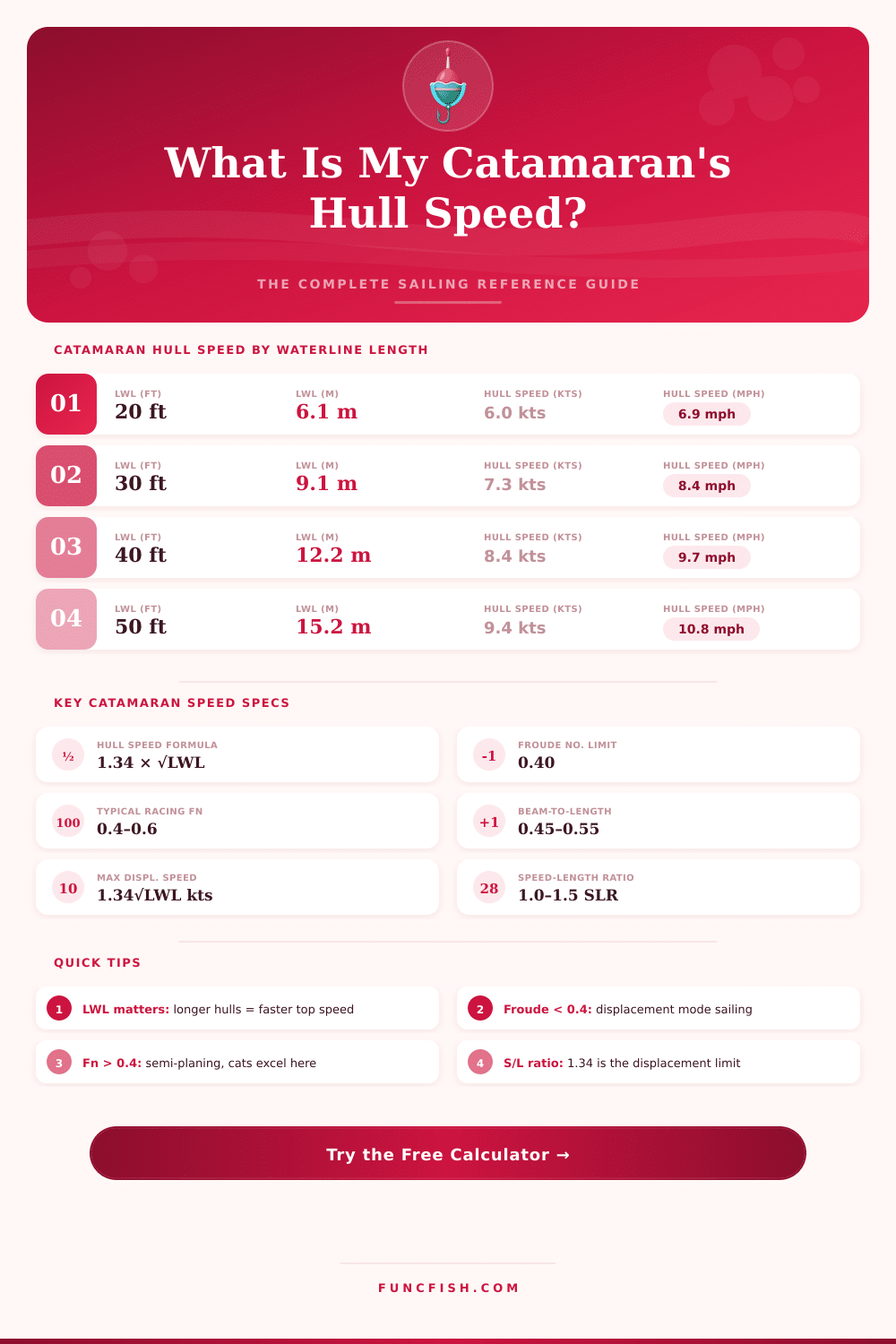
| LWL (ft) | LWL (m) | Hull Speed (kts) | Hull Speed (mph) | Hull Speed (km/h) |
|---|---|---|---|---|
| 15 ft | 4.6 m | 5.19 kts | 5.97 mph | 9.61 km/h |
| 20 ft | 6.1 m | 5.99 kts | 6.90 mph | 11.10 km/h |
| 25 ft | 7.6 m | 6.70 kts | 7.71 mph | 12.41 km/h |
| 30 ft | 9.1 m | 7.34 kts | 8.45 mph | 13.60 km/h |
| 35 ft | 10.7 m | 7.93 kts | 9.13 mph | 14.69 km/h |
| 40 ft | 12.2 m | 8.47 kts | 9.75 mph | 15.69 km/h |
| 45 ft | 13.7 m | 8.99 kts | 10.35 mph | 16.65 km/h |
| 50 ft | 15.2 m | 9.48 kts | 10.91 mph | 17.56 km/h |
| 60 ft | 18.3 m | 10.38 kts | 11.95 mph | 19.22 km/h |
| 70 ft | 21.3 m | 11.21 kts | 12.90 mph | 20.76 km/h |
| Hull Form | Typical S/L Ratio | Froude No. Range | Best Use |
|---|---|---|---|
| Narrow Round Bilge | 1.0 – 1.2 | 0.30 – 0.36 | Offshore cruising |
| Narrow Deep-V | 1.1 – 1.3 | 0.33 – 0.39 | Bluewater passage |
| Wide Flat Bottom | 0.9 – 1.1 | 0.27 – 0.33 | Coastal cruising |
| Asymmetric Daggerboard | 1.2 – 1.4 | 0.36 – 0.42 | Performance cruising |
| Wave-Piercing | 1.3 – 1.5 | 0.39 – 0.45 | Offshore racing |
| Beach Catamaran | 1.4 – 1.8 | 0.42 – 0.54 | Racing, day sailing |
| Foiling Catamaran | 2.0 – 4.0+ | 0.60 – 1.2+ | High-performance racing |
| Froude Number (Fn) | Speed Regime | Wave Resistance | Notes |
|---|---|---|---|
| Fn < 0.15 | Very Slow | Negligible | Motoring in calm water |
| 0.15 – 0.30 | Slow Displacement | Low | Light air / motoring |
| 0.30 – 0.40 | Displacement | Moderate | Normal sailing range |
| 0.40 – 0.50 | Semi-displacement | High | Cats excel over monohulls |
| 0.50 – 0.70 | Pre-planing | Very High | Performance cats reaching |
| > 0.70 | Planing / Foiling | Decreasing | Beach cats, foilers |
Hull speed really matters when you think about catamarans. The simple math behind that is easy: you take 1.34 and multiply it by the square root of the waterline length in feet. Assume you have a 36-foot waterline.
Root of 36 is 6 and 6 times 1.34 give a bit more than 8 knots. Big ships usually move faster. Sailors commonly use that 1.34 factor as base
How hull speed works for catamarans
Here things become interesting with catamarans. That formula was created for displacement hulls. Planing or semi-displacement hulls can pass those limits entirely.
Reality gets messy when you deal with ships with high length-to-beam ratio (catamarans are the main example). The secret why catamarans beat other forms is in that length-to-beam ratio. Displacement hulls struggle against two main sources of drag: skin friction of the surface area and wave-making resistance.
When the beam of the hull falls under 6% of its length, as in multihulls, the wave-making resistance almost disappears. Big advatnage.
Catamarans have much less water resistance, so they easily beat monohulls. They have smaller hulls, which reduces the fight against the bow wave. When the bow wave grows, water simply pushes aside the bow of the ship.
Above a certain speed the ship must climb above its own bow wave. A monohull at 8 knots reach its comfortable displacement pace. To reach 10 knots needs huge extra energy for only 2 knots more.
Not worth the effort. Catamaran of same length can reach 2 or 3 knots more and yet use less fuel.
Multihulls beat monohulls in same length because of those long, narrow hulls, they reduce flow separation and resistance overall. Catamarans with slim, pointed hulls, that weigh less, do not require a heavy lead keel for balance. They naturally sit higher in water.
The prize is that they go across water more purely and with much less resistance.
Every ship is efficient until the hull limit. Above that limit the power for more speed grows dramatically. Medium catamaran in 15 to 25 knots of wind cruise between 10 and 15 knots, according to heading and wind.
Semi-displacement hulls can a bit surpass their maximum hull pace, but not a lot. Next step is more reduction of resistance with planing hulls. Interestingly, planing catamarans and monohulls act almost the same in speed for each horsepower.
High performance catamaran reaches Froude number around 2.5, which shows stronger speed relative to hull volume than typical cargo ships. Every ship runs efficient until it hits hullspeed.