
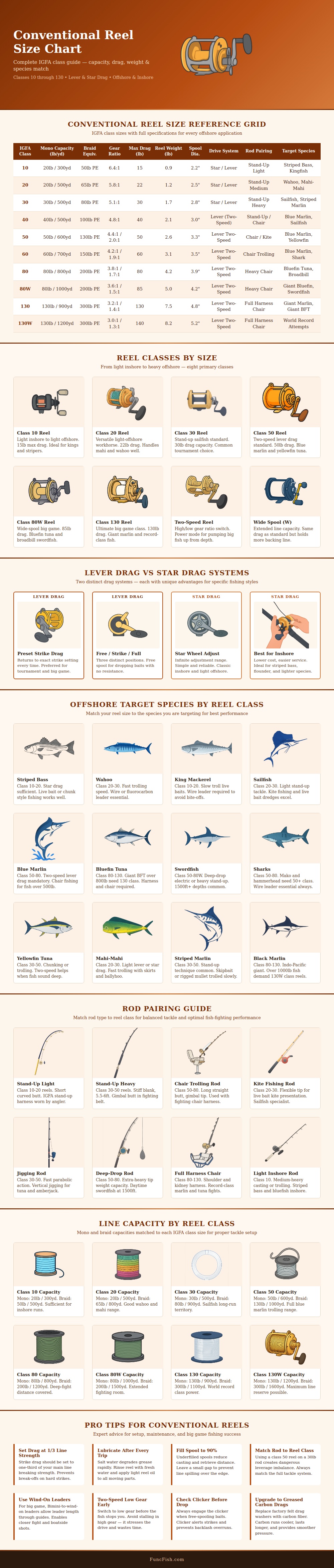
Selecting the proper fishing reel for the type of fish you are after requires that you select the correct reel class for your target species. Three main factor determine the class of a fishing reel: the power of the reel, the line capacity of the reel, and the drag strength of the reel. If the fishing reel you select is too small for the type of fish you are after, the fish may pull too much line off of the reel such that the drag system of the reel can no longer provide the required strength to hold the fish.
If the fishing reel you select is too large for the type of fish you are after, the fishing reel will be too heavy for you to effectively use when fishing. Therefore, prior to purchasing a fishing reel, you must utilize a size chart to understand the different size classes of fishing reels and what types of fish each of those classes are best suited for. Size charts provide information regarding the spool diameter and gear ratios of each of the different classes of fishing reels.
How to Pick the Right Fishing Reel
Fishing reel classes range from small inshore fishing reels to large big-game fishing reels. Anglers use small inshore fishing reels to catch species like kingfish or striped bass. Anglers use medium-sized fishing reels that are versatile enough to fish for a variety of fish species to catch species like mahi or sailfish.
Finally, large big-game fishing reels often feature two-speed lever drags. These two-speed lever drags allow anglers to use the high gear setting of the reel to quickly retrieve the line from the reel when the fish is close to the fishing boat, and to switch to the low gear setting of the reel to exert high torque on the fish when the fish is near the ocean floor. When the size of the fishing reel increases, the gear ratio of the fishing reel typically decreases.
In other words, a lower gear ratio allows the fishing reel to exert high torque, but at the expense of some of the retrieval speed with which the fishing reel can travel the line. There are two main types of drag systems for fishing reels: lever drags and star drags. Lever drags are characterized by having a variety of preset position into which the drag system can be set.
Lever drags can be set to different drag settings for different tasks, such as using the lever drag to set the line to the clear position when the bait is to be cast into the water, to the strike position to prepare for the catch of the fish, and then to the full position to exert the maximum amount of drag on the caught fish. Lever drags are often used in tournaments to fish for large amounts of time because the lever drag will always return to its exact preset position. Star drags are different than lever drags in that the drag utilizes a rotating wheel to vary the drag strength.
Thus, star drags allow anglers to make infinite adjustments in the drag strength with which the fishing reel will apply force to the caught fish. Additionally, star drags are typically lighter in weight and more easily serviced than lever drags. However, star drags dont have the same number of preset settings as lever drags.
The type of fish that you intend to catch will dictate the type of fishing reel class that you should use. You should use light setups for striped bass or kingfish, and you should use star drags for these species. For wahoo, you should use larger reels because wahoo can swim at high speeds.
You should use heavy reel classes and two-speed lever drags for blue marlin or yellowfin tuna so that you prevent the reel from stalling when the fish dives deep into the water. Species like bluefin tuna and black marlin are very large and require 130-class reels. If you do not use the proper class of reel for the species of fish that you are targeting, your line may snap or your reel may overheat.
A fishing reel must be paired with the appropriate fishing rod to ensure that the two work together to fight the fish. Light stand-up rods should be used with small class reels. A heavy stand-up rod should be used with medium class reels.
For large class reels, a chair rod with gimbal butts to lock into a fighting chair should be used. Pairing the incorrect rod with your reel will prevent the rod from providing the proper leverage for the fight with the fish. The size of the reel will determine the line capacity for that reel.
The smaller the reel, the less line it will hold. For example, the larger reels like the 80W and 130W models will hold a much larger amount of fishing line. You should ensure that your reel has enough line for the fish runs.
Fill the reel to 90% of the capacity and set the strike drag to one-third of the line test strength. Because salt water can damage the bearings in the fishing reel, it is a must to lubricate the reel after every fishing trip to prevent damage. There are several mistakes that you should avoid when you use a fishing reel.
Do not use a reel that is too large for the species of fish that you are targeting. Using a two-speed lever drag with the low gear will save your physical strength when you are using it for deep diving fish. Upgrading to carbon fiber drag components will allow for smoother pulls from the fish and will not overheat as quickly as metal drag components.