🎣 Crankbait Depth Guide Calculator
Estimate the running depth of any crankbait based on line type, diameter, cast length, and trolling speed
| Line Type & Test | Approx. Diameter | Depth Modifier | Best Crankbait Use |
|---|---|---|---|
| 6 lb Fluorocarbon | 0.008 in / 0.20 mm | +20% depth | Finesse, Trout, Panfish |
| 8 lb Fluorocarbon | 0.009 in / 0.23 mm | +15% depth | Bass, Walleye, Crappie |
| 10 lb Monofilament | 0.011 in / 0.28 mm | Baseline | All-purpose Bass, Walleye |
| 12 lb Monofilament | 0.013 in / 0.33 mm | –8% depth | Pike, Largemouth |
| 17 lb Monofilament | 0.015 in / 0.38 mm | –18% depth | Musky, Stripers |
| 20 lb Braid | 0.009 in / 0.23 mm | +5% depth | Cover fishing, Pike |
| 30 lb Braid | 0.011 in / 0.28 mm | Baseline equiv. | Heavy cover, Musky |
| Lead Core (per color) | ~1.7 mm | ~5 ft per color | Deep trolling, Walleye |
| Target Species | Typical Depth Zone | Recommended Line | Crankbait Style |
|---|---|---|---|
| Largemouth Bass | 2–15 ft | 10–14 lb Mono / Fluoro | Medium / Long Lip |
| Smallmouth Bass | 5–20 ft | 8–12 lb Fluoro | Long Lip Deep Diver |
| Walleye | 8–25 ft | 10 lb Mono / Lead Core | Long Lip / Lead Core |
| Trout (Stream) | 1–6 ft | 6–8 lb Fluoro | Short / Medium Lip |
| Northern Pike | 3–15 ft | 17–30 lb Braid + Leader | Medium / Long Lip |
| Musky | 5–20 ft | 50 lb Braid + Wire Leader | Large Magnum Diver |
| Striped Bass | 10–30 ft | 17 lb Mono / Lead Core | Magnum / Lead Core |
| Crappie | 2–10 ft | 6 lb Fluoro | Micro / Short Lip |
| Panfish / Bluegill | 1–5 ft | 4–6 lb Mono | Tiny Lipless |
| Speed (mph) | Depth Effect | Notes |
|---|---|---|
| 1.0–1.5 mph | Max dive depth | Slow roll for cold water |
| 1.5–2.0 mph | Near max depth | Ideal for walleye |
| 2.0–2.5 mph | Rated depth zone | All-purpose trolling |
| 2.5–3.0 mph | –10% shallower | Warm water bass |
| 3.0–4.0 mph | –20% shallower | Striper trolling |
| 4.0+ mph | –35% shallower | Speed trolling only |
| Cast Length (ft) | Depth % of Max | Metric Equiv. |
|---|---|---|
| 40 ft | ~55% depth | 12.2 m |
| 60 ft | ~70% depth | 18.3 m |
| 75 ft | ~80% depth | 22.9 m |
| 90 ft | ~88% depth | 27.4 m |
| 100 ft | ~93% depth | 30.5 m |
| 120 ft | ~98% depth | 36.6 m |
Controlling the depth of a crankbait is another necesary task for any angler who fish with these baits. The crankbait must be able to reach the depth where the fish are locate. If the crankbaits doesnt reach the depth where the fish are located, then the crankbaits will not be effectivly in their attempts to catch the fish.
There is many factors that determine or affect the depth of the crankbaits that travel through the water. These factors include the design of the crankbait bill, the type of line used when fishing with the bait, the speed at which the angler retrieves the crankbaits, and the angle of the fishing rod. The design of the crankbait bill can affect the depth at which the crankbaits travel.
How to Control the Depth of a Crankbait
For instance, manufacturers create squarebill crankbaits to deflect off rocks in the area and travel in shallow water. Squarebill crankbaits will stay in waters that is six feet deep or less. In contrast, longbill diver crankbaits are created to dive deeper into the water than the squarebill crankbaits.
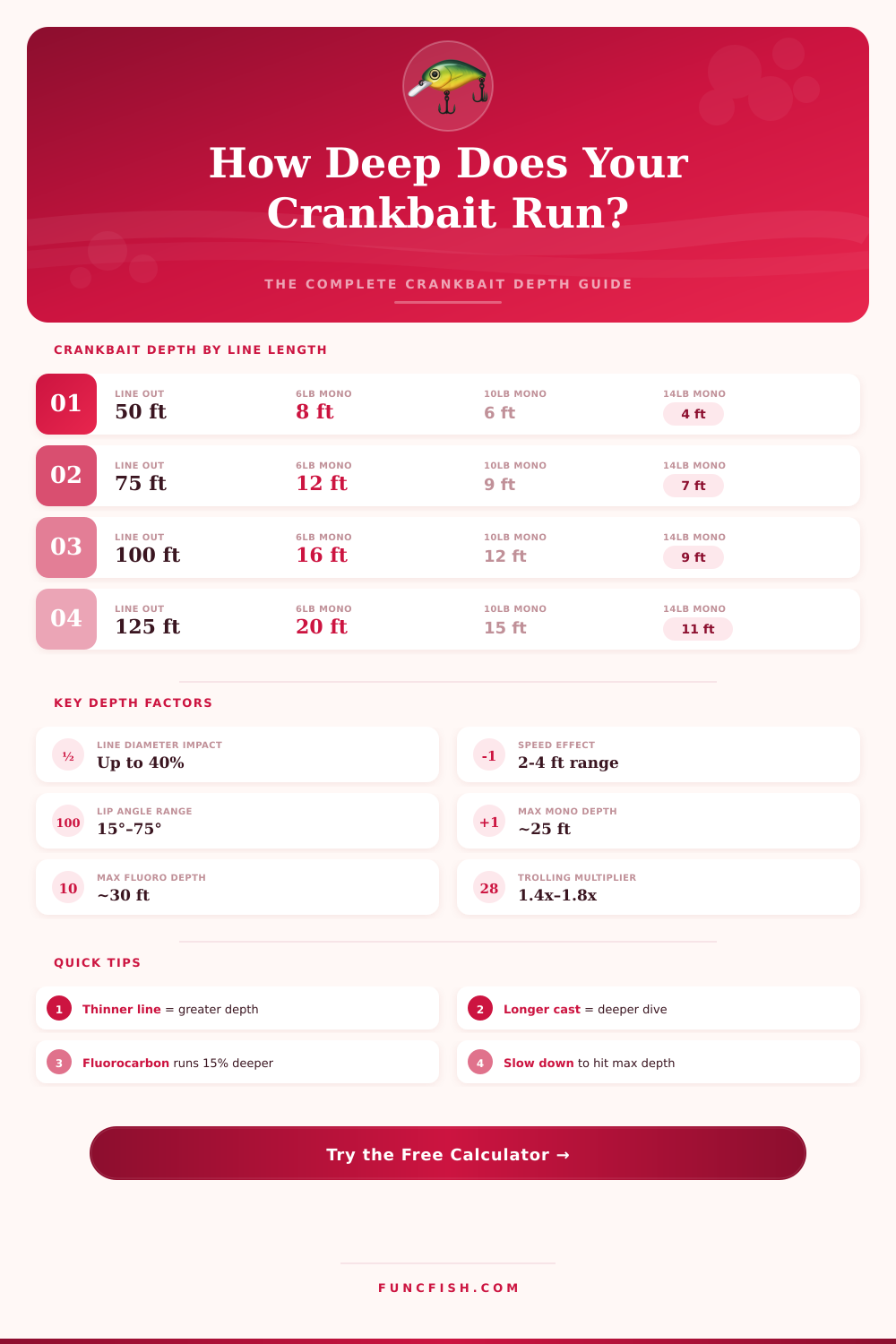
In order to allow these crankbaits to dive deeper into the water, angler must release a longer length of fishing line from the reel. Additionally, the type of fishing line used also affect the depth at which the crankbaits travel. If monofilament fishing line is used to fish with crankbaits, the line will remain buoyant on the waters surface due to the materials used to create the line.
Additionally, the stretchiness of the line will make it less precisely in the lines retrieval. However, if fluorocarbon or braided line is used, the lines are thinner than the monofilament line. Because these lines are thinner, there is less resistance in the water for the crankbaits to travel through, allowing them to dive deeper into the water.
Therefore, by using thinner lines, such as fluorocarbon or braided line, crankbaits will travel more deeper into the water than if using monofilament line. Furthermore, other factors that affect the depth of crankbaits include the speed at which the crankbaits are retrieved and the angle of the fishing rod used to retrieve the bait. If the angler retrieves the crankbaits at a faster rate, the crankbaits will rise towards the surface of the water due to the speed of the retrieval.
If the crankbaits are retrieved at a slower rate, the crankbaits will maintain their depth. Additionally, if the angler adjust the angle of the fishing rod to a 45-degree angle, the crankbaits will maintain their depth. However, if the fishing rod is lowered to a 30-degree angle, the crankbaits will dive deeper into the water.
Environmental condition, such as the clarity and the temperature of the water in which the crankbaits are being cast, can also impact the depth of the crankbaits. If the water is stained, the crankbaits will tend to travel shallower than if they were in clear water. Additionally, if the water temperatures is colder, the water will slow the dive of a flat-side crankbait.
Therefore, a slower retrieval rate may be necessary in areas with colder water temperature. A calculation tool can be use to calculate the depth of the crankbaits by inputting specific variable regarding the crankbaits and the fishing setup. These variables may include the type of crankbaits being used, the length of the fishing line, the type of fishing line, and the angle of the fishing rod.
The calculation tool will provide a score that indicate whether the setup of the crankbaits is appropriate for the depth at which the fish are located. If the score from the calculation tool indicate that the crankbaits will not reach the depth at which the fish live, adjustment must be made to the length of the fishing line, the type of fishing line used, or the angle of the fishing rod to ensure that the crankbaits will reach the depth where the fish are located. Therefore, the bill design, the type of fishing line, the retrieve speed, and the rod angle can control the depth of the crankbaits.
Depending upon the type of structure that live in the waters where fishing will occur, the crankbaits may need to be matched to those structures. Additionally, the crankbaits need to be tune to ensure that they travel to the depth where the fish live. By adjusting the fishing line and the rod angle, for instance, the angler can control the depth of the crankbaits to ensure they reach the location of the fish.