🐟 Fish Age from Otolith Calculator
Estimate fish age from otolith ring counts, species growth data, and otolith measurements
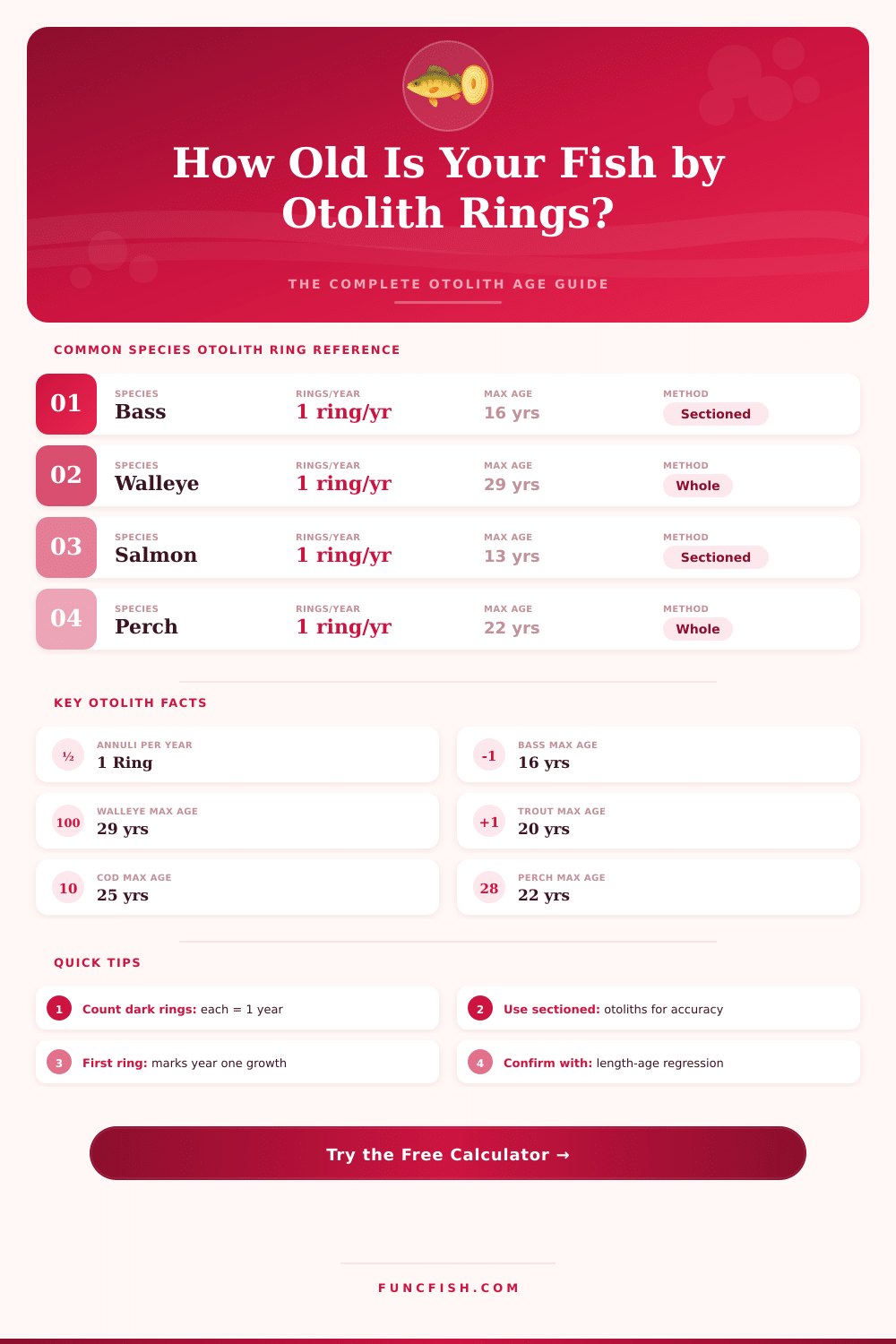
| Species | Annuli / Year | Max Known Age | Avg Otolith Radius (mm) | Preferred Method | Habitat |
|---|---|---|---|---|---|
| Largemouth Bass | 1 ring | 16 yrs | 2.8 – 4.2 | Whole / Sectioned | Freshwater |
| Walleye | 1 ring | 29 yrs | 3.5 – 5.8 | Sectioned | Freshwater |
| Atlantic Salmon | 1 ring | 13 yrs | 4.0 – 6.5 | Sectioned | Anadromous |
| Rainbow Trout | 1 ring | 11 yrs | 2.5 – 4.0 | Whole | Freshwater |
| Yellow Perch | 1 ring | 22 yrs | 2.2 – 3.5 | Whole | Freshwater |
| Atlantic Cod | 1 ring | 25 yrs | 5.0 – 8.5 | Sectioned | Marine |
| Bluegill | 1 ring | 10 yrs | 1.8 – 2.8 | Whole | Freshwater |
| Northern Pike | 1 ring | 24 yrs | 4.5 – 7.0 | Sectioned | Freshwater |
| Channel Catfish | 1 ring | 24 yrs | 3.8 – 6.0 | Sectioned | Freshwater |
| Summer Flounder | 1 ring | 12 yrs | 3.0 – 4.8 | Whole | Marine |
| Method | Accuracy Rating | Best For (Max Age) | Prep Time | Equipment Needed |
|---|---|---|---|---|
| Whole Otolith | High — young fish | Up to 8 yrs | 5–10 min | Light microscope |
| Sectioned Otolith | Very High | All ages | 30–60 min | Saw, microscope, dye |
| Ground / Polished | High | Up to 15 yrs | 20–40 min | Grinding wheel, scope |
| Burned / Charred | Medium–High | Up to 20 yrs | 10–15 min | Torch, black background |
| Age (yrs) | Avg Length (in) | Avg Length (cm) | Avg Weight (lb) | Avg Weight (kg) |
|---|---|---|---|---|
| 1 | 4–6 | 10–15 | 0.1–0.25 | 0.05–0.11 |
| 2 | 7–9 | 18–23 | 0.4–0.75 | 0.18–0.34 |
| 3 | 10–12 | 25–30 | 1.0–1.5 | 0.45–0.68 |
| 4 | 12–14 | 30–36 | 1.5–2.5 | 0.68–1.13 |
| 5 | 14–16 | 36–41 | 2.5–3.5 | 1.13–1.59 |
| 7 | 17–19 | 43–48 | 4.0–5.5 | 1.81–2.49 |
| 10 | 20–22 | 51–56 | 6.0–8.0 | 2.72–3.63 |
Figuring out the age of fish is like the method for guessing how old a tree is. Fish, like trees, form layers during growth. You can read them to find the age.
To age fish you usually check scales or one of the otoliths, which are inner ear bones.
How to tell a fish’s age
Researchers that want to know the age of fish, look for structures that grow slowly with time. The common methods are counting natural rings on scales, otoliths, vertebrae, fin spines, eye lenses, teeth, jaw bones, pectoral girdle or opercular series. Reading the rings, called annuli, in those parts, you find reliable age.
Every pair of annuli usually marks one year of growth. They show as dark and light strips on the scale. The first dark strip commonly shows the end of the first year, passed in freshwater during winter.
Depending on the season, fish have periods of slow and fast growth. During slow growth, otoliths form an opaque zone, during fast growth it becomes clear. Such pairs of areas mark one year.
New growth sometimes covers old rings, but you see them after breaking the otolith in half. In one lab someone aged a yelloweye rockfish at 121 eyars.
You can estimate fish age also by means of radiocarbon testing of otoliths. Those are found in vestibular organs for balance and acceleration, made from calcium carbonate and biominerals.
Scales are liked because of easy collection and preparation, if growth rings clearly appear regularly. For samples of species with fragile structures, like Atlantic herring or Atlantic mackerel, you freeze them whole four later processing in the lab.
Knowing ages of a cohort, a group of fish from the same birth year, helps a lot. The number of them drops each year. Known ages help to count deaths because of fishing or natural reasons.
When fish age, they grow bigger and move more slowly, so predators catch them easily. Almost always they get eaten before natural death. Some live only one year, others up to 50.
Pacific salmon commonly die after spawning, at 2 to 7 years. For instance Granddad, the lungfish at Shedd Aquarium, had anestimated age of 109 years.