🐟 Fish Headed & Gutted Weight Calculator
Estimate dressed, H&G, and fillet yield from whole fish weight — for any species
Typical Range
Typical Range
Typical Range
Typical Range
| Species | H&G Yield % | Dressed % | Fillet % | Steak % |
|---|---|---|---|---|
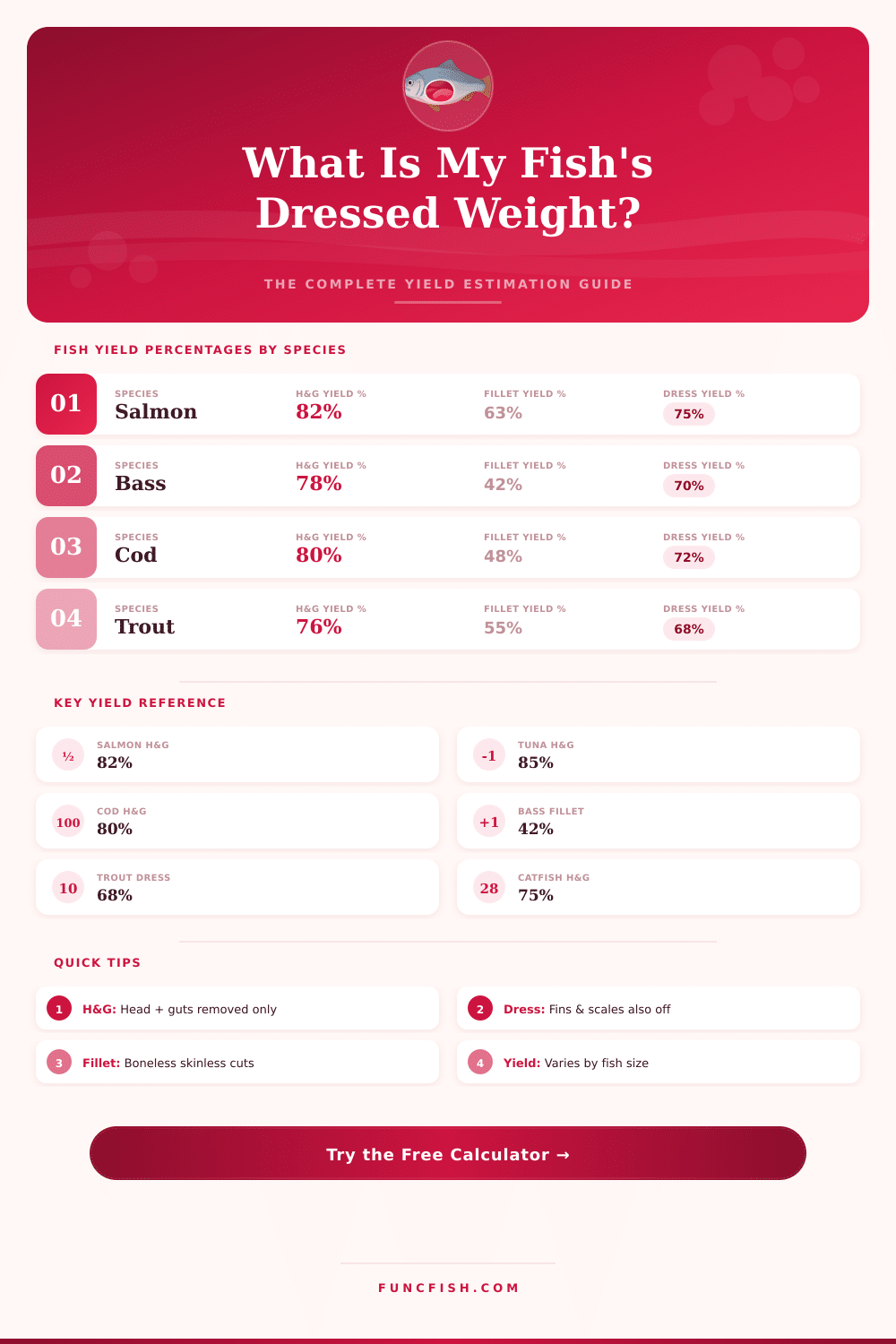
| Atlantic Salmon | 82% | 75% | 63% | 72% |
| Cod | 80% | 72% | 48% | 68% |
| Bass (Largemouth/Striped) | 78% | 70% | 42% | 65% |
| Trout (Rainbow/Brown) | 76% | 68% | 55% | 64% |
| Tuna (Yellowfin/Bluefin) | 85% | 78% | 62% | 75% |
| Catfish | 75% | 67% | 45% | 62% |
| Walleye | 79% | 71% | 44% | 66% |
| Tilapia | 77% | 69% | 38% | 63% |
| Halibut | 83% | 76% | 58% | 73% |
| Pike / Muskie | 74% | 66% | 40% | 60% |
| Size Class | Weight Range | Yield Adjustment | Notes |
|---|---|---|---|
| Small | Under 2 lb / 1 kg | –3% | Higher head-to-body ratio |
| Medium | 2–10 lb / 1–5 kg | 0% (baseline) | Standard yield applies |
| Large | 10–30 lb / 5–14 kg | +1% | More body mass per head weight |
| Trophy | Over 30 lb / 14 kg | +2% | Head proportionally smaller |
| Condition | Description | Yield Adjustment | Typical Scenario |
|---|---|---|---|
| Excellent | Fresh, well-fed, full body | +1% | Peak season catch |
| Good | Typical healthy catch | 0% (baseline) | Normal fishing conditions |
| Fair | Slightly lean or post-spawn | –2% | Late season / spawning run |
| Poor | Very lean or stressed fish | –4% | Stressed, drought conditions |
H&G means the head and internal organs are removed, but fins, scales, and skin remain. This is the most common commercial processing step. For most species, H&G yield ranges from 74%–85% of whole round weight.
Fillet yield depends heavily on species bone structure. Round fish like salmon yield more fillet than flat fish like flounder. Larger fish of the same species also tend to yield a higher fillet percentage because the body mass grows faster than head size.
Fish can sometimes get damaged when you weigh them. Using the right formula for the species you can quickly estimate the weight of a fish using a ruler. A fish weight calculator can help estimate the weight based on length and girth.
You can fairly exactly estimate the weight of a fish in pounds, without removing it from the water. Measure the length from the bottom jaw to the fork of the tail. Measure the girth around the thickest part.
How to Estimate Fish Weight
The formula is: girth times girth times length, divided by 800, that gives the weight in pounds. For instance, for 15-inch girth and 29-inch length, just plug those numbers into the formula.
Another example: a fish 20 inches long with 15-inch girth would weigh around 5.63 puonds by means of that same formula. The goal is to measure without too much stress on the fish.
For many species it is possible to estimate weight only from length. Measure the total length from mouth to tail, then check the table for that species. The weights listed are based on averages of every fish species across New York State.
When you study the math of fish weight, the standard equation uses an exponent close to 3.0 for most species. The coefficient varies by species. If the exponent goes past three for a species, that species usually becomes relatively more plump or has more girth wile it grows longer.
That is pretty interesting when you think about it.
Even so, length-based systems can be unfair. For instance, a really skinny 31-inch pike could seem to weigh 8.5 pounds on a chart, but actually only be 3 to 4 pounds. The biggest pike by weight and the biggest pike by length are not always the same fish.
Formulas with girth are probably more accurate for species like pike.
There is also a kitchen tool called a fish weight. It presses a filet down, so that the skin can crisp up while the meat cooks evenly. It comes in a fabric bag inside a cardboard box.
It is well made, has the right weight, easy to clean, and happy in a pass-through dishwasher. Some folks suggest checking antique stores for a small old clothes iron that works the same way, since that is just a metal weight with a handle.
For weighing fish directly, a scale with a lip gripper built in is the best way to go. Clip the gripper to the center of the bottom jaw. If the scale only has a hook, use it with a separate pair of lip grippers andjust tare the weight of that tool.