🐟 Fish Maturity Size Calculator
Determine if a fish has reached sexual maturity based on species, length, and water type
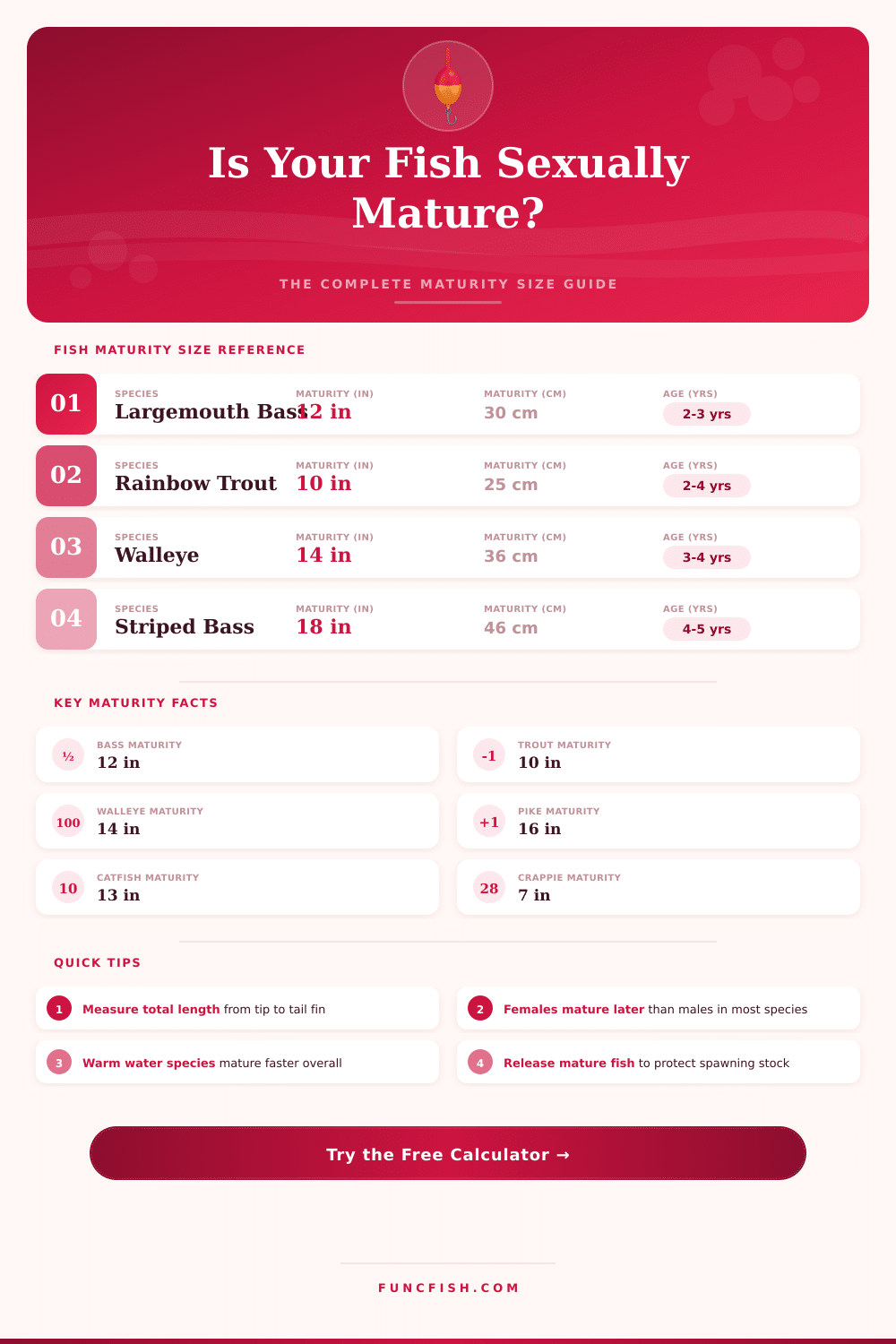
| Species | Min Maturity (in) | Min Maturity (cm) | Typical Age (yrs) | Max Length (in) | Water Class |
|---|---|---|---|---|---|
| Largemouth Bass | 12 in | 30 cm | 2–3 | 29 in | Warm |
| Smallmouth Bass | 10 in | 25 cm | 2–4 | 27 in | Cool |
| Striped Bass | 18 in | 46 cm | 4–5 | 60 in | Cool |
| Rainbow Trout | 10 in | 25 cm | 2–4 | 45 in | Cold |
| Brown Trout | 12 in | 30 cm | 2–4 | 47 in | Cold |
| Brook Trout | 6 in | 15 cm | 1–2 | 26 in | Cold |
| Walleye | 14 in | 36 cm | 3–4 | 36 in | Cool |
| Northern Pike | 16 in | 41 cm | 2–3 | 52 in | Cool |
| Muskellunge | 28 in | 71 cm | 4–6 | 72 in | Cool |
| Channel Catfish | 13 in | 33 cm | 3–5 | 52 in | Warm |
| Black Crappie | 7 in | 18 cm | 2–3 | 19 in | Warm |
| Bluegill | 5 in | 13 cm | 1–2 | 16 in | Warm |
| Yellow Perch | 6 in | 15 cm | 2–3 | 18 in | Cool |
| Common Carp | 14 in | 36 cm | 3–4 | 47 in | Warm |
| Species | Condition Factor (K) | Good Weight @ 12 in (lb) | Good Weight @ 30 cm (kg) |
|---|---|---|---|
| Largemouth Bass | 0.90–1.10 | 0.9–1.1 lb | 0.41–0.50 kg |
| Rainbow Trout | 0.85–1.05 | 0.7–0.9 lb | 0.32–0.41 kg |
| Walleye | 0.75–0.90 | 0.6–0.8 lb | 0.27–0.36 kg |
| Northern Pike | 0.60–0.75 | 0.5–0.6 lb | 0.23–0.27 kg |
| Channel Catfish | 0.85–1.00 | 0.7–0.9 lb | 0.32–0.41 kg |
| Bluegill | 1.05–1.25 | 0.3–0.4 lb | 0.14–0.18 kg |
| Temp Class | Range °F | Range °C | Growth Rate | Maturity Adjustment |
|---|---|---|---|---|
| Warm Water | >70°F | >21°C | Fast | −0.5 to −1.0 yr earlier |
| Cool Water | 55–70°F | 13–21°C | Moderate | No adjustment (baseline) |
| Cold Water | <55°F | <13°C | Slow | +0.5 to +1.5 yr later |
Fish maturity size is simply the length or size when a fish becomes ready to breed for the first time. The typical length at which fish of a given population mature first is called the length at maturity. Various methods help to estimate the average size at first maturity.
For instance you can draw the cumulative percentage curve of mature fishes against size. Another way is plotting the condition factor against size. This way you get a clear estimate of the maturity size in the population.
How Big Fish Are When They First Breed
Combining data about fish size with age info, you find clues about growth. If you know the age of fish, that helps to estimate death rate because of fishing and natural causes. Knowing how many years pass before fish matures is important for managing fish populations.
Many food fish, like salmon, cod bass and flounder, reach sexual maturity and full size in 2 to 5 years. Later they grow more slowly until death.
Deep sea fish is a whole different story. Because of limited food they grow slowly, have slow metabolism and low breeding rates. Many reach breeding maturity only after 30 to 40 years.
The deep sea orange roughy matures at around 25 years and can live until 125 years. A fillet of orange roughy at the store probably has at least 50 years.
The environment of fish, food availability and genetics all affect the growth rate to full size. Mature individuals weigh more, are longer and have better condition than immature young-of-the-year fish, which shows the role of individual growth rates during maturity. The proportion of maturing young-of-the-year fish grows with the size of fishes.
Surviving to sexual maturity and being able to contribute to the gene pool show fitness of an individual. Together those surviving fish decide the survival of the population. Size limits in grouper fishing, for instance, can create strong pressure for fish that mature earlier.
Only those that mature quickly have a chance to breed and pass on their genes. Even so size limits also help fish that simply grow very fast.
High ocean harvest commonly causes a decline in body size. If the harvest is strong, only fish return to spawn that escape it as soon as possible. Fish that mature at a smaller size are the ones that most commonly breed.
Decreases in lengths at maturity are at least partly because of fishing. Good fisheries management requires precise ratings of biological values, including growth rates, reproduction andsize at sexual maturity.