Fish Population Estimator
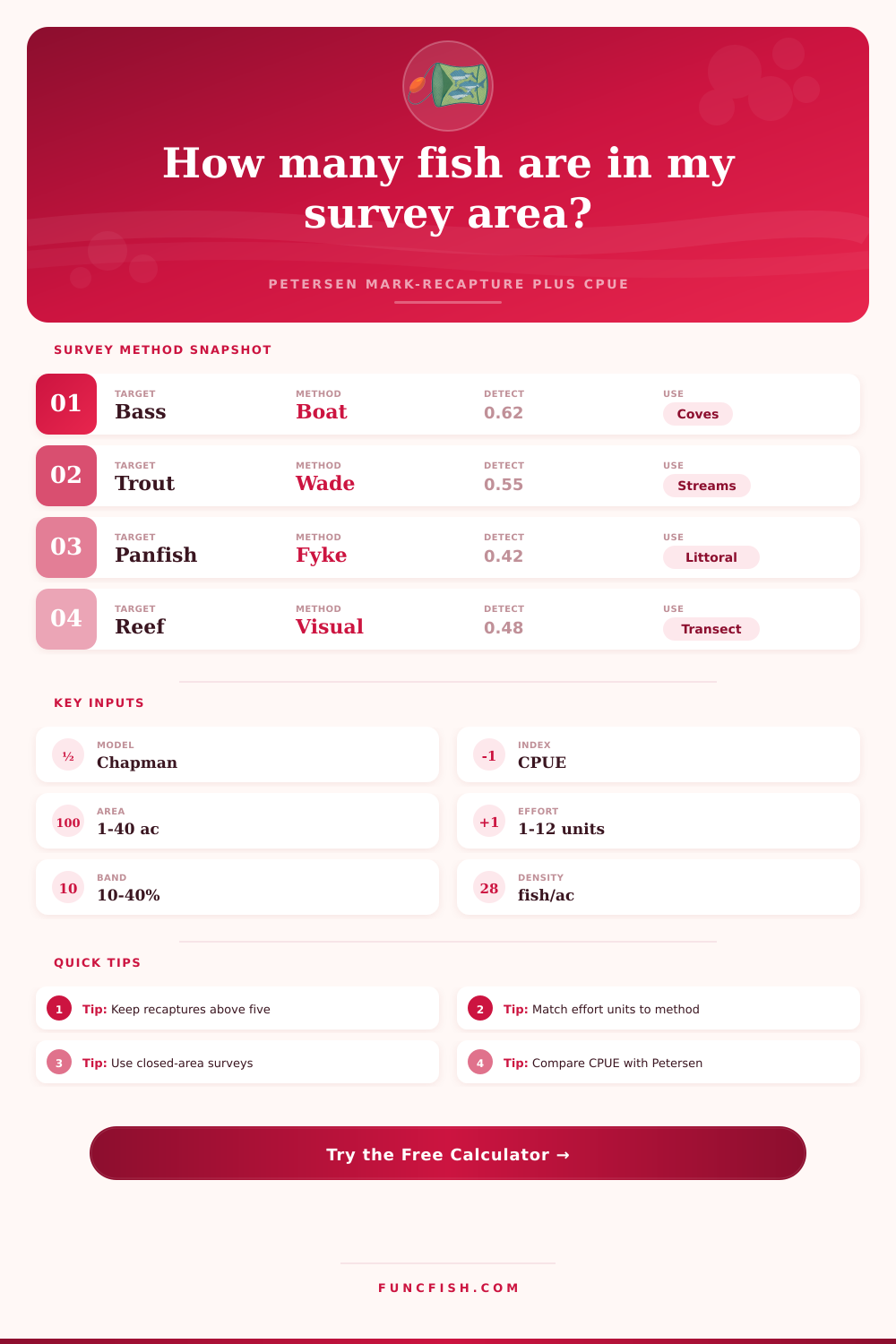
Estimate abundance from marked fish, second-sample catch, recaptures, survey area, habitat type, detection method, CPUE effort, and confidence adjustment.
📌Survey presets
⚙Population inputs
Fish population estimate
Calculation breakdown
🎣Detection method data
Boat Electro
Fyke Nets
Seine Haul
Visual Belt
📊Species and method comparison
Bass Cove
Boat electrofishing often tracks shoreline predators well in closed coves.
Trout Reach
Wade electrofishing suits short stream reaches with block nets or natural breaks.
Catfish Bend
Hoop nets index larger fish, so detection correction matters more than for visual surveys.
Reef Transect
Visual counts depend on water clarity, diver speed, and fish shelter behavior.
📘Reference tables
| Recapture signal | Typical recaptures | Petersen weight | Range behavior | Field note |
|---|---|---|---|---|
| Weak | 1-4 fish | Low | Very wide | Add CPUE support |
| Usable | 5-9 fish | Moderate | Wide | Check mark mixing |
| Good | 10-19 fish | High | Stable | Good estimator core |
| Strong | 20+ fish | Very high | Tighter | Watch closure only |
| Detection method | Effort unit | Coverage used | Detectability | Best habitat |
|---|---|---|---|---|
| Boat electrofishing | Shock hour | 2.40 ac | 0.62 | Lake shoreline |
| Wade electrofishing | Shock hour | 0.55 ac | 0.55 | Stream reach |
| Fyke net set | Net night | 0.38 ac | 0.42 | Vegetated bays |
| Hoop net set | Net night | 0.28 ac | 0.34 | River bends |
| Snorkel transect | Transect | 0.22 ac | 0.58 | Clear streams |
| Habitat type | Visibility effect | CPUE correction | Mark concern | Useful method |
|---|---|---|---|---|
| Clear littoral shelf | High | 0.95 | Low | Boat electro |
| Vegetated cove | Moderate | 1.18 | Moderate | Fyke net |
| Woody backwater | Low | 1.28 | Moderate | Hoop net |
| Turbid river margin | Low | 1.34 | High | Hoop or seine |
| Reef structure | Variable | 1.15 | Movement | Visual belt |
| Species group | CPUE response | Recapture pattern | Common bias | Comparison note |
|---|---|---|---|---|
| Bass and sunfish | Balanced | Good | Shoreline crowding | Blend works well |
| Trout or char | Effort sensitive | Strong | Block net leakage | Petersen favored |
| Catfish set | Gear selective | Fair | Bait attraction | Use wider band |
| Carp or buffalo | Patchy | Variable | Schooling pulses | Need more effort |
| Reef visual fish | Visibility linked | Limited | Hiding response | CPUE favored |
💡Estimator tips
Recaptures drive Petersen: A small recapture count can produce a very large population estimate. Use the confidence dropdown and compare against CPUE before treating the number as a field conclusion.
Keep CPUE units clean: Change the detection method before entering effort so the effort field matches shock hours, net nights, transects, trap arrays, or seine hauls.
Fish population survey are used to estimate the total number of fish that live in a body of water. Because it is not possible to count every single fish that lives in a body of water, mathematical method are employed to provide an estimation of the total number of fish in that environment. Knowing the number of fish in a body of water is helpful for humans in that it helps individuals to determine both the number of fish that should be stocked into a lake, as well as how many fish should be harvested from that lake.
Therefore, if the estimate of the total number of fish in a lake is incorrect, the management of that fish population will be based off incorrect data. One of the main methods that is utilized to estimate the total number of fish in a body of water is known as the mark recapture method. More specifically, the Petersen method is one of the common method of utilizing the mark-recapture method to estimate total fish population.
How to Count Fish in a Lake
To utilize the mark-recapture method, an individual must catch a group of fish from a body of water, mark those fish, and release those fish back into the water. After the fish have had time to rejoin the remainder of the fish in the body of water, a second group of fish are caught. When the second group of fish are caught, the proportion of marked fish to total fish in the second sample can be used to determine the total fish population of the body of water.
For instance, if 100 fish are marked and 10 of those marked fish are caught in a second sample of 100 fish, the total population of fish in that body of water is 1,000 fish. To calculate the proportion of marked fish to total fish, people often utilize the Chapman modification to the Petersen method to ensure that error in division do not lead to inaccuracies in the estimated total fish population. Furthermore, the Petersen method is also often combined with catch-per-unit-effort calculation, especially since the Petersen method can be inaccurate if the number of recaptured fish is small.
Catch-per-unit-effort, or CPUE, is another method that can be used to estimate the total number of fish in a body of water. CPUE measures the number of fish that are caught during a specific amount of time or with a specific amount of fishing effort. For instance, CPUE may be calculated as the number of fish that are caught per hour of electrofishing effort, or the number of fish that are caught per fishing night with a net.
However, the number of fish that are actualy counted using this method may not always reflect the true population of fish in the body of water. For instance, some fish may hide in the weeds within a lake, or may move away from the fishing efforts. Thus, detection rates will be higher for fish that are more easily spotted, such as during boat electrofishing in clear water, and lower for areas that is murky water.
Furthermore, the habitat in which these efforts occur may also affect the CPUE value; different habitat may make it easier or harder to fish for fish. Therefore, another factor to consider when calculating fish population estimates with the CPUE method is the habitat where the population is to be estimated. In combining the Petersen method and the CPUE method for estimating total fish population, the determination of in what proportion to weight each estimate can change based upon the total number of fish that are recaptured during the Petersen method.
For instance, if the number of fish that are recaptured is high, it is appropriate to place more weight on the Petersen method’s estimate of total fish population. However, if the number of fish that are recaptured is low, it is more appropriate to weight the estimate from the CPUE method more heavily. Thus, utilizing both methods to estimate total fish population ensures that the estimate is not inaccurate as a result of one method alone.
Within the program, there are presets that can be created that allow individuals to estimate the population of fish for common scenario. For example, a preset can be created for estimating the number of trout that live in a stream, or the number of bluegill fish that live in a bay. Each of these presets has a marked batch of approximately 100 fish and a specific amount of effort for that environment preloaded into the preset.
However, each of these presets can be adjusted to account for the different behaviors of different fish species. For example, carp tend to move in groups, while trout tend to remain in one location in their habitats of riffle areas. Furthermore, the presets also include confidence slider that allow for the individual to account for the potential change of the fish population within the body of water.
For instance, if the body of water is an open area in which fish may leave the area, a wider confidence band should be used. However, if the body of water is a closed area in which the fish cannot leave, a narrow confidence band should be used within the preset population estimation. Within the program, there are also common mistake that should be avoided during the performance of fish population surveys.
For instance, if the area in which the fish are being surveyed is not closed off from the remainder of the body of water, the fish may leave the area that is being surveyed. Thus, the population estimate will likely be too low. Additionally, if the fish are only sampled in one specific spot within the body of water, the estimate will be based upon only specific condition within the body of water, and the population within that area may not accurately reflect the population of all of the fish in that body of water.
Furthermore, it is important to ensure that the marks are placed on the fish and that they dont fall off. If the marks fall off the fish that were sampled, the mark-recapture method will provide an incorrect estimate of the total fish population. Finally, it is important to make sure that the unit of effort is correctly entered into the program.
For instance, if fishing with a net, the unit of effort is “net-nights”, but if using electrofishing methods, the unit of effort is “shock hours”.