🐟 Fish Slot Limit Checker
Enter your fish length and species to instantly determine if it is a legal keeper, must be released, or falls within the protected slot limit
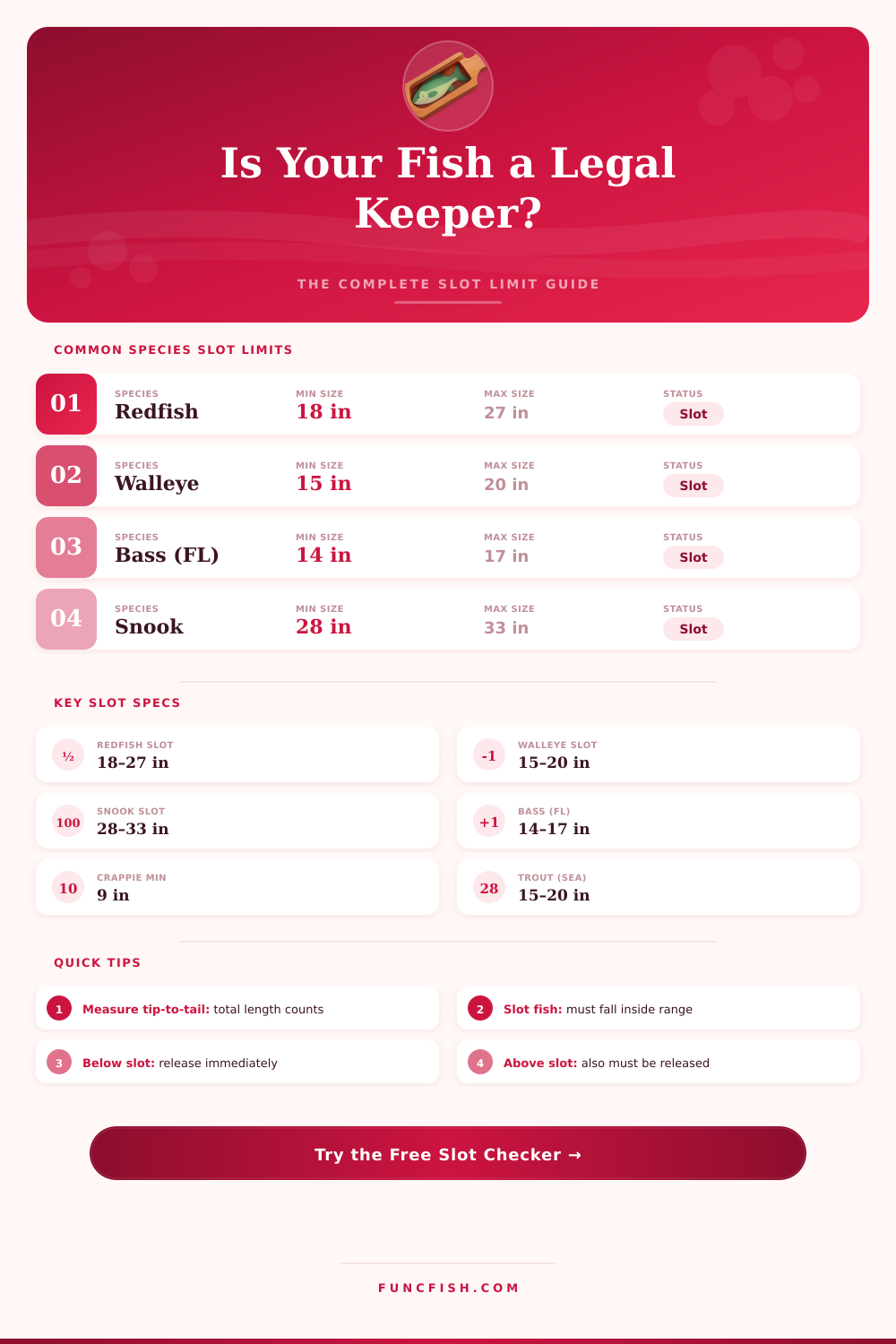
| Species | Min Size (in) | Max Slot (in) | Min Size (cm) | Max Slot (cm) | Slot Type | Typical Daily Limit |
|---|---|---|---|---|---|---|
| Redfish (Red Drum) | 18 | 27 | 45.7 | 68.6 | Hard Slot | 1–2 |
| Snook | 28 | 33 | 71.1 | 83.8 | Hard Slot | 1 |
| Spotted Seatrout | 15 | 20 | 38.1 | 50.8 | Slot Limit | 5 |
| Walleye | 15 | 20 | 38.1 | 50.8 | Protected Slot | 5–6 |
| Largemouth Bass (FL) | 14 | 17 | 35.6 | 43.2 | Slot Limit | 5 |
| Smallmouth Bass | 12 | — | 30.5 | — | Minimum Only | 5 |
| Crappie | 9 | — | 22.9 | — | Minimum Only | 25–30 |
| Striped Bass (Atlantic) | 28 | 35 | 71.1 | 88.9 | Slot Limit | 1–2 |
| Flounder | 12 | — | 30.5 | — | Minimum Only | 10 |
| Northern Pike | 24 | 36 | 61.0 | 91.4 | Protected Slot | 2–3 |
| Muskellunge | 36 | 54 | 91.4 | 137.2 | Slot Limit | 1 |
| Channel Catfish | 12 | — | 30.5 | — | Minimum Only | 10–15 |
| Method | Description | Typical Difference vs Total | Used By |
|---|---|---|---|
| Total Length | Tip of mouth to end of tail (pinched) | Baseline (0%) | Most state regs |
| Fork Length | Tip of mouth to middle fork of tail | −3 to −5% | Tuna, Salmon, Striped Bass |
| Standard Length | Tip of mouth to base of tail fin | −8 to −12% | Scientific / Research |
| Tip-to-Fork (Compressed) | Tail compressed flat, measured to fork | −2 to −4% | Billfish, Tuna |
| Condition | Revival Time | Release Method | Survival Rate |
|---|---|---|---|
| Excellent | < 10 sec | Immediate side-slip release | 98–99% |
| Good | 10–30 sec | Hold upright, gentle swish | 95–98% |
| Stressed | 1–3 min | Upright in water, gentle movement | 80–95% |
| Exhausted | 3–8 min | Extended upright support, shade | 60–80% |
A fish slot limit is a way of fishing management that controls the size of fish for legal harvest only in a set length range or “slot”. You must release fish that are too small or too big for that range but you can keep those that fit. That limit usually bans keeping fish of a certain size, but in other cases it allows harvest only in that range.
Biologists use slot limits to improve the growth rate of fish populations. This protects certain size groups to keep healthy breeding populations and trophy-class specimens. The main reason to start such protected limits is to help anglers have better chances in a particular body of water or several.
How Fish Slot Limits Work
Here is how a protected slot limit works. For instance, a limit of 13 to 16 inches allows you to harvest only fish under 13 or above 16 inches while you leave those between 13 and 16. A harvest slot limit works differently: it allows you to keep only fish inside the defined length range.
Slot limits probablly are the most misunderstood of fish size rules, compared with minimum or maximum length. North Dakota now does not have such slot rules. But many states do: Maine, New Hampshire, Massachusetts, Rhode Island, Connecticut, New York, New Jersey, Pennsylvania, Delaware, Virginia and North Carolina all started to use slot limits recently.
Maryland uses a slot limit for fish caught in the ocean.
Slot limits put the fish pressure on year classes when they pass through the harvestable slot. They also leave more fish in the water. In the Chesapeake Bay for sport fishing, including charter boat fishing, you introduced a limit of 19 to 24 inches with a bag limit of one fish per person per day.
Occasionally you catch only fish outside the slot. With a limit of 19 to 24 inches you can take unders and overs, but occasionally go home without dinner.
Creel or bag limits usually help to avoid over-harvest and spread the harvest more in the long term between several anglers. For instance, for a “slot” Red Drum between 18 and 27 inches you can keep them, but fish below you must release, and those over only with a special tag for red drum.
When size limits leave too much freedom to people, you risk too much harvest and endanger the fish populations. A closed season in the EEZ helped well for red drum as management. Seasons and size limits together with slot limits probably will be more strict than current rules, because of the bigger number of fish inside the slotlimit.