How Long Is a Fishing Kayak Calculator
Estimate a practical fishing kayak length from angler size, water type, stability needs, stand-up fishing, gear load, drive style, handling preference, and transport limits.
📌Kayak fishing presets
⚙Fishing kayak fit inputs
Fishing kayak size recommendation
Calculation breakdown
🛶Gear and spec comparison grid
Short Paddle Hull
All-Round Sit-On
Stable Stand-Up
Long Pedal Hull
📊Fishing kayak reference tables
| Water type | Typical length | Why it fits | Handling note |
|---|---|---|---|
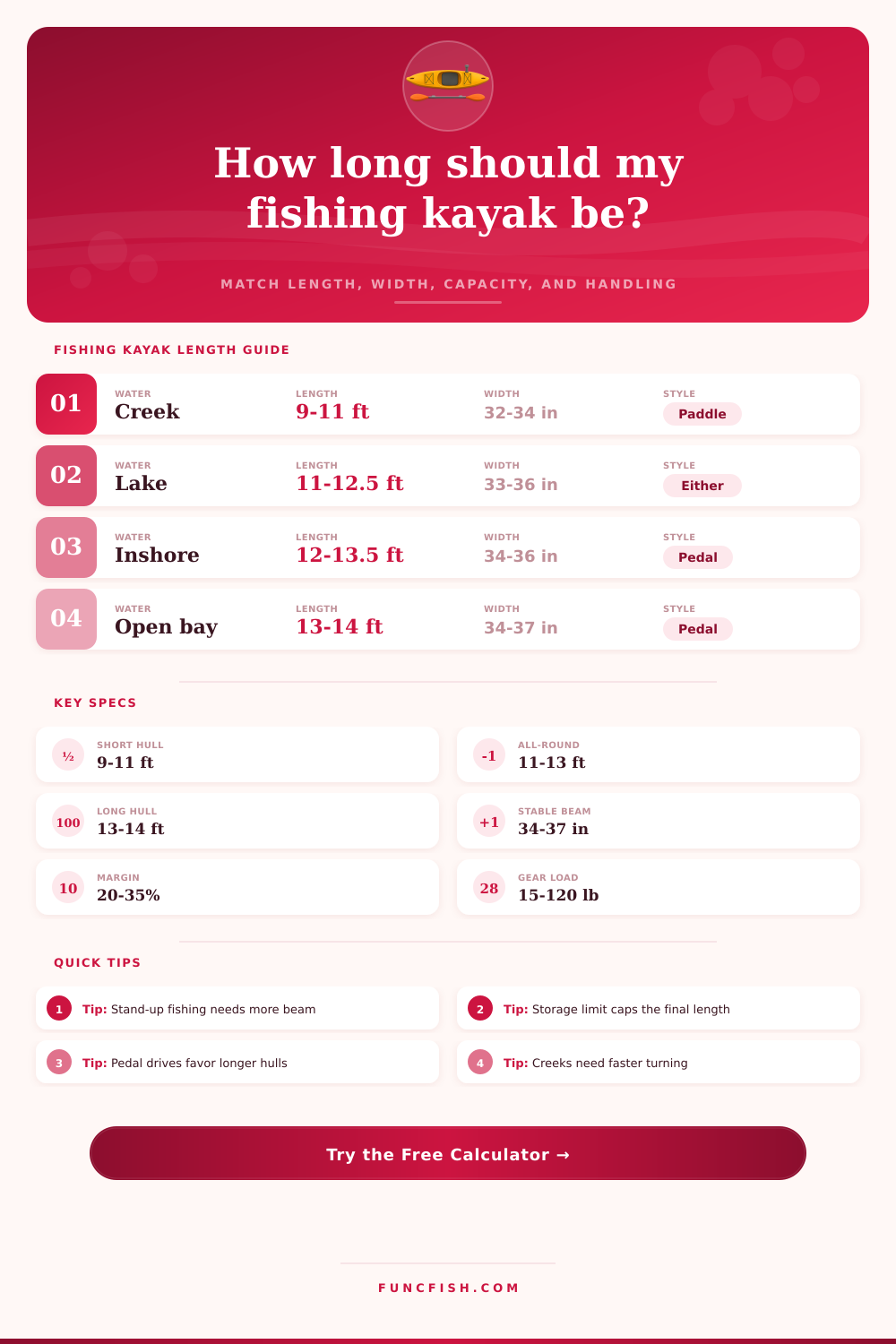
| Pond / protected cove | 9.5 to 11.5 ft / 290 to 351 cm | Shorter hull is easy to launch and turn around docks. | Choose beam before length if standing matters. |
| Tight creek / backwater | 9 to 11 ft / 274 to 335 cm | Less length keeps the bow from hanging in bends. | Tracking fins or rudders help on open reaches. |
| River current | 10.5 to 12.5 ft / 320 to 381 cm | Moderate length balances ferrying, turning, and line control. | Avoid overlong hulls in tight current lanes. |
| Small lake | 11 to 12.5 ft / 335 to 381 cm | Enough glide for crossing coves without feeling sluggish. | Works well for paddle or pedal layouts. |
| Large lake / reservoir | 12 to 13.5 ft / 366 to 411 cm | Longer waterline improves cruising and wind tracking. | Rudder control becomes more valuable. |
| Inshore marsh / flats | 12 to 13.5 ft / 366 to 411 cm | Handles gear, pedal drive weight, and moderate chop. | Keep draft and deck layout in mind. |
| Open bay / windy water | 13 to 14 ft / 396 to 427 cm | More waterline holds course better across exposed water. | Confirm transport and storage before sizing up. |
| Stability class | Width range | Best use | Tradeoff |
|---|---|---|---|
| Quick paddle | 30 to 32 in / 76 to 81 cm | Light tackle, seated casting, faster strokes. | Less forgiveness with high seat positions. |
| Balanced fishing | 32 to 34 in / 81 to 86 cm | Most seated anglers with crate and rods. | Moderate glide and moderate deck stability. |
| High stability | 34 to 36 in / 86 to 91 cm | Larger anglers, pedal drives, calmer stand-up work. | More hull to push while paddling. |
| Maximum platform | 36 to 38 in / 91 to 97 cm | Frequent standing, sight casting, heavier kits. | Turns slower and catches more wind. |
| Total load | Useful margin | Capacity target | Reading the result |
|---|---|---|---|
| Under 220 lb / 100 kg | 20 to 25 percent | 275 to 295 lb / 125 to 134 kg | Light paddlers can keep length compact. |
| 220 to 300 lb / 100 to 136 kg | 25 to 30 percent | 300 to 390 lb / 136 to 177 kg | Common fishing range for all-round kayaks. |
| 300 to 380 lb / 136 to 172 kg | 30 to 35 percent | 410 to 515 lb / 186 to 234 kg | Look for more beam and deck volume. |
| Over 380 lb / 172 kg | 35 percent plus | 515 lb plus / 234 kg plus | Prioritize capacity before speed claims. |
| Drive style | Length tendency | Width tendency | Fit note |
|---|---|---|---|
| Paddle kayak | Can stay shorter | Moderate beam helps stroke clearance | Too much width makes long paddles tiring. |
| Pedal-drive kayak | Adds about 0.5 to 1 ft | Often 34 in or wider | Extra length offsets drive and hull weight. |
| Motor-ready kayak | Favors 12.5 ft plus | Stable platform preferred | Plan capacity for battery and mount weight. |
| Storage-limited kayak | Cap at available space | Use beam for stability | Accept less tracking if the hull must fit. |
💡Calculator notes
Capacity tip: A fishing kayak can float at its printed capacity, but it usually fishes better when angler, drive, and gear stay well below that ceiling.
Handling tip: Longer hulls track and glide better; shorter hulls turn faster around timber, docks, grass edges, and narrow current lanes.
When you are choosing a fishing kayak, you must consider its length. The length of the fishing kayak will determine in what type of water the fishing kayak can perform. For instance, a short fishing kayak will find it easy to turn when maneuvering in tight area, but may become difficult to control if there is any winds.
In contrast, a long fishing kayak will find it easy to travel in a straight line, but may be difficult to turn when navigating narrow area. Thus, you will have to decide whether you want a fishing kayak that turns quick, or one that travels in a straight line. The type of water in which you will be fishing will dictate the length of the fishing kayak that you should purchase.
How to Choose a Fishing Kayak
If you will be fishing in ponds or other areas with many dock and branches, a short fishing kayak will be helpful in that it can turn quickly to maneuver in these tight area. However, if you are fishing in large area of water, such as lakes, a short fishing kayak may make it difficult for you to maneuver, as the wind may push the kayak sideways. In these cases, purchasing a long fishing kayak will allow it to slice through the water and waves, and will allow the kayak to stay on a designated path.
Additionally, your size will play a role in the purchase of your fishing kayak. For instance, if you are tall, you will need a fishing kayak with a large cockpit to fit in. Similarly, if you are a heavy person, you will need a fishing kayak with more capacity for your weight.
The level of stability that you want from your fishing kayak is another factor to consider when you are purchasing one. Fishing kayaks that are narrow will be faster when moving through the water, but tend to be less stable; they may tip when the individual move within the kayak. In contrast, fishing kayaks that are wider offer more stability, which is better for individuals who intend to stand within there fishing kayak.
Thus, if you plan to stand within your fishing kayak, you will need to purchase a fishing kayak that is wide. Additionally, if you plan on adding a pedal drive to your fishing kayak, you should opt for a longer model; the weight of the pedal drive will shift the balance of the kayak, and a longer fishing kayak will allow the kayak to track in a straight line. The amount of gear that you will be carrying when you go fishing will play a role in the purchase of your fishing kayak.
Your fishing kayak will have to account for the weight of your fishing rods, coolers, and any fishing electronic. The fishing kayak should have a capacity that can hold twenty to thirty-five percent more than the total weight of the gear that you will carry when fishing. By purchasing a fishing kayak with this capacity, you ensure that it will remain stable and dry when you are fishing.
If you do not purchase a fishing kayak with enough capacity, the weight of your gear will cause the fishing kayak to sink lower into the water. By sinking lower into the water, the fishing kayak will lose its ability to remain stable and to maintain its fishing speed. There are some common mistake that many individuals make when they are purchasing a fishing kayak.
One such mistake is purchasing a long, touring fishing kayak for their intention of fishing. These types of fishing kayaks are generally difficult to manage when they are loaded with the gear that is needed for fishing. Another mistake that many individuals make is ignoring the weight capacity of their fishing kayak.
If a fishing kayak is close to its maximum weight capacity, then it will be unstable, and the water may come over the sides of the kayak. Finally, the final mistake that many individuals make when purchasing a fishing kayak is that they do not consider the manner in which they will have to transport their fishing kayak. If their fishing kayak is very long, they may encounter difficulty to transporting it on a car rack or into a storage area.