Fishing Kayak Load Distribution Calculator
Balance paddler weight, tackle, battery, cooler, tankwell gear, and hatch loads against payload capacity, trim target, beam stability, and fishing conditions.
📌Scenario presets
⚙Kayak and load settings
Kayak load balance forecast
Full breakdown
📋Kayak platform reference grid
Sit-on-top
Wide standup
Pedal drive
Motorized
📐Load and trim reference tables
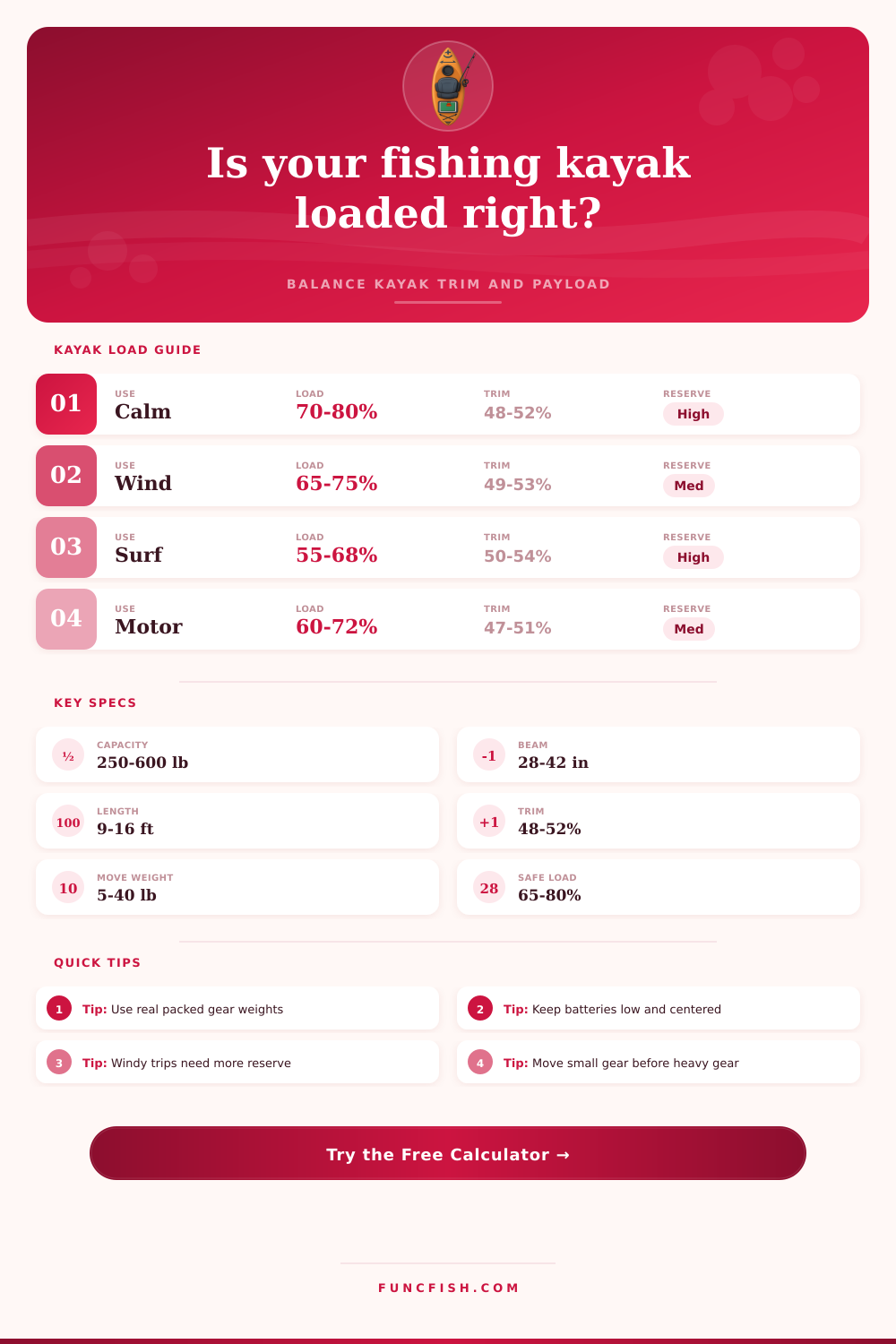
| Payload zone | Capacity used | Reserve meaning | Fishing use |
|---|---|---|---|
| Light | Under 55% | High freeboard reserve | Short tackle trips and open deck fishing |
| Balanced | 55-72% | Good reserve for chop | Most kayak fishing days |
| Heavy | 72-82% | Lower scupper and deck margin | Calm water only unless very stable |
| Crowded | Over 82% | Little reserve for waves | Reduce load before rough water |
| Center of load | Trim feel | Likely symptom | First correction |
|---|---|---|---|
| Under 46% | Stern heavy | Bow rides high and wind pushes bow | Move crate, battery, or cooler forward |
| 46-48% | Slight stern bias | Good for chop if reserve is high | Shift small tackle forward if needed |
| 48-52% | Neutral trim | Balanced tracking and turning | Keep dense gear low and centered |
| 52-54% | Slight bow bias | Tracks well but may plow in waves | Move dry bag or anchor aft |
| Over 54% | Bow heavy | Wet bow and sluggish turning | Move forward load behind the seat |
| Gear item | Typical weight | Best station | Trim note |
|---|---|---|---|
| Small tackle crate | 15-30 lb / 7-14 kg | Behind seat or low center | Move forward if stern is low |
| Battery box | 10-35 lb / 5-16 kg | Low center or forward of seat | Do not stack high in tankwell |
| Cooler or fish bag | 15-45 lb / 7-20 kg | Midship if possible | Recheck after adding fish or ice melt |
| Anchor and chain | 5-15 lb / 2-7 kg | Low and secured | Use as movable trim ballast |
| Motor and mount | 20-55 lb / 9-25 kg | Stern with forward battery | Forward battery often fixes trim |
💡Practical checks
Tip: Weigh packed dry bags, tackle trays, batteries, anchor bags, and coolers before loading. A few small items in the tankwell can shift trim more than expected.
Tip: If the kayak feels tender, lower dense gear before removing weight. Height above deck hurts stability faster than the same weight secured against the hull.
When you load a fishing kayak, the fishing kayak does not just have a relationship with the weight that you load onto the fishing kayak. The fishing kayak also has a relationship with the position of that loaded weight. The position of the loaded weight relative to the hull of the fishing kayak and the waterline of the fishing kayak is importance.
Additionally, the position of the loaded weight relative to the conditions of the water in which the fishing kayak will operate is also important. A crate of tackle that the angler places behind the seat of the fishing kayak will feel differently to the angler than the same crate of tackle if the crate is placed low and centered upon the fishing kayak. If the gear is placed into the fishing kayak in a way that creates an imbalance in the weight distributed upon the fishing kayak, the fishing kayak may experience weather helm in the wind, the bow of the fishing kayak may bury into choppy waters, or the hull of the fishing kayak may feel tippy when the angler stand to sight fish along the bank.
How to Load and Balance Your Fishing Kayak
The calculator will provide mathematical results after the angler enters information about the type of fishing kayak that is to be used, the conditions in which the fishing kayak will be used, the gear that the fishing kayak will carry, and the weights of that gear. The calculator will return to the angler a payload used by the fishing kayak, the center of load of the fishing kayak, a suggested trim move for the fishing kayak, and a stability score for the fishing kayak that accounts for the beam of the fishing kayak, the height of the gear above the fishing kayak’s deck, and the amount of standing time that the angler will spend aboard the fishing kayak. Many anglers first consider the capacity of the fishing kayak that they will use.
The number that is printed upon the hull of the fishing kayak represents the theoretical maximum capacity of the fishing kayak. This theoretical maximum, however, does not account for the weight of the paddler and their gear, so there is often a reserve capacity of the fishing kayak that can be utilized. By entering the variables of the load that the fishing kayak will carry into the calculator, the tool can compare that load to the adjusted safe payload of the fishing kayak.
An adjusted safe payload that accounts for the conditions of the water will allow more weight upon the fishing kayak in calm lakes and flat waters than in surf or cold weather gear. The results will convey to the angler the adjusted safe load and the remaining margin for that load within the fishing kayak. The location of the load within the fishing kayak is just as important as the total load of the fishing kayak.
A fishing kayak will trim the best if the total weight of the paddler and the gear is locate near the middle of the fishing kayak. The calculator measures the distance from the stern of the fishing kayak as 0%, and the calculator measures the distance from the bow of the fishing kayak as 100%. The calculator will compare the actual center of load of the fishing kayak to a target center of load.
If the gear and paddler is not distributed evenly along the length of the fishing kayak, several issues will emerge when operating the fishing kayak. For instance, if the load is distributed too far towards the stern of the fishing kayak, the bow of the fishing kayak will sit high in the water and may be pushed forward by the wind. In contrast, if the load is too far towards the bow of the fishing kayak, the fishing kayak will plow into the water and the fishing kayak will turn sluggishly.
The suggested trim move will indicate to the angler the weight that should be shifted within the fishing kayak, and in which direction that the weight should be shifted. The height of the gear that is to be loaded onto the fishing kayak is an important factor to consider when loading the fishing kayak, but one that those loading the fishing kayak with their gear often ignore. A crate of heavy tackle may appear to be stable within the fishing kayak, but the heavy weight of the crate can cause the fishing kayak to lever when encountering waves that roll under the hull.
The stability score for the fishing kayak reduces its stability score if the loads upon the fishing kayak are high. High loads reduce the benefit of the wide beam of the fishing kayak. Loading gear low within the fishing kayak will improve the stability score, even if the total weight of the fishing kayak is the same as a load of gear that is heavy and high above the deck of the fishing kayak.
A grid within the fishing kayak indicates the stability score of each type of fishing kayak model, with various factors being displayed for each model. This grid can assist the angler in determining whether a wide stand-up fishing kayak would be better than a narrow sit-inside fishing kayak, or vice versa. Many people make mistakes when loading their fishing kayak.
For example, many people tend to add the tackle to their fishing kayak without first weighing the tackle. Many people will discover that the weight of the tankwell crate exceeds their expectations. Many people load their gear into their fishing kayak to the stern where it is most convenient, yet causes the bow to weathercock in the wind.
Finally, many people load their fishing kayak for a calm morning but neglect to account for the changing winds during the afternoon. While the calculator cannot correct these mistakes, it will assist the angler in understanding these variables before launching their fishing kayak. To effectively use a fishing kayak, anglers should weigh the items that they plan to carry on their fishing kayak trips.
By weighing the items that are to be carried, the anglers can enter those numbers into the calculator. By noting the center of load and the reserve of the fishing kayak, the angler can adjust the heaviest piece of gear that the fishing kayak will carry prior to each outing. Small shifts in the placement of the battery within the fishing kayak or in each crate of fishing gear will allow anglers to maintain all of the gear that they intend to have aboard on each trip.
Over time, the numbers that is provided from the calculator will become familiar to each angler. Each angler will begin to be able to feel the weight of the gear and the balance of that gear within the fishing kayak. This ability to feel the weight and balance of each piece of gear will allow anglers to better maintain the balance of their fishing kayak when the conditions of the water change during the day trip.