🎣 Fishing Leader Size Calculator
Calculate the ideal leader length, diameter, and strength for any species, technique, and water condition
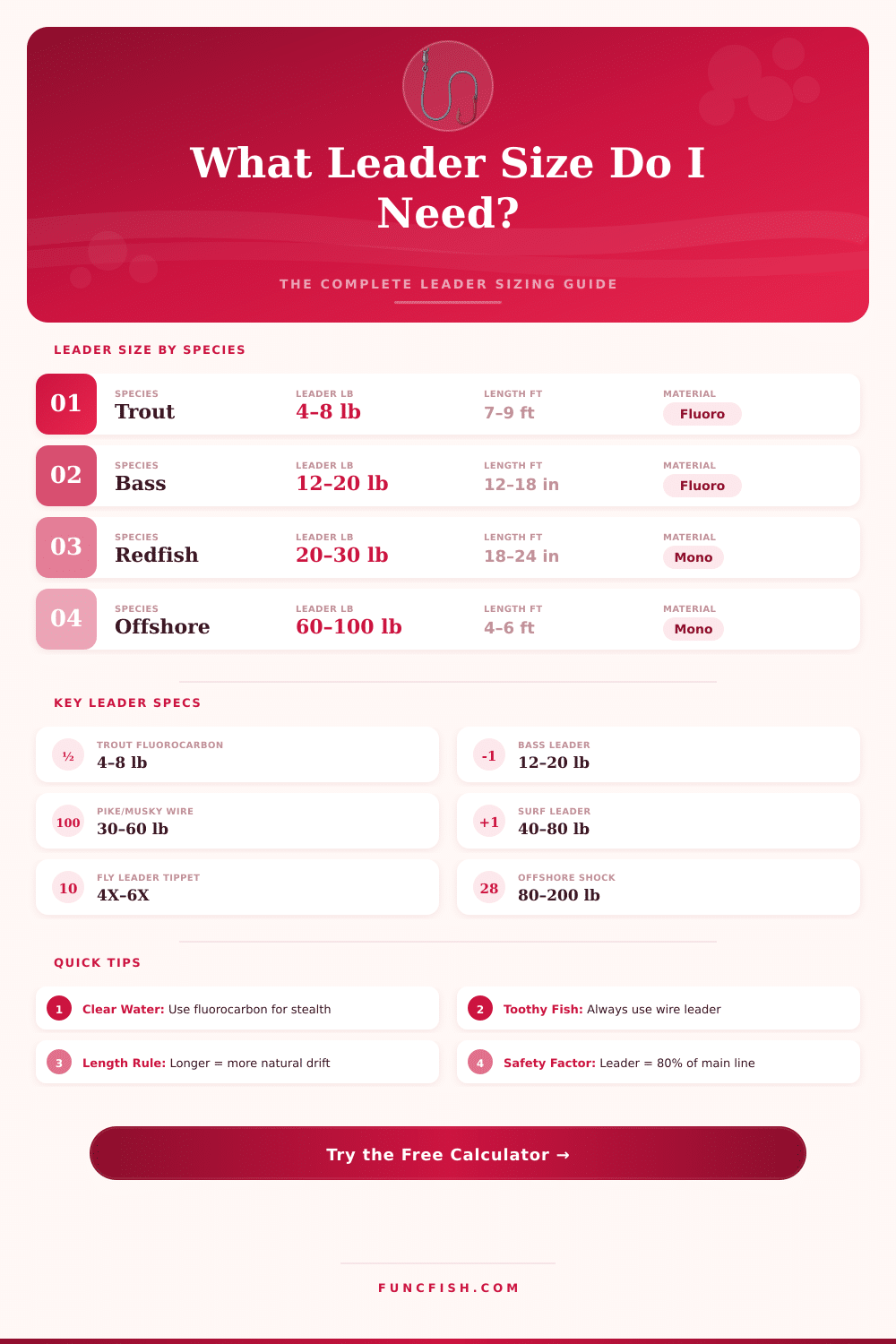
| Species | Leader lb | Length | Material |
|---|---|---|---|
| Brook Trout | 2–6 lb | 6–9 ft | Fluoro |
| Rainbow Trout | 4–8 lb | 7–9 ft | Fluoro |
| Largemouth Bass | 12–20 lb | 12–18 in | Fluoro |
| Smallmouth Bass | 8–14 lb | 12–18 in | Fluoro |
| Walleye | 8–14 lb | 10–14 in | Fluoro |
| Northern Pike | 30–50 lb wire | 8–12 in | Wire |
| Musky | 50–80 lb wire | 10–15 in | Wire |
| Redfish | 20–30 lb | 18–24 in | Fluoro |
| Snook | 25–40 lb | 18–36 in | Fluoro |
| Striped Bass | 30–50 lb | 24–36 in | Mono/Fluoro |
| Yellowfin Tuna | 60–100 lb | 4–6 ft | Mono/Fluoro |
| Mahi Mahi | 40–80 lb | 3–5 ft | Mono |
| Catfish | 25–40 lb | 12–24 in | Mono |
| Panfish / Crappie | 2–6 lb | 6–12 in | Mono/Fluoro |
| Technique | Rec. Length | Metric | Notes |
|---|---|---|---|
| Fly Fishing | 7–12 ft | 2.1–3.7 m | Long for drag-free drift |
| Spinning (fresh) | 12–24 in | 30–61 cm | Match to water clarity |
| Baitcasting | 12–18 in | 30–46 cm | Shorter for accuracy |
| Trolling | 4–8 ft | 1.2–2.4 m | Longer for baits to swim |
| Jigging | 8–18 in | 20–46 cm | Short for sensitivity |
| Bottom Fishing | 12–24 in | 30–61 cm | Prevents sinker abrasion |
| Surf Casting | 3–5 ft | 0.9–1.5 m | Shock leader for casting |
| Ice Fishing | 6–12 in | 15–30 cm | Short for direct jigging |
| Tippet Size | Diameter (in) | Diameter (mm) | Breaking Strength (lb) | Best For |
|---|---|---|---|---|
| 0X | 0.011" | 0.28 mm | 12–15 lb | Large streamers, salmon |
| 1X | 0.010" | 0.25 mm | 10–12 lb | Large streamers, bass |
| 2X | 0.009" | 0.23 mm | 8–10 lb | Large flies, steelhead |
| 3X | 0.008" | 0.20 mm | 6–8 lb | Trout, nymphs |
| 4X | 0.007" | 0.18 mm | 4–6 lb | Trout, dry flies |
| 5X | 0.006" | 0.15 mm | 3–5 lb | Small trout, clear water |
| 6X | 0.005" | 0.13 mm | 2–3.5 lb | Midges, tiny dry flies |
| 7X | 0.004" | 0.10 mm | 1–2.5 lb | Ultra-clear, small flies |
| Main Line (lb) | Main Line (kg) | Clear Water Leader | Stained Water Leader | Murky Water Leader |
|---|---|---|---|---|
| 6 lb | 2.7 kg | 4–6 lb Fluoro | 6 lb Mono | 6–8 lb Mono |
| 10 lb | 4.5 kg | 8 lb Fluoro | 10 lb Fluoro | 10–12 lb Mono |
| 15 lb | 6.8 kg | 10–12 lb Fluoro | 15 lb Fluoro | 15–20 lb Mono |
| 20 lb braid | 9.1 kg | 14–16 lb Fluoro | 20 lb Fluoro | 20–25 lb Mono |
| 30 lb braid | 13.6 kg | 20 lb Fluoro | 25–30 lb Mono | 30–40 lb Mono |
| 50 lb braid | 22.7 kg | 30–40 lb Fluoro | 40–50 lb Mono | 50–60 lb Mono |
| 80 lb braid | 36.3 kg | 60–80 lb Fluoro | 80 lb Mono | 80–100 lb Mono |
| 100 lb braid | 45.4 kg | 80–100 lb Fluoro | 100 lb Mono | 100–130 lb Mono |
Choosing the right size for the Fishing Leader during fishing is not as hard as it seems, everything depends simply on your target and on the state of the water. For most cases a Fishing Leader of 36 inches works well. This measure ensures right balance: it stays short enough to escape problems with knots or swivels that would like to climb up the rod during the whole day even so it stays long enough for use with alive or dead bait in coastal waters.
If you prefer something shorter, between 12 and 18 inches works for most occasions very well. Who are the main exceptions? In blue water, when you hunt ocean fish or jacks, or in crystal clear rivers, where silver trout and wild trout live.
How to Choose the Right Fishing Leader
Most fake baits aim to cause strong striking blows, so you really do not need to add a long Fishing Leader to the end. When you fish in very dirty water, the kind that looks like chocolate milk, cutting it to 8 to 12 inches does the job. In such conditions you really do not need to hide your broken lnie, because the visibility already is very low.
The clarity of the water seriously affects the choice. In dirty or rough situations Fishing Leaders of around 7.5 feet work, because the fish then are not too picky. But in clear, shallow water you need something longer, imagine 9 to 12 feet.
For fly fishing especially, a Fishing Leader of 9 feet with a taper to 3X works well for trout fishing with dry flies ore little nymphs. A Fishing Leader of 9 feet in 4X or 5X cone shape works also for most dry fly cases.
The system with X-sizes commonly confuses folks at first. It ranges from 03X to 8X, where 03X is the thickest and strongest, while 8X is the thinnest and weakest. Think about it like this: lower numbers mean thicker material.
Thicker Fishing Leaders help to cast heavy flies and keep strong pull against big fish. Here is practical advice: divide the size of your fly by three, to find the right X-size. So a fly of size 18 matches with 6X.
For bass and panfish, 3X to 6X cover your usual trout and panfish occasions. For normal sized bass, 0X to 2X make sense. For heavy cover or bigger fish?
Then you use 1X or even heavier.
The length of Fishing Leader for casting rigs works differently. A Fishing Leader of 4 feet keeps the knot point away from the spool, so that everything casts smooth. For lure fishing, around 2 feet of mono line does the job.
The idea is that the knot stays short enough to sit on the spool itself, instead of sliding up the rod, where it could pass through the rings and cause damage. Tests show no difference in the action of baits between 1-foot and 4-foot Fishing Leaders. That clearly is only a myth.
The diameter matters almost as much as the strength of the line, extra thickness protects your gear against teeth and hard mouthsof fish, while it eases the knots.