Fishing Line Decomposition Calculator
Estimate persistence, microfragment risk, mass equivalent, and retrieval priority for lost monofilament, fluorocarbon, braided, or copolymer fishing line under real exposure conditions.
📌Line-loss scenarios
⚙Decomposition inputs
Estimator scope: these are practical persistence ranges for abandoned fishing line. Plastic line does not compost like organic matter; the model estimates visible weakening, fragmentation, burial persistence, and retrieval urgency.
Fishing line persistence estimate
Full breakdown
🧵Gear and material comparison grid
Nylon Mono
Common single-strand nylon that weakens fastest where sun and abrasion work together.
Fluorocarbon
Dense PVDF leader material with very slow visible breakdown, especially in sediment.
Braided PE
Thin woven fibers can fuzz and split into many strands before the line disappears.
Copolymer
Nylon blend line usually persists between mono and tougher coated leader materials.
📘Reference tables
| Line material | Typical polymer family | Visible sun persistence | Buried or deep persistence | Fragment pattern |
|---|---|---|---|---|
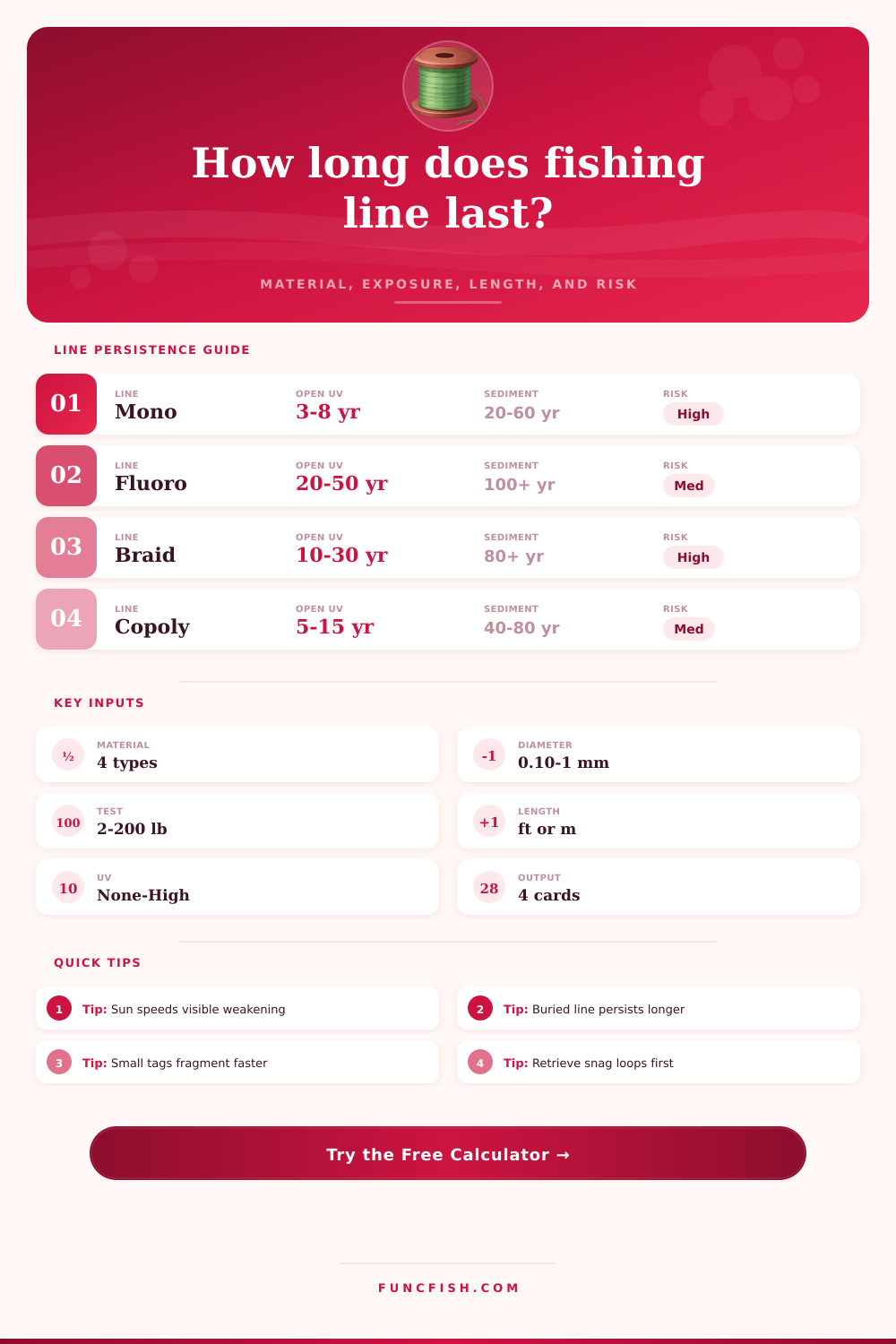
| Nylon monofilament | Polyamide nylon | About 3-8 years | About 20-60 years | Cracks, coils, then short stiff pieces |
| Fluorocarbon leader | PVDF fluoropolymer | About 20-50 years | Often over 100 years | Dense clear pieces with slow weakening |
| Braided PE mainline | UHMWPE fibers | About 10-30 years | Often 80 years or more | Fuzz, fiber shedding, and thin tangles |
| Copolymer nylon | Nylon blend or coating | About 5-15 years | About 40-80 years | Clouding, kink cracks, and flakes |
| Exposure setting | Persistence effect | Microfragment effect | Retrieval access | Best interpretation |
|---|---|---|---|---|
| Dry bank, open sun | Shortens visible life | High once brittle | Usually good | Remove before it splinters |
| Intertidal wash or surf | Shortens through abrasion | High from tumble | Variable | Leader scraps rank high |
| Suspended in water | Moderate persistence | Moderate to high | Often visible | Loops can entangle quickly |
| Bottom with light silt | Lengthens persistence | Lower early, delayed later | Limited | Long strands still matter |
| Buried sediment | Longest persistence | Low until uncovered | Poor | Old line remains for decades |
| Diameter or test class | Common use | Mass per 100 ft mono | Breakdown behavior | Risk cue |
|---|---|---|---|---|
| 0.006-0.010 in / 2-8 lb | Trout and panfish | 0.4-1.1 g | Small tags scatter fast | Hard to see after clipping |
| 0.011-0.016 in / 10-20 lb | Bass and inshore | 1.3-2.9 g | Loops hold shape | Bird and lure tangles |
| 0.017-0.024 in / 25-50 lb | Surf and leaders | 3.2-7.2 g | Stiff coils persist | High snag potential |
| 0.025-0.040 in / 60-150 lb | Heavy leader | 7.8-20 g | Large pieces linger | Easy to retrieve when seen |
| Scenario type | Typical material | Typical lost length | Priority driver | Calculator expectation |
|---|---|---|---|---|
| Drop-shot tag ends | Fluorocarbon | 1-3 ft total | Small scattered pieces | Long persistence, modest mass |
| Surf leader scrap | Monofilament | 6-12 ft | UV plus sand abrasion | High fragment risk |
| Braid snag | Braided PE | 20-80 ft | Long entangling line | Very high retrieval priority |
| Backlash nest | Copolymer | 30-100 ft | Many loops in one clump | High mass equivalent |
💡Practical estimator notes
Use persistence as a range: sunlight, abrasion, burial, and oxygen change the visible weakening timeline. The upper number matters when line is shaded, submerged, or buried.
Retrieval priority is not just mass: a light braid loop in weeds may score higher than a heavier buried mono piece because loops and fibers create immediate snag and fragment pathways.
Fishing line is an type of material that will remain in the environments for a long time. Unlike other material, fishing line dont biodegrade. When a person loses their fishing line, the fishing line will remain in the environment for much years.
Because of the longevity of fishing line, it can become a hazard to bird and turtles that becomes entangled in the line. In order to manage fishing line proper, an understanding of the different type of fishing line and how fast they break down is necessary. There are different type of fishing line, and each type of fishing line break down at a different rate.
Fishing Line: How Long It Lasts and Why It Is Dangerous
For example, nylon monofilament is the most common type of fishing line. However, nylon monofilament can last between twenty and sixty years if buried in sediment. However, if sunlight exposes nylon monofilament, it will crack in a few year.
Fluorocarbon is another type of fishing line that is dens than nylon monofilament. Fluorocarbon can last between twenty and fifty years in open water but can last one hundred year or more if it is underwater. Braided fishing line shed fibers into tangles over a decade.
Due to each material having a different chemical structure, they will degrade at a different rate. Environmental factor can also affect the rate at which fishing line break down. For instance, sunlight contain UV ray that will break down the fishing line.
If the fishing line is in a sunny spot, it will break down more faster than the fishing line in a shaded spot. Abrasion from sand and shell will break down fishing line into small flake. If the water in which the fishing line is located is warm, the fishing line will break down more faster than if it were in cold water.
If fishing line is buried in mud, the lack of oxygen in the mud will stall the breakdown of fishing line and preserve it over time. The size and thickness of the fishing line also has an impact on the environment. Thicker fishing line have more mass; however, thin fishing line can break into small fragment.
These fragment are dangerous for fish as they may think they are food. These small fragment of fishing line become microplastic. Many small fragment will cause more harm to the environment than one large fragment of fishing line as more animal can eat more small fragment.
Given the different type of fishing line, the priority for fishing line to be retrieved is based off the risk that it pose. For example, the priority should of been given to retrieving loop of fishing line as they may catch animal. The priority should also be given to long run of braided fishing line as it may get entangled with the prey that is still alive in the water.
However, there is no priority to retrieve fishing line that is buried deep in the sediment in the environment as it is difficult to locate and does not pose an immediate threat to the environment. Retrieving fishing line from the environment is important to prevent it from breaking into microplastic. By retrieving fishing line from the environment, the fishing line will not become a permanent part of the environment.
Each piece of fishing line are important to retrieve. However, the priority should be given to the fishing line that may pose a threat to the environments animal. Therefore, the focus should be on retrieving loop, thin tag of fishing line, and long strand of fishing line that is still moving in the water.