🎣 Fishing Line Strength Calculator
Find the right lb test for your target species, technique, and conditions — imperial & metric
| Line Type | Stretch | Visibility | Abrasion Resist. | Best Use | Diameter vs lb Test |
|---|---|---|---|---|---|
| Monofilament | 15–30% | Medium | Good | General, topwater, live bait | 0.010″ @ 10 lb |
| Fluorocarbon | 8–12% | Very Low | Excellent | Leader, clear water, jigging | 0.011″ @ 10 lb |
| Braided Line | <5% | High | Excellent | Cover, sensitivity, distance | 0.006″ @ 10 lb |
| Copolymer | 10–18% | Low | Good | Versatile all-around | 0.010″ @ 10 lb |
| Wire Line | <1% | Medium | Superior | Deep trolling, toothy fish | 0.018″ @ 30 lb |
| Lead-Core | ~5% | High | Good | Trolling depth control | 0.035″ @ 18 lb |
| Fused Superline | <5% | High | Very Good | Long casts, deep water | 0.007″ @ 10 lb |
| Nanofil | <3% | Low | Good | Ultralight, finesse | 0.005″ @ 8 lb |
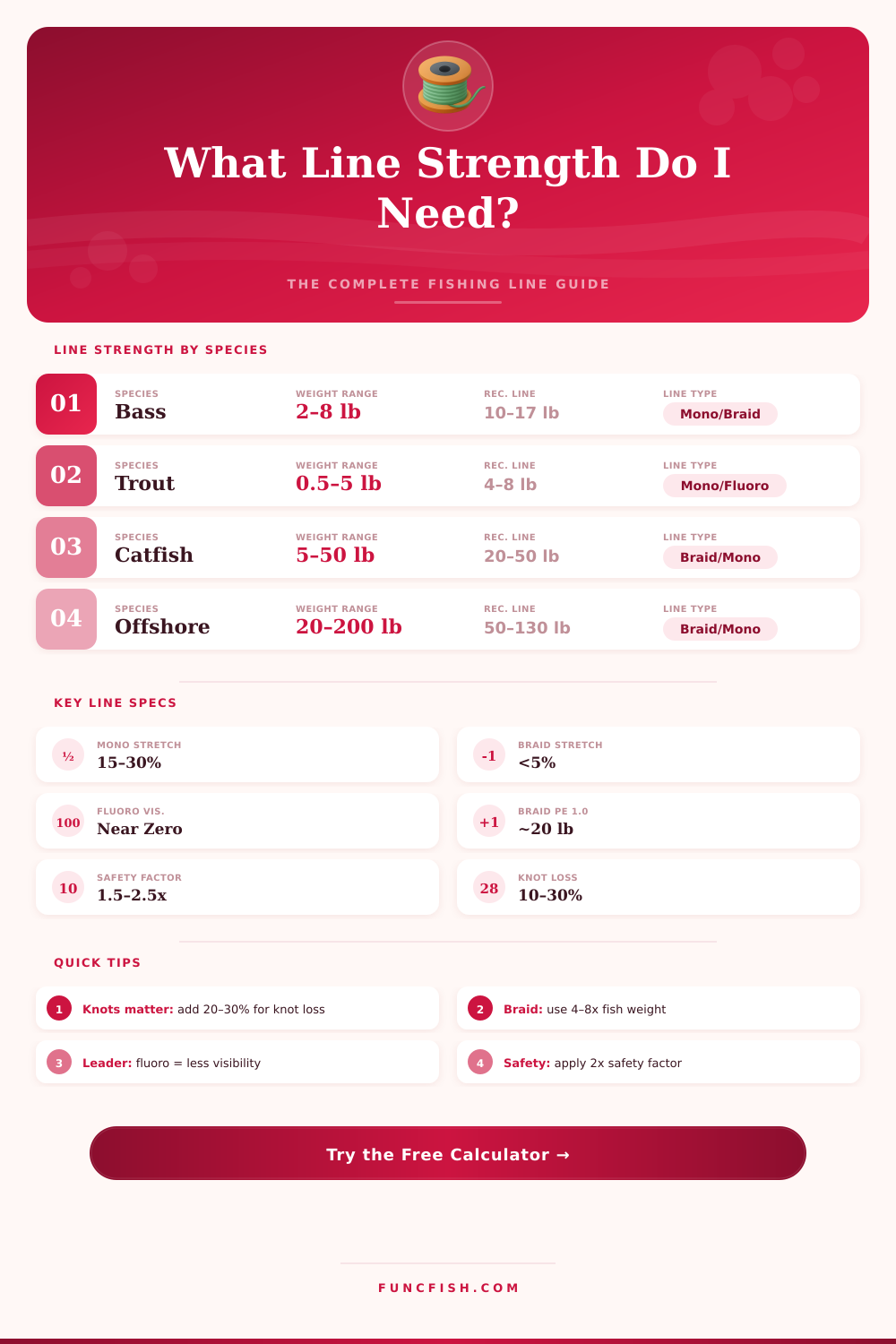
| Species | Avg Weight | Max Weight | Rec. Line (lb) | Rec. Line (kg) | Best Line Type |
|---|---|---|---|---|---|
| Largemouth Bass | 2–5 lb (0.9–2.3 kg) | 22 lb (10 kg) | 10–17 lb | 4.5–7.7 kg | Mono / Braid |
| Rainbow Trout | 0.5–3 lb (0.2–1.4 kg) | 30 lb (13.6 kg) | 4–8 lb | 1.8–3.6 kg | Mono / Fluoro |
| Channel Catfish | 5–15 lb (2.3–6.8 kg) | 58 lb (26 kg) | 15–30 lb | 6.8–13.6 kg | Mono / Braid |
| Walleye | 1–5 lb (0.5–2.3 kg) | 25 lb (11.3 kg) | 6–12 lb | 2.7–5.4 kg | Fluoro / Mono |
| Northern Pike | 5–15 lb (2.3–6.8 kg) | 55 lb (25 kg) | 17–30 lb | 7.7–13.6 kg | Braid + Wire Leader |
| Bluegill / Panfish | 0.25–1 lb (0.1–0.5 kg) | 4.5 lb (2 kg) | 2–6 lb | 0.9–2.7 kg | Mono / Nanofil |
| Striped Bass | 5–20 lb (2.3–9 kg) | 125 lb (56.7 kg) | 17–40 lb | 7.7–18 kg | Braid / Mono |
| Yellowfin Tuna | 30–100 lb (13.6–45 kg) | 427 lb (194 kg) | 50–130 lb | 22.7–59 kg | Mono / Heavy Braid |
| Salmon (Chinook) | 10–30 lb (4.5–13.6 kg) | 126 lb (57 kg) | 20–40 lb | 9–18 kg | Mono / Braid |
| Redfish / Red Drum | 5–15 lb (2.3–6.8 kg) | 94 lb (42.6 kg) | 15–30 lb | 6.8–13.6 kg | Braid / Fluoro Leader |
| Rod Power | Line Range (lb) | Line Range (kg) | Lure Weight (oz) | Lure Weight (g) | Typical Use |
|---|---|---|---|---|---|
| Ultralight | 2–6 lb | 0.9–2.7 kg | 1/64–1/8 oz | 0.4–3.5 g | Panfish, small trout |
| Light | 4–8 lb | 1.8–3.6 kg | 1/16–1/4 oz | 1.8–7 g | Trout, crappie, small bass |
| Medium-Light | 6–10 lb | 2.7–4.5 kg | 1/8–3/8 oz | 3.5–10.6 g | Walleye, bass, panfish |
| Medium | 8–14 lb | 3.6–6.4 kg | 1/4–1/2 oz | 7–14 g | Bass, walleye, pike |
| Medium-Heavy | 12–20 lb | 5.4–9 kg | 3/8–1.5 oz | 10.6–42.5 g | Bass, pike, surf |
| Heavy | 17–40 lb | 7.7–18 kg | 3/4–3 oz | 21–85 g | Big bass, catfish, salmon |
| Extra-Heavy | 25–80+ lb | 11.3–36+ kg | 2–8+ oz | 57–227+ g | Offshore, muskie, big game |
The weight of a fishing line measures itself in pounds. This tells you how much weight it fits to bear and last before break. The real strength measure according to the pressure required for smash wet sample.
Because none uses a dry line for fishing, the International Game Fish Association applies this standard for control lines. The force of lines a bit adjusts according to the producer. You inherent know, that the real strength in practice depend of your knots, treatment of the line, enviromental exposure and factory tolerances.
How to Choose a Fishing Line
Various kinds of lines answer for different targets. Monofilament stay the most oftaĵo between beginners until professionals. Its advantage reclines in the flatly maintenance of knots, and it sinks more slowly than fluorocarbon.
Fluorocarbon like to monofilament, but tighten less, sinks consequently and reflects to light otherwise. Twisted lines from Spectra either Dyneema project by means of gross strengths. Those polyethylene fibers surpass steel plurfoje and polyester even more.
They weigh like this little, that they float. Dank’ to his little diameter, twisted line ease the launching and allows to lay more it on the spool. Moreover, it remorigas nothing about the bobena form, so do not stay rolled after use.
Even so too thick line creates troubles. It eases for fish note it and can inhibit the natural move of hook or bait. Too heavy line confines also the jetdistanco and sensitivity.
During fishing matter to well set the volvan frenilon. In saltwater fishing one accustoms to set it no more than in 30 % of the pointed line strength. For instance for 20-pound line one lays 6-7 pounds.
Widely well operate 1/3 or 1/4 from the force of the weakest part, usually the leader. If the freno surpass the linear weight, more risk to lose the hook. For panfish answer twisted line of 2 until 4 pounds, because it quite a lot senteblas for little stings.
Troutaro use typical 4-pound test. Superbly operates line, whose strength matches the weight of intended fish species, for instance 30-pound for tuna of 30 pounds.