🎣 Fishing Net Size Calculator
Calculate mesh size, net dimensions, twine strength & total net area for any fishing technique
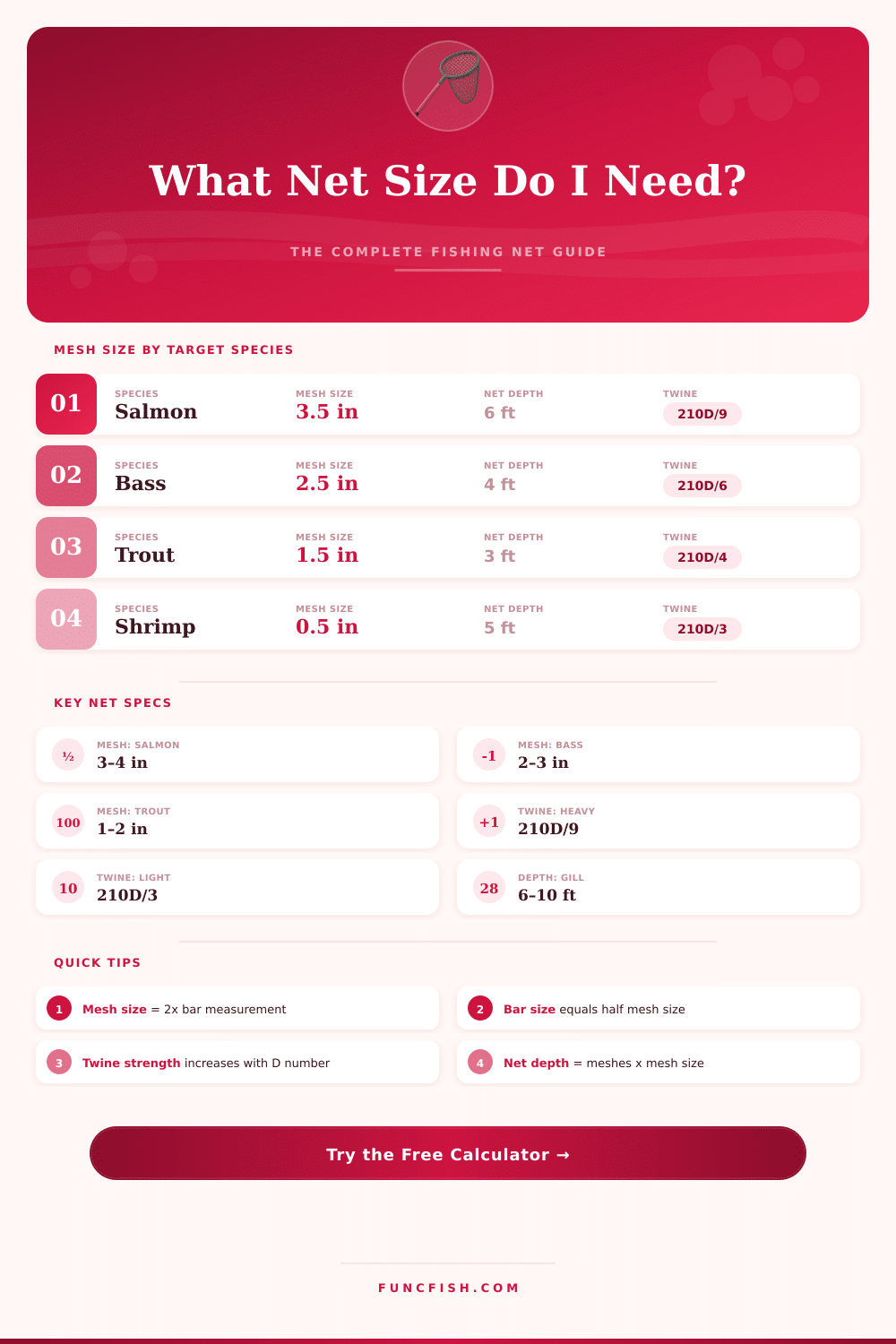
| Species | Typical Weight | Mesh Size (in) | Mesh Size (cm) | Recommended Twine | Net Type |
|---|---|---|---|---|---|
| Minnow / Baitfish | <0.5 lb / 0.2 kg | 0.25–0.5 in | 0.6–1.3 cm | 210D/2–3 | Trap / Seine |
| Shrimp | <0.1 lb / 0.05 kg | 0.5–1 in | 1.3–2.5 cm | 210D/3 | Cast / Trap |
| Trout | 0.5–5 lb / 0.2–2.3 kg | 1–2 in | 2.5–5 cm | 210D/4 | Seine / Gill |
| Panfish / Perch | 0.25–2 lb / 0.1–0.9 kg | 1–1.5 in | 2.5–3.8 cm | 210D/3–4 | Seine |
| Bass (LM/SM) | 1–8 lb / 0.5–3.6 kg | 2–3 in | 5–7.6 cm | 210D/6 | Cast / Seine |
| Walleye | 1–10 lb / 0.5–4.5 kg | 2–2.5 in | 5–6.4 cm | 210D/6 | Gill Net |
| Catfish | 2–50 lb / 0.9–22.7 kg | 2.5–4 in | 6.4–10 cm | 210D/9–12 | Hoop / Gill |
| Salmon | 5–30 lb / 2.3–13.6 kg | 3–4 in | 7.6–10 cm | 210D/9 | Gill Net |
| Striped Bass | 5–50 lb / 2.3–22.7 kg | 3.5–5 in | 8.9–12.7 cm | 210D/9–12 | Gill Net |
| Tuna | 20–200 lb / 9–91 kg | 4–6 in | 10–15.2 cm | 210D/18 | Purse Seine |
| Crab | 0.5–4 lb / 0.2–1.8 kg | 1.5–2 in | 3.8–5 cm | 210D/6 | Pot / Trap |
| Net Type | Typical Length | Typical Depth | Mesh Range | Best Conditions |
|---|---|---|---|---|
| Gill Net | 50–300 ft / 15–91 m | 4–12 ft / 1.2–3.7 m | 1.5–5 in | Lakes, slow rivers |
| Cast Net | Radius: 4–12 ft / 1.2–3.7 m | N/A (circular) | 0.5–2.5 in | Shallow flats, docks |
| Seine Net | 10–100 ft / 3–30 m | 3–8 ft / 0.9–2.4 m | 0.25–2 in | Streams, ponds |
| Hoop Net | 8–20 ft / 2.4–6.1 m | N/A (cylindrical) | 1.5–4 in | Rivers, lakes |
| Trap / Pot Net | 2–6 ft / 0.6–1.8 m | 1–3 ft / 0.3–0.9 m | 0.5–2 in | Any depth |
| Purse Seine | 300–2000 ft / 91–610 m | 20–60 ft / 6–18 m | 3–6 in | Open ocean |
| Twine Type | Diameter (mm) | Break Strength (lb) | Break Strength (kg) | Weight (oz/100ft) | Best Use |
|---|---|---|---|---|---|
| Nylon 210D/2 | 0.6 mm | 12 lb | 5.4 kg | 0.4 oz | Minnow traps, fine mesh |
| Nylon 210D/3 | 0.8 mm | 18 lb | 8.2 kg | 0.7 oz | Shrimp, bait seines |
| Nylon 210D/4 | 0.95 mm | 25 lb | 11.3 kg | 1.0 oz | Trout, panfish seines |
| Nylon 210D/6 | 1.2 mm | 42 lb | 19.1 kg | 1.5 oz | Bass, walleye, crab |
| Nylon 210D/9 | 1.5 mm | 65 lb | 29.5 kg | 2.2 oz | Salmon, catfish gill nets |
| Nylon 210D/12 | 1.8 mm | 88 lb | 39.9 kg | 3.0 oz | Heavy catfish, stripers |
| Nylon 210D/18 | 2.2 mm | 130 lb | 59.0 kg | 4.4 oz | Tuna, large pelagics |
| PE/Polyester #4 | 1.0 mm | 35 lb | 15.9 kg | 1.2 oz | Saltwater traps, crab pots |
Choosing the right fishing net really depends on your position and on the place where you fish. For bait or for catching little fishes one uses most commonly little nets, while for trophy species or for commercial targets one requires heavy and big versions. The magnitude of the loop, so the distance between the knots in the net material, usually nylon, decides which fishes ultimately end in your net.
One chooses different loop sizes for targeting certain fish species, while allowing that water flows through it, so that your catches stay in good state.
How to Choose the Right Fishing Net
Fishing of bass and walleye require a bit bigger loop with openings around one inch. For bigger fishes one must consider something between 1.5 and 2 inches. Here the advantage of bigger loop holes: they less resist the water, so that the net slips through the water without opposition to you.
On the otehr hand, little loops require much force for pulling through and can easily catch stones or other garbage. And what is the bonus of big loop? More water passes freely, what can help you more easily catch fish.
For general fly fishing I found good luck with medium sized net with ring. Magnitude about 34 until 36 inches, or maybe 12 by 9 inches. It well catches fish until around 20 inches without problems.
Anglers that wade on foot commonly like nets with long handle, because that extends your reach while you intend fish in around 18 inches. When you use a rod long 9 feet or more, long handle becomes almost needed, otherwise you hardly catch fish that is quite near. Long handles also help in rocks or in weed zones, while short versions commonly twist wrong when one does knot want.
Fishing of carp differs, because those fishes range so much in magnitude, so one chooses nets between 42 and 46 inches. Some collapsible models fold until almost 30 inches, what really simplifies the carrying of a full big 42-inch net. Here something important to note: fish must not exactly match the size of the net.
They are flexible creatures, so even a net that is a bit too little yet can work well.
Cast netting has its own series of sizes. For start, a 6-foot net with four-inch loop is reliable and lands flat. If you fish in deeper water, go to a 10-foot net with half-inch loop (it sinks much more quickly).
Naturally, the biggest net that you can cast covers more area for bait. Weight also matters; heavier net with same loop goes down more quickly. For shallow water where is bait, something between 3 and 3.5 feet does the task.
Using a loop of 3/8 inch feels good here, because bigger openings help you not lose time removing stickingbranches.
Nets with short handle and basket shape work great for trout, bass, whitefish and grayling. A net with rubber loop without knots deserves to mind if you commonly release fishes, knots can injure the scales and the slime coating. Even so, some areas have strict rules, so always knowingly check what is allowed before you buy something.