🎣 Fishing Reel Handle Torque Calculator
Calculate cranking torque, mechanical advantage, and handle efficiency for any reel setup
| Handle Length | Metric (cm) | Force 5 lb / 2.3 kg | Force 10 lb / 4.5 kg | Force 20 lb / 9.1 kg | Best Application |
|---|---|---|---|---|---|
| 3.0" / 7.6 cm | 7.6 cm | 1.25 ft‑lb / 1.69 N‑m | 2.50 ft‑lb / 3.39 N‑m | 5.00 ft‑lb / 6.78 N‑m | Panfish / Ultralight |
| 3.5" / 8.9 cm | 8.9 cm | 1.46 ft‑lb / 1.98 N‑m | 2.92 ft‑lb / 3.96 N‑m | 5.83 ft‑lb / 7.91 N‑m | Trout / Light Spin |
| 4.0" / 10.2 cm | 10.2 cm | 1.67 ft‑lb / 2.26 N‑m | 3.33 ft‑lb / 4.52 N‑m | 6.67 ft‑lb / 9.04 N‑m | Light Bass / Walleye |
| 4.5" / 11.4 cm | 11.4 cm | 1.88 ft‑lb / 2.55 N‑m | 3.75 ft‑lb / 5.08 N‑m | 7.50 ft‑lb / 10.17 N‑m | Bass / Inshore |
| 5.0" / 12.7 cm | 12.7 cm | 2.08 ft‑lb / 2.82 N‑m | 4.17 ft‑lb / 5.65 N‑m | 8.33 ft‑lb / 11.29 N‑m | Inshore / Pike |
| 5.5" / 14.0 cm | 14.0 cm | 2.29 ft‑lb / 3.11 N‑m | 4.58 ft‑lb / 6.21 N‑m | 9.17 ft‑lb / 12.43 N‑m | Catfish / Heavy Inshore |
| 6.0" / 15.2 cm | 15.2 cm | 2.50 ft‑lb / 3.39 N‑m | 5.00 ft‑lb / 6.78 N‑m | 10.00 ft‑lb / 13.56 N‑m | Surf / Offshore |
| 6.5" / 16.5 cm | 16.5 cm | 2.71 ft‑lb / 3.67 N‑m | 5.42 ft‑lb / 7.35 N‑m | 10.83 ft‑lb / 14.68 N‑m | Big Game / Trolling |
| Species | Typical Weight | Rec. Handle Length | Rec. Drag (lb) | Reel Type | Target Torque |
|---|---|---|---|---|---|
| Panfish / Bluegill | 0.25–1 lb | 3.0–3.5" | 2–4 lb | Ultralight Spin | 0.6–1.5 ft‑lb |
| Trout (Stream) | 0.5–3 lb | 3.5–4.0" | 3–6 lb | Light Spin | 1.0–2.5 ft‑lb |
| Bass (Largemouth) | 2–8 lb | 4.0–5.0" | 8–15 lb | Spin / Baitcast | 2.5–5.0 ft‑lb |
| Walleye | 1–6 lb | 4.0–4.5" | 6–12 lb | Med. Spinning | 2.0–4.0 ft‑lb |
| Pike / Muskie | 5–30 lb | 5.0–6.0" | 12–20 lb | Heavy Baitcast | 4.5–8.0 ft‑lb |
| Inshore Redfish | 3–20 lb | 5.0–5.5" | 10–18 lb | Med–Heavy Spin | 3.5–7.0 ft‑lb |
| Striped Bass (Surf) | 5–50 lb | 5.5–7.0" | 15–25 lb | Surf Spin / Conv. | 6.0–12.0 ft‑lb |
| Bluefin / Big Game | 50–500+ lb | 6.0–8.0" | 25–60 lb | Overhead / Lever | 10.0–30.0 ft‑lb |
| Catfish | 2–50 lb | 5.0–6.5" | 15–30 lb | Heavy Baitcast | 5.0–10.0 ft‑lb |
| Fly Fishing Trout | 0.5–5 lb | 3.5–4.5" | 2–8 lb | Fly Reel | 0.8–3.0 ft‑lb |
| Gear Ratio | Retrieve Speed | Torque Output | IPT (6" spool) | Best Use |
|---|---|---|---|---|
| 4.9:1 – 5.2:1 | Slow | Very High | ~20–24 in | Deep cranking, swimbaits |
| 5.3:1 – 5.9:1 | Medium–Slow | High | ~24–28 in | Spinnerbaits, jigs |
| 6.0:1 – 6.5:1 | Medium | Medium | ~28–33 in | Versatile all-around |
| 6.6:1 – 7.2:1 | Fast | Medium–Low | ~33–38 in | Topwater, reaction baits |
| 7.3:1 – 8.1:1 | Very Fast | Low | ~38–45 in | Flipping, pitching, frogs |
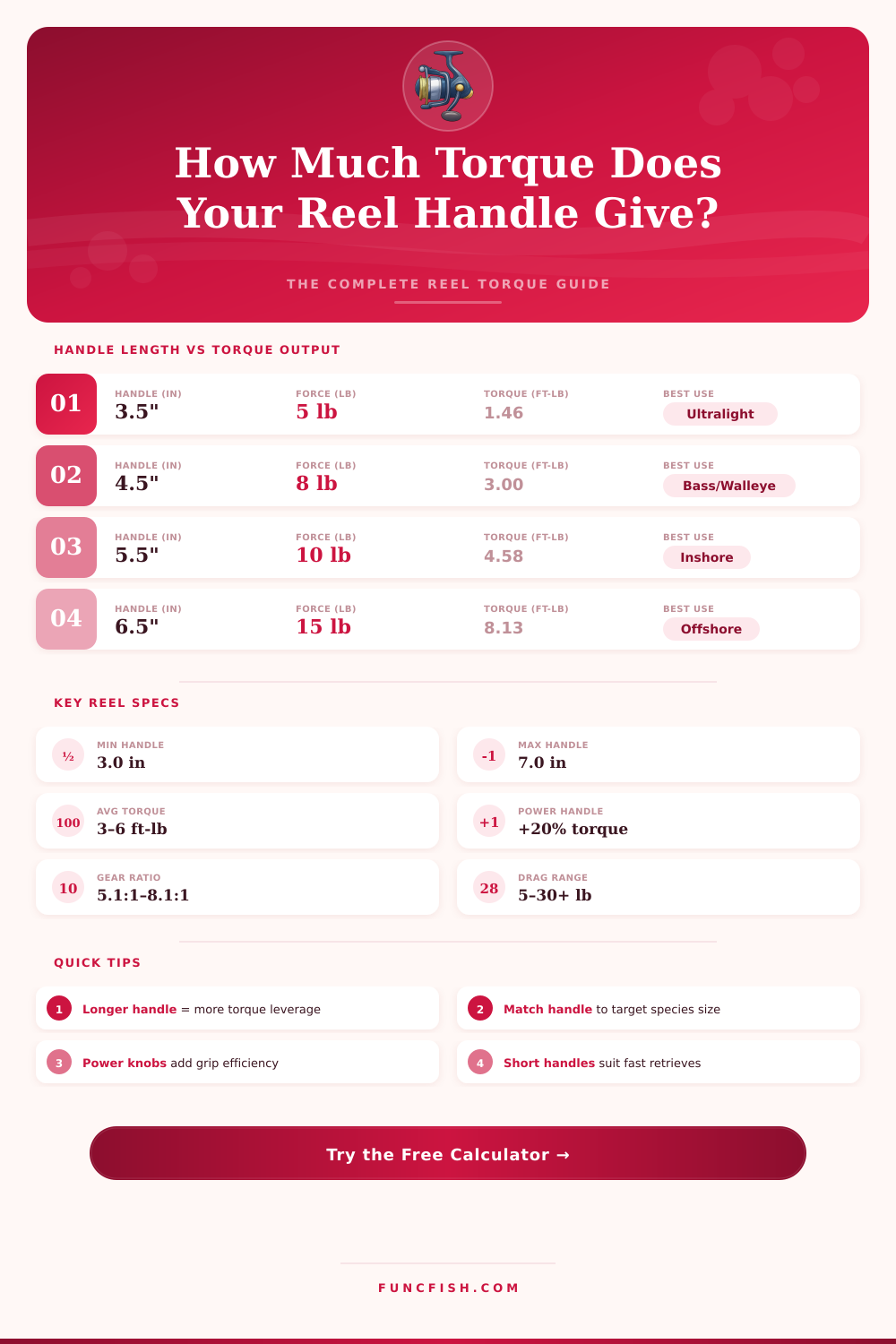
The length of the handle of a fishing reel is one of the more important factor that determines how a fishing reel will perform. The length of the handle of a fishing reel will determine the amount of torque that can be applied to the reel. If the handle of a fishing reel is too short, it will be more difficult to crank the reel; shorter length of handles provide less leverage to the fishing reel.
If a fishing reel have a longer handle, however, a person will have more leverage with which to apply more torque to the gears of the fishing reel. The torque of a fishing reel is the force that allow a person to effectively pull their fishing lure through the water, even through heavy cover. The length of the handle of a fishing reel can be considered the radius of the fishing reel; the longer that handle, the more torque will be exerted prior to the force reaching the gears of the fishing reel.
How Handle Length Affects Reel Turning Power
For example, if the length of the handle of a fishing reel is doubled, the handle will also roughly double the torque that is created. Therefore, those who uses baitcasting fishing reels (which often have high gear ratios) often utilize fishing reels with longer handles. In contrast, those who use finesse fishing reels (which are used for more rhythmic movement) often have shorter handles on there fishing reels.
Another factor that can impact the performance of the handle of a fishing reel is the diameter of the spool of the fishing reel. Full spools will create more resistance against the movement of the fishing line than empty spools; therefore, it will make the fishing reel more difficult to turn when the spool is full of line. Finally, the gear ratio of a fishing reel will also impact the amount of torque that can be applied to a fishing reel.
For instance, fishing reels with high gear ratios will allow for the fishing line to retrieve quick from the spool, but will reduce the amount of torque that may be applied to the line. A low gear ratio, such as a 5:1 ratio, will retrieve the fishing line slow. However, low gear ratios offer more torque to help a person pull heavy lure or troll.
The type of knob on the fishing reel also affect the force a person can apply to the fishing reel handle. Power knobs allow a person to apply more force to the handle than knobs in the T-shape. Power knobs are helpful for people who find themselfs bracing their hand against a rail on a fishing boat or against a kayak.
For people with wet hands who experience slipping knob, larger knobs are preferred. Fast cranking with a long fishing reel handle may tire a person more quick than cranking slow. The length of the handle on a fishing reel depends on the type of fishing a person will be doing.
For people who fish for trout in a creek, shorter fishing reel handles are preferred. For people who fish in the surf with heavy lures, longer fishing reel handles is needed. A person must also consider the temperature of the air when fishing because the cold can constrict the grease inside the fishing reel, reducing its efficiency by five percent.
The best length for a fishing reel handle depends on the weight of the load a person will be pulling. A person can measure their current fishing reel handle. For testing, a person can add half an inch to the length of the fishing reel handle to test if the torque increase.
A chain that starts at the grip of the handle and ends at the fishing reel spool creates the torque on a fishing reel. By finding the best length for the handle for the load a person is fishing for, the fishing reel will operate more smooth.