🎣 Fishing Rod Guide Size Calculator
Calculate the optimal guide sizes and spacing for your custom rod build
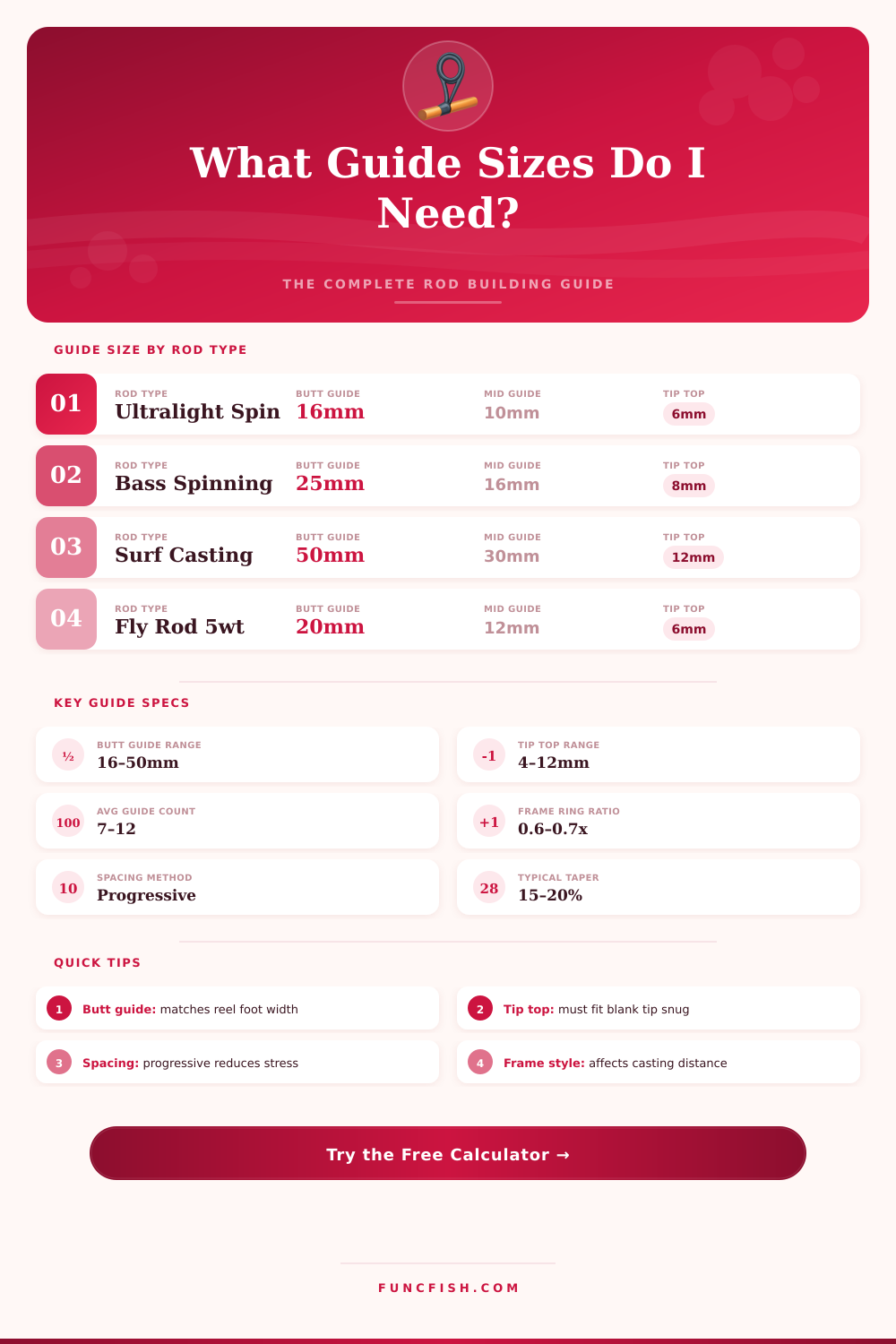
| Rod Type | Butt Guide (mm) | Mid Guides (mm) | Tip Top (mm) | Guide Count |
|---|---|---|---|---|
| Ultralight Spinning | 10–16 | 6–10 | 4–6 | 5–7 |
| Light Spinning | 16–20 | 8–12 | 5–7 | 6–8 |
| Medium Spinning | 20–30 | 10–16 | 6–8 | 7–9 |
| Heavy Spinning | 30–40 | 16–25 | 8–10 | 8–10 |
| Medium Baitcast | 16–20 | 10–16 | 6–8 | 7–9 |
| Heavy Baitcast | 20–25 | 12–16 | 7–8 | 7–9 |
| Surf Casting | 40–50 | 20–30 | 10–12 | 6–8 |
| Fly Rod (3–5wt) | 16–20 | 8–12 | 5–6 | 7–9 |
| Fly Rod (7–10wt) | 20–25 | 10–16 | 6–8 | 8–10 |
| Offshore Trolling | 40–50 | 25–40 | 12–16 | 5–7 |
| Target Species | Avg Weight | Rod Power | Line Weight | Butt Guide |
|---|---|---|---|---|
| Panfish / Crappie | 0.25–1 lb (0.1–0.5 kg) | Ultralight | 2–6 lb | 10–16mm |
| Trout (stream) | 0.5–3 lb (0.2–1.4 kg) | Light | 4–8 lb | 16–20mm |
| Bass (largemouth) | 2–8 lb (0.9–3.6 kg) | Medium–MH | 8–17 lb | 20–30mm |
| Walleye | 1–6 lb (0.5–2.7 kg) | Medium | 6–14 lb | 20–25mm |
| Pike / Muskie | 5–30 lb (2.3–13.6 kg) | Heavy–XH | 17–40 lb | 25–30mm |
| Catfish | 5–50 lb (2.3–22.7 kg) | Heavy–XH | 20–60 lb | 30–40mm |
| Striped Bass (surf) | 10–50 lb (4.5–22.7 kg) | Heavy | 17–40 lb | 40–50mm |
| Salmon / Steelhead | 5–30 lb (2.3–13.6 kg) | MH–Heavy | 10–25 lb | 25–30mm |
| Offshore (Tuna) | 20–200+ lb (9–90+ kg) | Extra Heavy | 50–200 lb | 40–50mm |
| Material | Hardness (Mohs) | Heat Dissipation | Best For | Weight |
|---|---|---|---|---|
| SiC (Silicon Carbide) | 9.3 | Excellent (60%) | High-speed braid, all lines | Light |
| Alconite | 8.5 | Very Good | Mono, fluoro, braid | Light |
| Zirconia | 8.5 | Good | Mono, heavy applications | Medium |
| Hardloy | 8.0 | Good | Mono, freshwater | Medium |
| Titanium Frame | 6.0 | Moderate | Lightweight builds | Very Light |
| Stainless Steel | 6–7 | Low | Budget builds | Heavy |
| Ceramic | 7.0 | Good | General freshwater | Light |
The size of a fishing rod has big influence during fishing. You seriously check do the apt guides use on all rods. The space of guides depends on the rod-length and on its shape.
For instance, a rod can have progressive, para or convex shape. Many rod companies bid charts that point the apt number and position of guides according to the length. You can match your guides with those of other rod of same length that you already own.
Fishing Rod Guide Sizes, Spacing and Length
Some rod producers lay space charts on their pages on-line.
Different rods require different arrangements of guides. For single foot fly rods, guides usually have sizes 10, 8, 7, 6 and 5. These numbers show the diameter of the guide ring in millimeters.
Builder for casting rod could choose size 12 for the butt, later 10, then 8 and end with size 6. For freshwater fishing by means of 5 wt rod or weaker, typical arrangement carries #8 or 10 stripper-guide, all #1/0 snake-guides, one #1 snake and #2 snake between 4 and 6 inches above the stripper. For light and ultralight rods that will not use reel more than size 2000, guides can be 20, 10 and 6, usually the most little reduction guide.
Wire guides widely have sizes 6, 5, 4, 3, 2, 1, 1/0 and 2/0 where 6 is the biggest. Some use size 16 for stripper and later lower to 5.5-high frame micro-guide, followed by size 04 running guides. During construction some rod builders set guides to the slim rod before wrap them.
Later they pass line through them and bend the rod for check spacing. That is usual method although spacing rules do not apply to spiral wrapped rods.
Rod length also affects the usage of guides. A 7 foot rod is good for start. Shorter rods between 5 and 7 feet are more easy to handle.
They commonly have more power for big fish. On open lakes and big waters a rod of 7’3” until 7’6” extend the casting arc and stores more energy during load. They help to send lures as chatterbaits spinnerbaits and mid-size swimbaits more far in same effort.
This extra distance allows to reach wandering fish.