
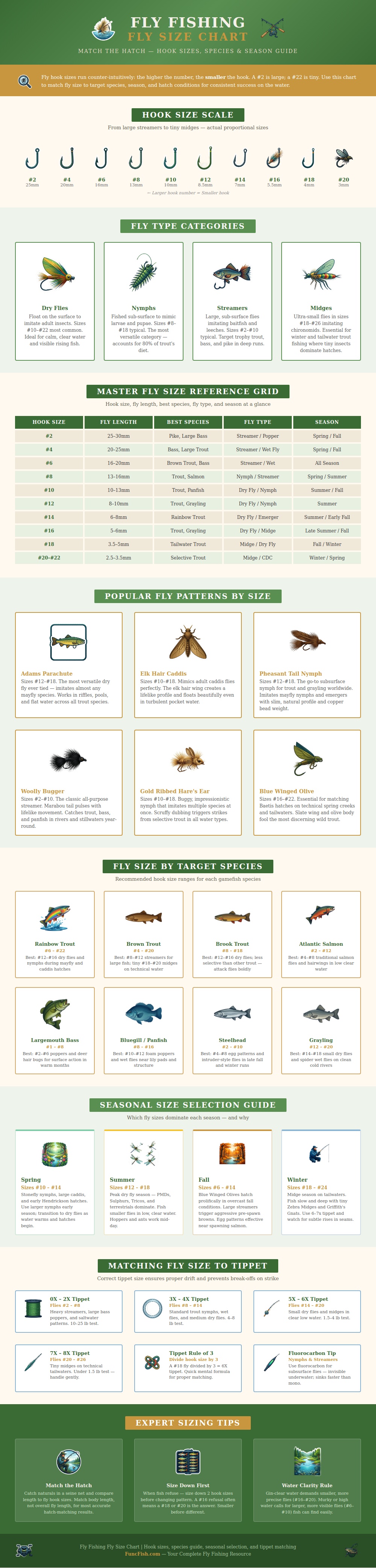
Fly fishing fly size are crucial to succesful fly fishing. The size of the flies used in this sport follow a specific numerical scale that many peoples misinterpret when first exposed to the sport of fly fishing. For hook sizes, a larger number mean a smaller hook and a smaller number means a larger hook.
The sizes is connected inversely. Thus, as the number of the hook size increase, the size of the fly decrease. A persons understanding of these sizes is crucial to understanding whether the fish will eat the fly.
How to Choose the Right Fly Size
The sizes of the flies range from large streamers to very small flies such as midge. Large streamers is used to mimic the life of baitfish. These large flies are often used when the water is cloudy or when one is targeting larger predatory fish species.
As the size of the hook decrease, different type of flies are used until one reaches midges. Midges are small flies that are often the primary food source of trout. For flies in sizes in between large streamers and small midges are consume by trout.
The different types of flies is targeted in different areas of the size scale. Dry flies is designed to float on the waters surface and come in medium hook size. Nymphs are designed to fish beneath the water’s surface and come in a variety of sizes because some of these imitations can be weighted.
Streamers are larger flies used to mimic the life of baitfish and large prey and are found at the larger end of the size scale. Finally, midges come in very small size because the insects that they mimic is also very small. Different species of fish has a preference for the size of the flies that they are offered.
Rainbow trout prefer the consumption of mid-sized dry and nymph flies but may eat other sizes of flies depending on the life cycle of the insects that is present in the water. Brown trout prefer eating mid-sized flies but will eat large streamers when hunting for baitfish. Brook trout eat a variety of sizes of flies.
Steelhead and salmon will require large sized flies when fishing for these fish species because the large flies is easier to see when the water is heavy with weeds or other natural debris. Grayling and certain type of trout that live in tailwaters will require very small sizes of flies. The time of year when one is fishing for fish will affect the ideal size of the flies.
In the spring, when the population of larger insects such as stoneflies are active, larger nymph and dry flies will be used. When the summer fish habitats is clearer, smaller sized flies should be used when fishing. In the fall, fish are more aggressive so streamers can be targeted.
During the winter months, when the fish are feeding on midge larvae, small midge flies should be used. The size of the tippet will depend upon the size of the flies that are being used. For instance, if the tippet is too heavy for the size of the flies, the flies will drag in the water unnaturally.
If the tippet is too light for the size of the flies, the tippet may break when a large fish bite. To determine the proper size of tippet to use divide the size of the hook by three. This will indicate the proper size of tippet to use with the fishing flies.
If the fish will not eat the flies that are currently being used, change the size of the flies before changing the pattern of the flies. Decreasing the size of the flies by two size of hooks will entice the fish to bite. In very clear water, larger sized flies is easier for the fish to see so larger flies should be used in these conditions.
Outside of clear water, smaller sized flies will be required if the fish are very selective in what they eat. Thus, changing the size of the flies that are being used will get the fish to eat the flies. This is more effective than changing the pattern of the flies.