Fly Hackle Size Calculator
Match hook gap, fly style, feather type, barb length, collar density, and water speed for dry flies, wets, nymphs, streamers, and emergers.
📌Scenario presets
⚙Hackle settings
Hackle sizing forecast
Full breakdown
📋Hackle material reference grid
Cock Neck
Cock Saddle
Midge Saddle
Hen Neck
Partridge
Starling
Schlappen
Guinea
📏Reference tables
| Hook size | Typical gap | Dry hackle barb | Wet collar barb |
|---|---|---|---|
| #24 | 2.6 mm / 0.102 in | 3.4 mm / 0.134 in | 2.2 mm / 0.087 in |
| #22 | 3.0 mm / 0.118 in | 3.9 mm / 0.154 in | 2.6 mm / 0.102 in |
| #20 | 3.5 mm / 0.138 in | 4.6 mm / 0.181 in | 3.0 mm / 0.118 in |
| #18 | 4.2 mm / 0.165 in | 5.5 mm / 0.217 in | 3.6 mm / 0.142 in |
| #16 | 5.0 mm / 0.197 in | 6.5 mm / 0.256 in | 4.3 mm / 0.169 in |
| #14 | 6.0 mm / 0.236 in | 7.8 mm / 0.307 in | 5.1 mm / 0.201 in |
| #12 | 7.4 mm / 0.291 in | 9.6 mm / 0.378 in | 6.3 mm / 0.248 in |
| #10 | 8.8 mm / 0.346 in | 11.4 mm / 0.449 in | 7.5 mm / 0.295 in |
| #8 | 10.3 mm / 0.406 in | 13.4 mm / 0.528 in | 8.8 mm / 0.346 in |
| #6 | 11.8 mm / 0.465 in | 15.3 mm / 0.602 in | 10.0 mm / 0.394 in |
| Fly style | Barb-to-gap ratio | Usual wraps | Hackle choice |
|---|---|---|---|
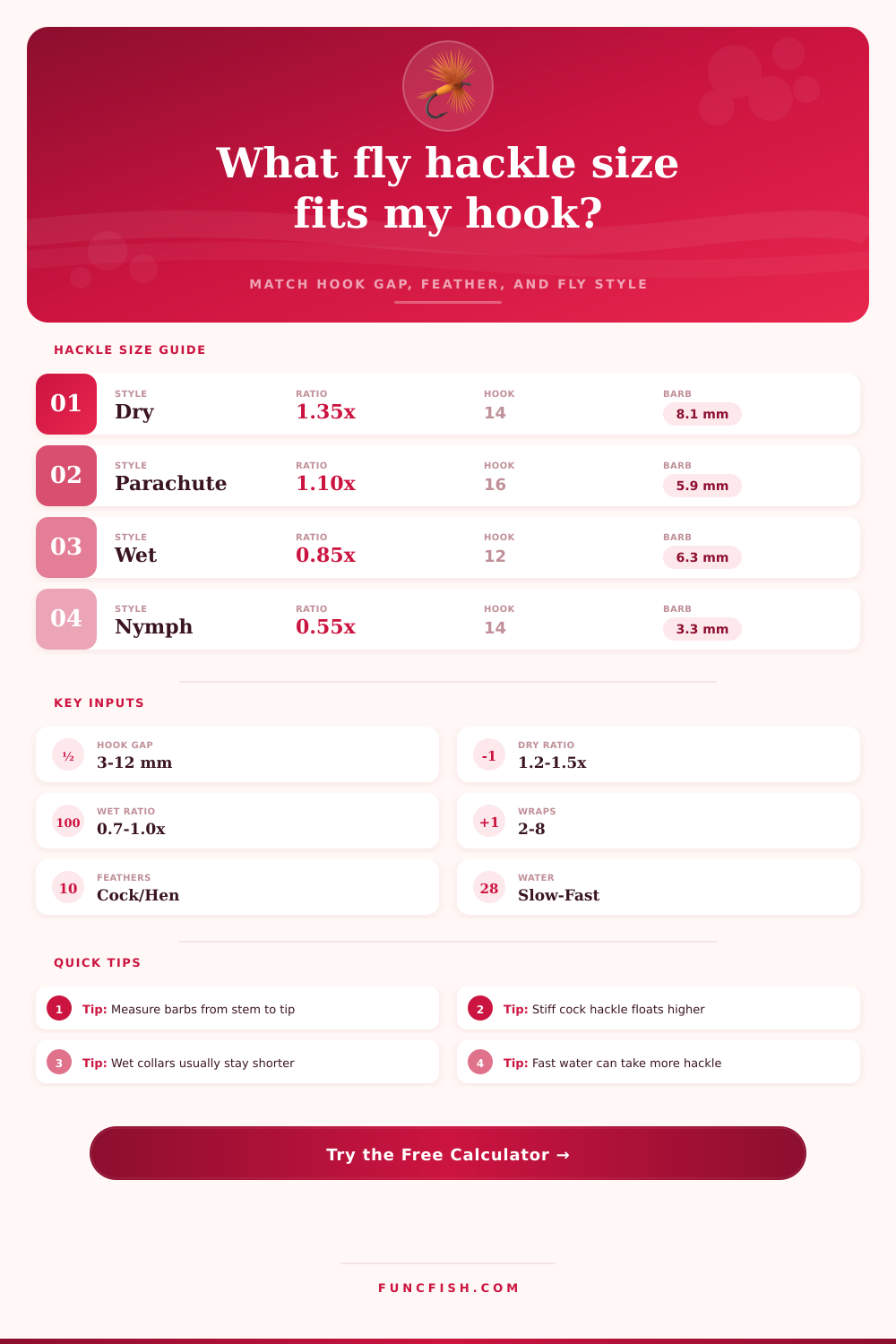
| Standard dry | 1.25 to 1.45 | 4 to 6 | Stiff cock neck |
| Parachute dry | 1.05 to 1.20 | 4 to 7 | Cock saddle |
| Palmered caddis | 1.10 to 1.30 | 5 to 8 | Dry saddle |
| Wet fly collar | 0.75 to 0.95 | 2 to 4 | Hen or partridge |
| Soft hackle | 0.85 to 1.15 | 1.5 to 3 | Partridge / starling |
| Nymph legs | 0.45 to 0.70 | 1.5 to 3 | Hen, soft cock |
| Streamer collar | 0.70 to 1.10 | 2 to 5 | Schlappen / guinea |
| Bass bug | 1.00 to 1.40 | 3 to 6 | Deer hair / saddle |
| Water condition | Length shift | Density shift | Best use |
|---|---|---|---|
| Glass calm | -5% | -1 wrap | Delicate dry flies |
| Slow slick | -2% | -0.5 wrap | Small dries and emergers |
| Riffle | 0% | baseline | General trout water |
| Fast broken water | +6% | +1 wrap | High-floating dries |
| Stillwater chop | +3% | +0.5 wrap | Wind-ruffled lakes |
| Hatch / target | Common hook | Barb range | Common hackle |
|---|---|---|---|
| Midge dry | #20 to #24 | 3.2 to 4.8 mm | Midge saddle |
| Blue-winged olive | #16 to #22 | 4.0 to 6.8 mm | Cock neck |
| Pale morning dun | #14 to #18 | 5.4 to 8.2 mm | Cock neck |
| Caddis adult | #12 to #18 | 5.0 to 9.5 mm | Dry saddle |
| March brown wet | #10 to #14 | 5.2 to 8.2 mm | Hen neck |
| Leech / bugger | #6 to #10 | 8.0 to 13.0 mm | Schlappen |
| Bass popper | #2 to #6 | 12.0 to 17.5 mm | Saddle / deer |
💡Hackle sizing checks
Tip: A dry-fly gauge reads the straight barb length from stem to tip. Do not include the rachis or the fuzzy web near the stem.
Tip: For wet flies, judge the swept-back collar against the hook point. Soft fibers fish longer than they measure when current opens them.
Hackle size is another critical component of tie success. The hackle size will determine how the fly land on the water, how it will float, and how it will move through the waters currents. Using the wrong hackle size will make the fly fail in performing its critical function of landing correctly on the water surface.
The hook gap will help determine the size of the hackle. The barbs of the hackle must be long enough to support the width of the fly, but not so long that the hackle overwhelm the hook. If the collar of the hackle is too long, it will ride too highly off the water.
How to Choose the Right Hackle Size
If the hackle collar is too short, the fly will list to one side than the other. Different types of flies will require different lengths of hackle. For instance, dry flies will require longer hackle barbs because dry flies must be able to support the weight of the hook and the body of the fly above the water surface.
The fibers that are used, such as cock neck feathers, will create a wide platform for the dry fly to rest upon, keeping it from sinking below the water surface. For wet flies and soft hackles, the hackle will have more shorter and softer fibers because wet flies has to move with the water current. Hence, different measures of hackle will be used with the same hook size for dry and wet flies.
The speed at which the water is moving will also play a role in the size of the hackle that will be used for the dry and wet flies. In faster and more turbulent waters, fuller hackle collars will work better because the turbulence will hide the extra bulk of the hackle. The hackle also will be more visible in the water.
In calm and flat waters, the hackle will have to be more sparse so that the hackle does not make a splash when the fly land on the water surface. The shadows that the hackle will make on the water surface should not look incorrect. Another important factor is the type of feather that is selected for the hackle because this will determine the stiffness of the hackle and the movement of the hackle barbs.
For example, cock neck feathers has stiffness in their fibers that will help the dry fly to remain on the water surface. However, the same feathers may not be appropriate for wet flies. For wet flies, hen neck and partridge feathers will provide the softness to the hackle fibers so that the hackle will move in the water current.
However, the downside of using these feathers is that the fly will sink more fast in the water. Saddle feathers will provide length to the hackle that can be wrapped around the body of the entire fly. The size of the zone on the hook will also determine the length of the hackle that can be used.
If the zone is small, such as for the thorax of the fly, there will be very little room for the hackle to wrap around the hook. Using too many hackle wraps on a small thorax will make the stem of the hackle crowd each other. Hence, for larger hooks, there is more room for the hackle, but it will also change how the fly will float or swim.
A calculator can be used to determine the proper distance between each hackle stem. This will eliminate the need to guess at how to space the hackle wraps around the hook. Many people make mistakes with the hackle.
For instance, someone who found success with using a hackle for a size fourteen dry fly may use that same hackle for a size twelve wet fly. Another mistake is to use the stiffest feather for a soft hackle spider, which will make the fly refuse to sink. The stiffness of the hackle will play a role in how many wrap you can use with the hackle collar.
The body diameter of the hook is another factor that must be used in determining the length of the hackle. The length of the hackle must allow it to clear the materials on the hook. Using a dubbed body or a wing post will change the bodys diameter.
Using this will result in the hackle sit too low on the flys body when finished tying the fly. In the past, people used reference tables to determine the hook gaps and hackle ratios. These tables will help you when you are selecting the different types of feathers.
However, the most important tool is to hold the selected feather against the hook to ensure the barbs meets the requirements of the dry or wet fly. Small differences in measurement will make a big difference in whether or not the fly will remain on the water surface. Also, measuring the hackle prior to tie will save time in that you wont have to rebuild the fly with different hackle materials.
It should of been done earlier.