Fly Reel Arbor Size Calculator
Compare arbor class, retrieve per turn, backing capacity margin, and reel balance from measured fly reel diameter, arbor diameter, spool width, backing, line weight, and retrieve target.
📌Named fly reel presets
⚙Reel and arbor settings
Fly reel arbor forecast
Full breakdown
📋Fly reel/arbor comparison grid
Small Arbor
Mid Arbor
Large Arbor
XL Arbor
📐Reference tables
| Arbor class | Arbor/reel ratio | Retrieve effect | Capacity tradeoff |
|---|---|---|---|
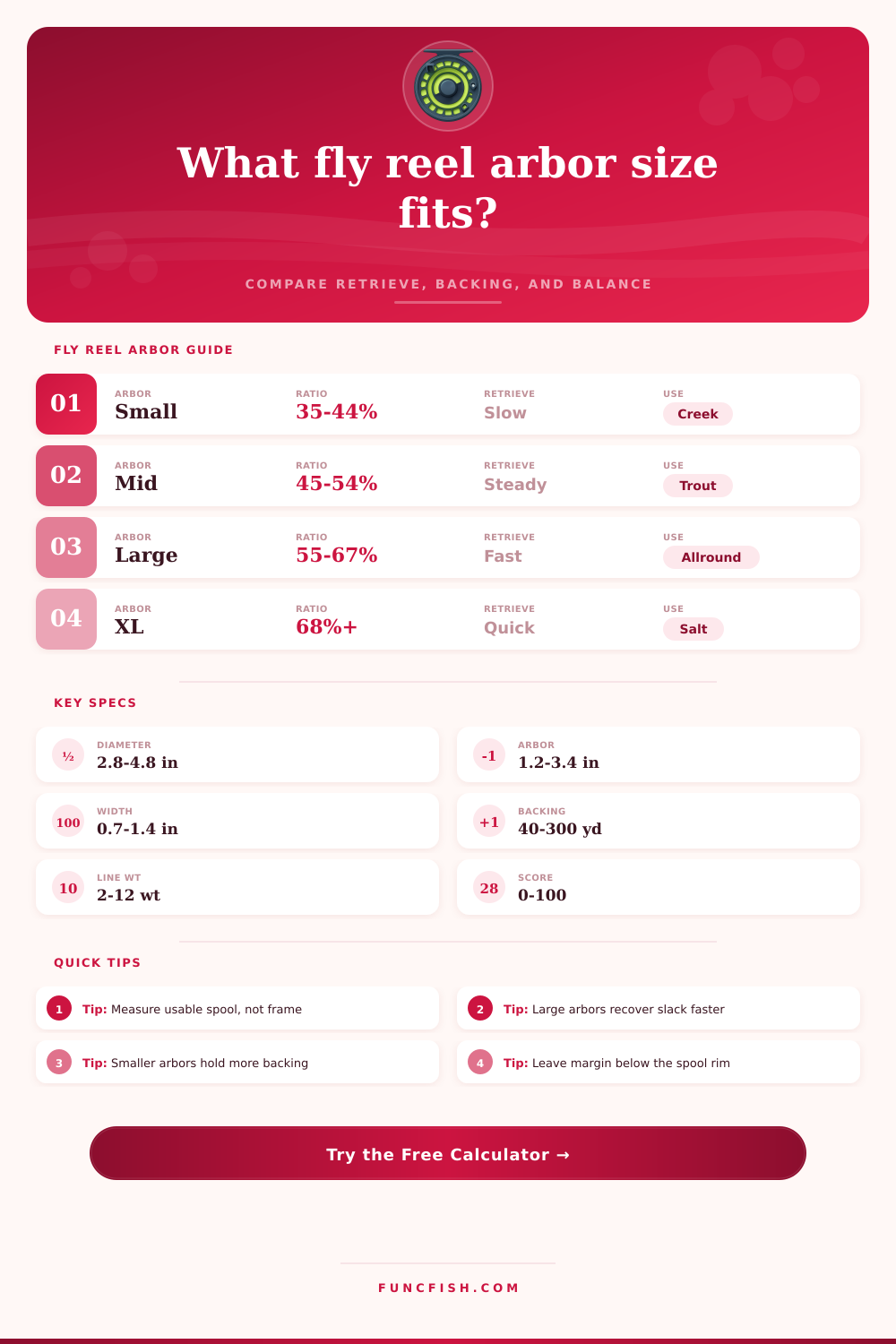
| Small arbor | 35-44% | Slow pickup, higher startup inertia | Most backing room |
| Mid arbor | 45-54% | Steady pickup for trout work | Balanced capacity |
| Large arbor | 55-67% | Fast slack recovery and steadier drag | Moderate backing room |
| Extra-large arbor | 68% and up | Quick pickup and low line coil memory | Least backing room |
| Fly line weight | Estimated line volume | Common backing target | Typical arbor fit |
|---|---|---|---|
| 2-3 wt | 6-8 cc | 20-60 yd / 18-55 m | Small to mid arbor |
| 4-5 wt | 9-12 cc | 60-100 yd / 55-91 m | Mid to large arbor |
| 6-8 wt | 14-22 cc | 100-200 yd / 91-183 m | Large arbor |
| 9-12 wt | 26-43 cc | 175-300 yd / 160-274 m | Large to XL arbor |
| Backing diameter | Approx line type | Pack behavior | Capacity note |
|---|---|---|---|
| 0.012 in / 0.30 mm | Thin gel-spun | Very tight | High yardage, thin feel |
| 0.015 in / 0.38 mm | Gel-spun 50 lb | Tight | Common saltwater capacity choice |
| 0.018 in / 0.46 mm | 20 lb Dacron | Normal | Common trout and bass baseline |
| 0.022 in / 0.56 mm | 30 lb Dacron | Bulkier | Lower capacity but easy handling |
| Balance preference | Favored arbor ratio | Retrieve target | Capacity priority |
|---|---|---|---|
| Tip-light trout rod | 48-56% | Moderate | Medium |
| Neutral all-around | 55-63% | On target | Medium |
| Backing capacity priority | 42-52% | Lower | High |
| Fast line pickup | 66-74% | High | Lower |
| Saltwater drag balance | 62-72% | High | High enough |
💡Arbor measurement tips
Tip: Measure the diameter where the backing starts, then measure the inside rim diameter where a safe full spool would stop.
Tip: If the calculator shows negative capacity margin, reduce backing length before changing fly line or arbor size.
The correct size of an arbor for a fly reel is an important decision that will impact the functions of the reel. The arbor size will determine how much line the reel can hold (known as it’s capacity), and will also impact how quick the line will pick up slack on the reel. For instance, if you choose a small arbor size for your reel, you will have more room for line to be wound onto the reel; however, the small arbor will cause the reel to pick up slack more slow.
Conversely, if you choose a large arbor size, the reel will pick up slack more quick; however, there will be less room for line to be wound onto the reel. The arbor size is the diameter of the center of the spool in relation to the diameter of the entire fishing reel. A small arbor will allow for more line to be wound onto the reel in the spaces between the arbor and the rim of the spool.
Choose the Right Arbor Size for Your Fly Reel
A large arbor will take up much of the space within the spool, forcing the line to sit closer to the outer rim. If the line is forced to sit closer to the outer rim of the spool, the line will be picked up at a fast rate during each turn of the reel. In order to calculate the number of inches of line that will be picked up per turn of the reel, there are several different measurements that must be provide to the tool.
The diameter of the fishing reel, the diameter of the arbor, the width of the spool, the diameter of the backing, the tension with which the backing is packed onto the reel, the weight of the fly line, and the rate at which the line is targeted to be retrieved are all require to be entered into the calculator. Many individuals will look at the arbor ratio of the reel to determine what type of fishing reel it is. Trout fishing rods, for instance, typically has arbor ratios in the mid-forties.
If an arbor ratio is in the fifties and sixties, the line will pick up more quick. A larger arbor ratio will provide for a steadier drag when fishing. If the arbor ratio is above sixty-eight percent, then the reel is an extra large arbor reel.
Extra-large arbor reels are common among individuals that fish in saltwater locations. Saltwater fishing lines require fast line recovery. An additional factor in the calculation of the line that will be picked up with each turn of the reel is the balance that the individual prefers for the rod.
Individuals who prefer a light setup for their rods, especially those used for trout fishing, may opt for a more moderate arbor ratio. Individul who prefer a setup that will allow for fast line pickup for fishing for nymphs will opt for a higher arbor ratio. Saltwater anglers may require a rod with less margin for capacity for the same reasons that it must have fast line recovery.
Each of these factors will impact the tool’s display of whether or not the measurements of the fishing rod are useful. Another factor for consideration in fishing is the capacity margin for the rod. The capacity margin for a fishing rod is a measurement of whether or not there is extra space for the line on the rod after the installation of the fly line.
A positive number indicate extra space for the line; a negative number indicates there isnt enough space for the line to be added to the rod. The calculation of the capacity margin uses the size of the space for the fly line to be installed and calculate how much space remains for the remaining line (known as the backing). Another factor that may impact whether the line can fill the space that is calculated by the tool is the way in which the line is wound onto the reel.
If the line is wound loosely onto the reel, it will occupy more space than if it was wound more firmly. Additionally, the humidity and the temperature of the line and the area in which the line is stored could alter the number of space in which it can pack. Finally, the space between the line and the outer rim of the reel (known as the rim clearance) must be taken into consideration; most fishing reels require some space between the line and the rim to prevent the line from rubbing against the reel.
This aspect of the calculation is approximate, and the actual measurements for the individuals reel may vary. The retrieve rate for a fishing rod is the number of inches of line that will be picked up per turn of the reel once the reel is fully loaded with line. The number of inches will change as the rod fills with line.
For instance, it is common for fishing reels to feel slow when they are empty of line. However, once they are loaded with both a layer of backing and a layer of fly line, they may feel faster with each turn of the reel. The retrieve rate that is calculated is based off the loaded diameter of the reel, not the empty diameter of the arbor.
Some of the most common mistakes in calculating the retrieve of a fishing reel are incorrect measurements of the line or the diameter of the reel. For instance, the outside of the frame of the reel may be measured instead of the inside diameter of the spool. Such a mistake will result in incorrect calculations of the retrieve.
Additionally, individuals may not account for the space that the fly line take up within the rod. If such a mistake is made, individuals will calculate that the reel has more space for line than it actualy does. It is important to make sure that the measurements that are entered into the calculator are correct by measuring the actual fishing rod.
Each type of fishing has different requirement of the size of the arbor for the fly reel. For instance, small arbor sizes are helpful for 3-weight rods. Large arbor sizes are helpful for 8-weight rods.
These recommendations can be tested with the given line and measurements to determine which arbor size will work best for the individuals fishing style.