
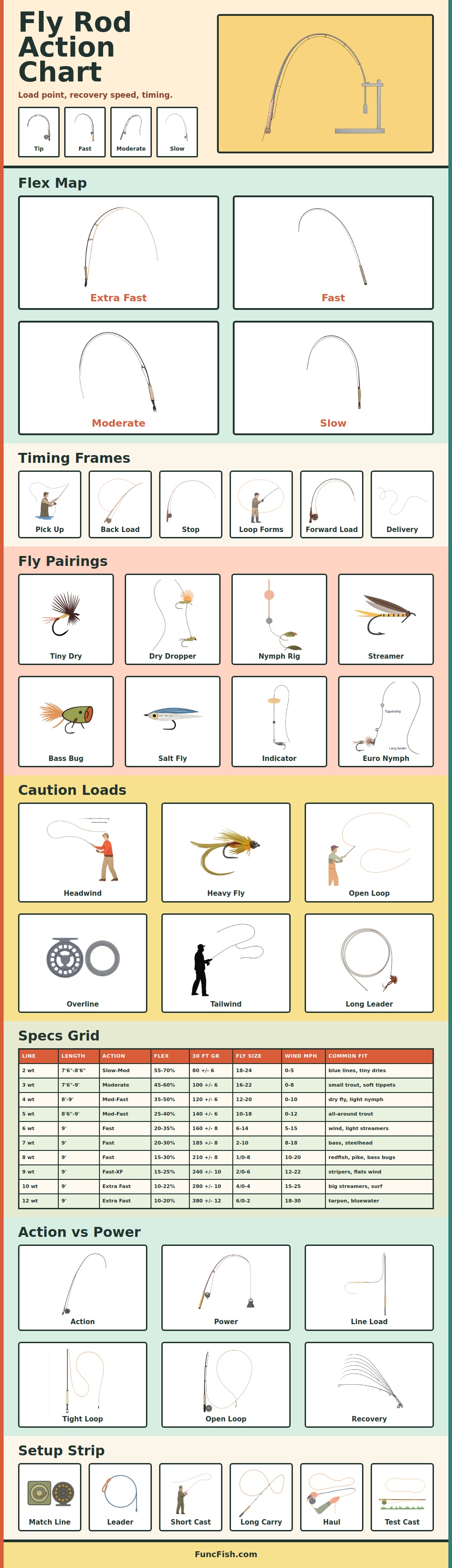
Fly rod actions is the pattern of bend that occurs in a fly rod when a person use the rod to cast. The rod action will determine where the rod bends, how quick the rod will recover from a cast, and how much energy the rod can transfer to the fly line. Each of these factor impact the way that the rod will perform in various environment.
There are several different type of action for fly rods, each of which will impact the way that the rod bends when performing a cast. Slow action flies will bend deep into the butt section of the rod, and load energy in a more gradual fashion along the rod. These types of rods are typically used for short casts, and tend to be more forgiving of error in the timing of the cast.
How a Fly Rod Bends and Affects Your Cast
Moderate action rods will bend within the middle section of the rod, and offer a balance between finesse and power. Fast action rods will remain stiffly along most of the rod, and only bend into the top quarter of the rod. These rods will quickly load and recover from a cast, allowing for the formation of tight loops with the line that can easy move through the wind.
Finally, extra fast action rods are very stiff, and are typically used to cast heavy fly in high wind conditions. The action of the rod also impact the formation of the fly line loops created during a cast. Slow action rods will create larger loop and allow the line to move more slow through the air.
Fast action rods will create tight, narrow loops in the line, and allow the line to move more quick through the air. Thus, the action of the rod will impact the way that the line is delivered to the specified location of the cast. The action of the rod should also match the type of fly that is being cast.
Dry flies are more delicate than other type of flies, so a slow or moderate action rod will be required to cast these type of flies. Streamers and other heavy flies will create more air resistance, so a person should use a fast or extra fast action rod to cast these types of flies. Slow action rods should not be used to cast heavy streamers, as the tip of the rod may break under the overload of such a heavy fly.
The environment in which the fly rod will be used should also be considered in the selection of the action of the rod. Slow action rods will have difficulty moving through headwinds, so a person should use fast action rods in these environment. Slow action rods may be pushed against by tailwinds, which may cause the rod to buckle.
Additionally, overlining a rod may create problems for the same reason that slow action may be challenged by tailwinds; overlining will force the rod to bend in a way that it was not designed to bend. It is important to note the difference between action and power for a fly rod. Action is the location at which the rod bends when casting, while power is the stiffness of the entire rod.
Power will impact the amount of weight that the rod can lift at a given distance, while action will impact the timing and the shape of the loops of the cast. Thus, a light line can be used in conjunction with a slow action rod for finesse casting, and heavy line can be used in conjunction with fast action rods. Additionally, the line that is used with the rod should also match the action of the rod, and the leader taper should also match the action of the rod.
Each person should practice developing the rhythm of their cast while feeling the fly rods load and how it stop. Finally, by ensuring that each of these factor is matched to the type of environment in which the rod will be used, and the type of flies that will be cast, the rod will function correctly.