🧊 Fish Cooler Size Calculator
Find the exact cooler capacity you need based on your catch, trip length, and ice requirements
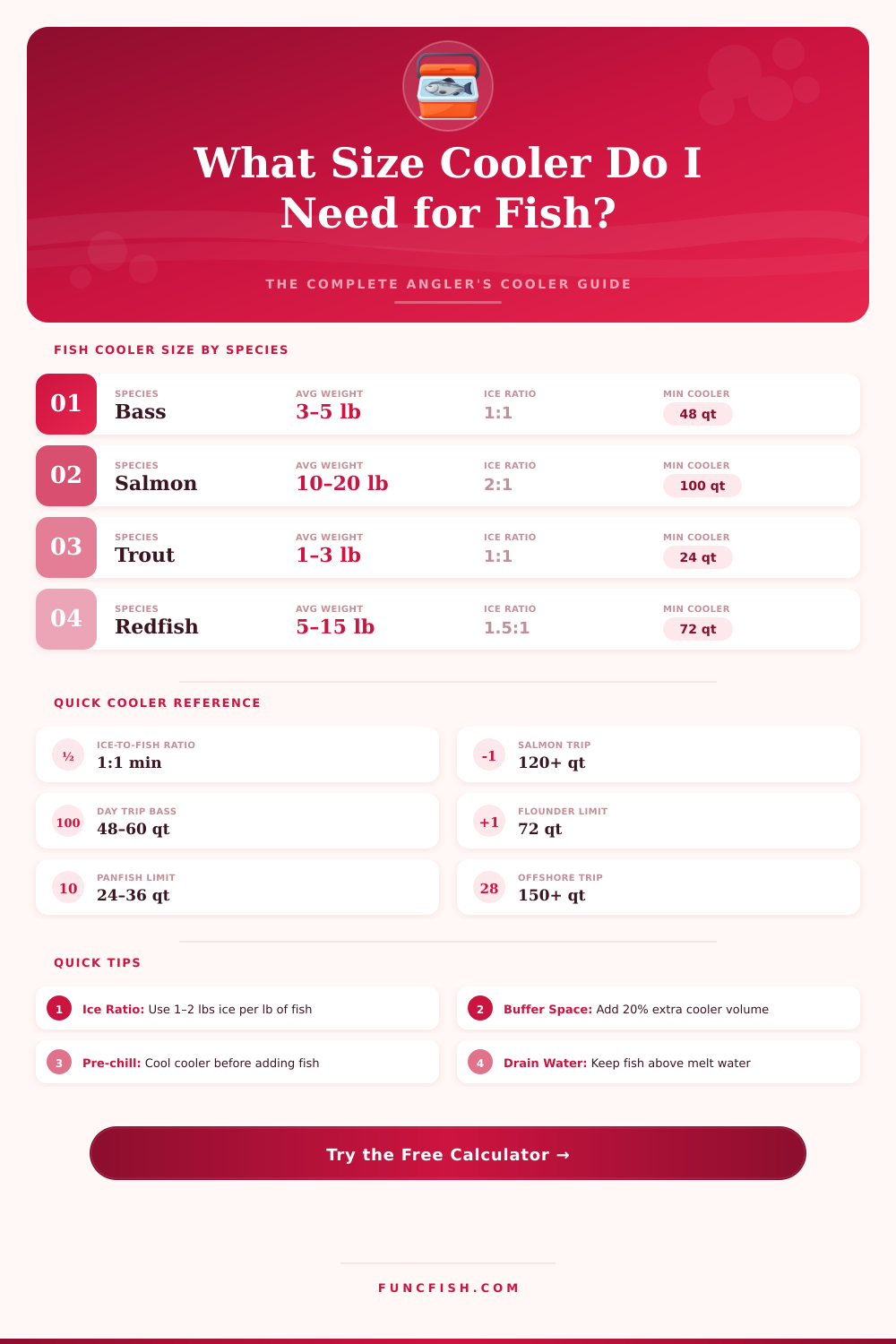
| Species | Avg Weight (lb / kg) | Space per Fish (qt / L) | Ice Ratio Rec. | Min Cooler (qt / L) |
|---|---|---|---|---|
| Panfish | 0.3–0.5 lb / 0.15–0.23 kg | 1.5 qt / 1.4 L | 1:1 | 24 qt / 23 L |
| Trout | 0.5–2 lb / 0.23–0.9 kg | 3 qt / 2.8 L | 1:1 | 24 qt / 23 L |
| Bass | 2–5 lb / 0.9–2.3 kg | 5 qt / 4.7 L | 1.5:1 | 48 qt / 45 L |
| Walleye | 2–4 lb / 0.9–1.8 kg | 4 qt / 3.8 L | 1.5:1 | 48 qt / 45 L |
| Pike | 4–10 lb / 1.8–4.5 kg | 8 qt / 7.6 L | 1.5:1 | 60 qt / 57 L |
| Catfish | 3–8 lb / 1.4–3.6 kg | 7 qt / 6.6 L | 1.5:1 | 48 qt / 45 L |
| Flounder | 1–3 lb / 0.45–1.4 kg | 4 qt / 3.8 L | 1.5:1 | 48 qt / 45 L |
| Redfish | 3–10 lb / 1.4–4.5 kg | 7 qt / 6.6 L | 2:1 | 60 qt / 57 L |
| Salmon | 8–20 lb / 3.6–9 kg | 14 qt / 13.2 L | 2:1 | 100 qt / 95 L |
| Tuna / Mahi | 15–60 lb / 6.8–27 kg | 30 qt / 28 L | 2.5:1 | 150 qt / 142 L |
| Trip Length | Ice Needed (lb / kg) per 10 lb Fish | Heat Factor | Recommended Buffer |
|---|---|---|---|
| Half Day (4h) | 5–8 lb / 2.3–3.6 kg | 1.0x | +10% |
| Full Day (8h) | 10–15 lb / 4.5–6.8 kg | 1.2x | +15% |
| Overnight (24h) | 20–30 lb / 9–13.6 kg | 1.4x | +20% |
| 2–3 Days | 40–60 lb / 18–27 kg | 1.6x | +25% |
| 4–7 Days | 80–120 lb / 36–54 kg | 1.8x | +30% |
| Cooler Size | Capacity (qt / L) | Max Fish Capacity | Best For |
|---|---|---|---|
| Mini / Soft | 16–24 qt / 15–23 L | 5–8 panfish | Short stream/pond trips |
| Small Hard | 28–40 qt / 26–38 L | 6–10 trout | Solo day trip |
| Medium Hard | 48–65 qt / 45–62 L | 8–12 bass/walleye | 2-angler day trip |
| Large Hard | 70–100 qt / 66–95 L | 8–15 redfish | Multi-day freshwater |
| XL Rotomold | 105–160 qt / 100–152 L | 8–12 salmon | Charter / overnight trips |
| Marine Chest | 162–250 qt / 153–237 L | Large tuna/mahi | Offshore 3+ days |
Choosing the right fish cooler size depends on how many fish you expect to catch and how much time you will spend on the water. For day trip with friends or family, where only a few fish will be caught, a small cooler should work. It works for freshwater fishing with a small group.
A cooler of 20 to 30 quarts works well for one to four people for a day trip, with drinks, snacks and a bit of fish. A ten quart cooler is good enough for lunch or bait.
How to Choose the Right Fish Cooler Size
Coolers usually fall into three categories by size. Small have 5 to 16 quarts, medium 17 to 35 quarts, and large are above 36 quarts. For many days of camping, hunting or fishing, you advise a cooler of 40 to 70 quarts.
They can serve the storage needs of 2 to 3 people during several days, by the amount of food and drinks. The most popular sizes range between 40 and 50 quarts. A 65 quart cooler often seems the best for the cost.
On ocean fishing boats, a 150 quart cooler is a standard fish box. Some people use even huge 320 quart coolers, that keeps ice for days.
Different kinds of coolers fit different fishing needs. You have small backpacks and big wheeled coolers available. A backpack cooler works for hikes, where you can attach gear to it.
Small size helps to move easy and carry weight well. Coolers also fit anywhere on boat, for example in the front or back bracket, freely giving precious top space. A 60 quart hard side cooler form a good setup for camp food, road drinks and a bag of dead fish home.
A 52 quart cooler weighs around 26 pounds empty. Some people favors a 120 quart cooler for fish and a small 35 quart for lunch. If you use only two coolers, it is more good to choose big than two medium and one large.
A 120 quart cooler give good ice for a big bag for two days.