🐟 Grass Carp Weight Calculator
Estimate grass carp weight from length & girth measurements — imperial & metric
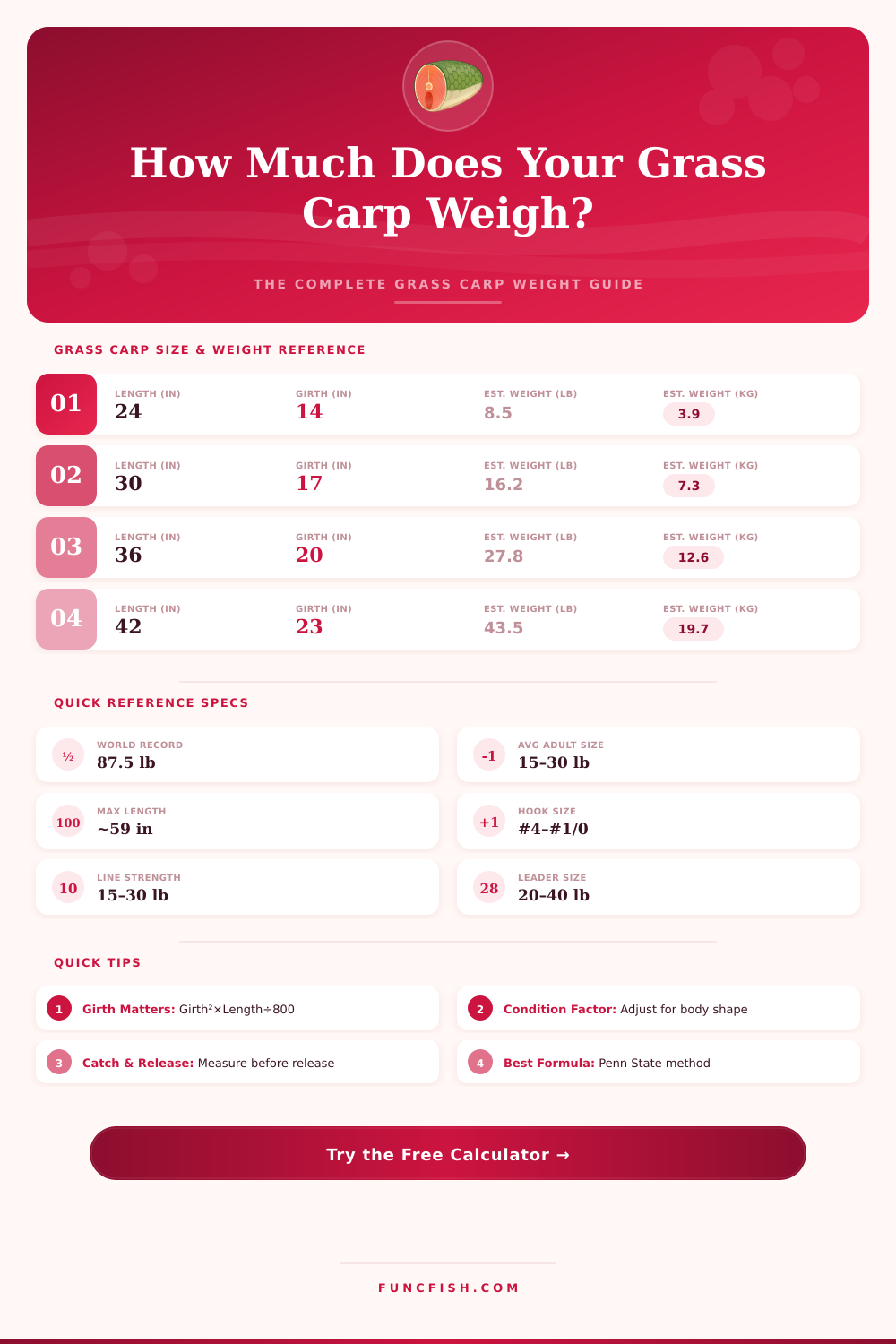
| Length (in) | Length (cm) | Avg Girth (in) | Est. Weight (lb) | Est. Weight (kg) | Life Stage |
|---|---|---|---|---|---|
| 12 | 30 | 7 | 0.9 | 0.4 | Juvenile |
| 18 | 46 | 10 | 3.2 | 1.5 | Sub-adult |
| 24 | 61 | 13 | 7.6 | 3.5 | Young Adult |
| 28 | 71 | 15 | 11.8 | 5.4 | Adult |
| 32 | 81 | 17 | 17.7 | 8.0 | Adult |
| 36 | 91 | 20 | 27.5 | 12.5 | Large Adult |
| 40 | 102 | 22 | 36.6 | 16.6 | Trophy |
| 44 | 112 | 24 | 48.4 | 22.0 | Trophy |
| 48 | 122 | 26 | 62.2 | 28.2 | Specimen |
| 52 | 132 | 28 | 78.4 | 35.6 | Record Class |
| Fish Size | Line (lb) | Hook Size | Rod Power |
|---|---|---|---|
| Under 10 lb | 10–15 | #4–#2 | Medium |
| 10–20 lb | 15–20 | #2–#1 | Med-Heavy |
| 20–35 lb | 20–25 | #1–1/0 | Heavy |
| 35–55 lb | 25–30 | 1/0–2/0 | Heavy |
| 55+ lb | 30+ | 2/0–3/0 | X-Heavy |
| Formula | Inputs Needed | Accuracy | Best For |
|---|---|---|---|
| G²xL/800 | Length + Girth | ±5–8% | General use |
| Girth Only | Girth only | ±15% | Quick est. |
| Length Only | Length only | ±20% | No girth tape |
| Penn State | Length + K | ±10% | Condition data |
| Weight Scale | Direct weigh | Exact | Best accuracy |
| Species | Typical Weight Range | Record Weight | Similar Length at 30 in |
|---|---|---|---|
| Grass Carp | 5–50 lb (2.3–22.7 kg) | 87.5 lb / 39.7 kg | ~15–18 lb |
| Common Carp | 4–40 lb (1.8–18.1 kg) | 105 lb / 47.6 kg | ~18–22 lb |
| Bighead Carp | 10–60 lb (4.5–27.2 kg) | 90 lb / 40.8 kg | ~20–25 lb |
| Silver Carp | 5–40 lb (2.3–18.1 kg) | 80 lb / 36.3 kg | ~14–17 lb |
| Buffalo (Bigmouth) | 5–70 lb (2.3–31.8 kg) | 70 lb / 31.8 kg | ~20–28 lb |
In order to accurately estimate the weight of a grass carp it is first necessary to consider the physical measurement of the grass carp, since the physical shape of grass carp can vary significant. Grass carp can have long body or thin bodies, so the length of the grass carp isnt a reliable measurement of its weight. While common carp tend to have deep and barrel shaped bodies, grass carp have long and slender bodies, so you must measure the girth and depth of the grass carp to find its weight.
The girth of the grass carp is the measurement of the widest part of the grass carp, and the depth are the measurement of the thickness of the grass carp from its bodys vertical thickness. If you measure the length and girth of the grass carp, the weight of the grass carp may be overestimated if the grass carp are slender. To obtain the weight of a grass carp, you should measure the depth of the grass carp behind the pectoral fin.
How to Measure the Weight of a Grass Carp
Measuring the depth behind the pectoral fin will allow for the math to account for the body shape of the grass carp. The environment in which the grass carp lives can impact its body shape, which will impact its weight. Grass carp that live in lakes with much submerged plants have access to much food, causing their bellies to be rounder and their body density to be more high.
Grass carp that live in flowing rivers must use more energy to swim, causing their bodies to be leaner. The type of waterbody in which the grass carp lives will impact the body density of the grass carp, so it is necessary to consider this factor in calculating its weight. Beyond the physical measurements of the grass carp and its environment, it is also necessary to consider the biology of the grass carp.
Grass carp can be fertile diploid grass carp or sterile triploid grass carp. People often use triploid grass carp for vegetation control in lakes and rivers because they dont breed. Triploid grass carp may exhibit different growth patterns then fertile grass carp, though it may not be possible to visually determine whether the grass carp being measured is triploid or diploid.
To accurately find the weight of a grass carp it is first necessary to determine the tools that will be used to measure the grass carp. Using a hard tape and girth strap will provide the most accurately measurements of the grass carp. However, if you estimate the size of the grass carp from a photograph, there will be additional error in the measurement.
Because a small error in the measurement of the girth of the grass carp can lead to a larger error in the weight calculation, it is more accurate to provide a range of weight for the grass carp rather than a single weight. A range of weights will account for the fact that the measurement of the weight of a grass carp will not be perfect. It is also necessary to consider the weight of the grass carp for gear safety.
For instance, it would of been possible to experience a situation in which a sixty-pound grass carp was weighed on a scale that only have a thirty pound capacity. It is therefore necessary to calculate a recommended scale capacity for grass carp that considers the possibility that the grass carp may create a dynamic load on the scale. A dynamic load is one that temporarily exceed the weight of an object when that object move suddenly, such as a grass carp when it is being moved in a sling.
Considering the dynamic load that a grass carp may create will ensure that the scale used will not break when the grass carp is weighed. In order to accurately determine the weight of a grass carp it is first necessary to consider the physical measurements of the grass carp. You must look at the girth of the grass carp, the depth of the grass carp, and the environment in which the grass carp live.
By considering each of these factors it is possible to move from a guess as to the weight of the grass carp to a scientific estimate of the weight of the grass carp.