🐟 Hair Rig Length Calculator
Calculate the perfect hair rig length based on bait size, hook size, hooklink material & feeding behaviour
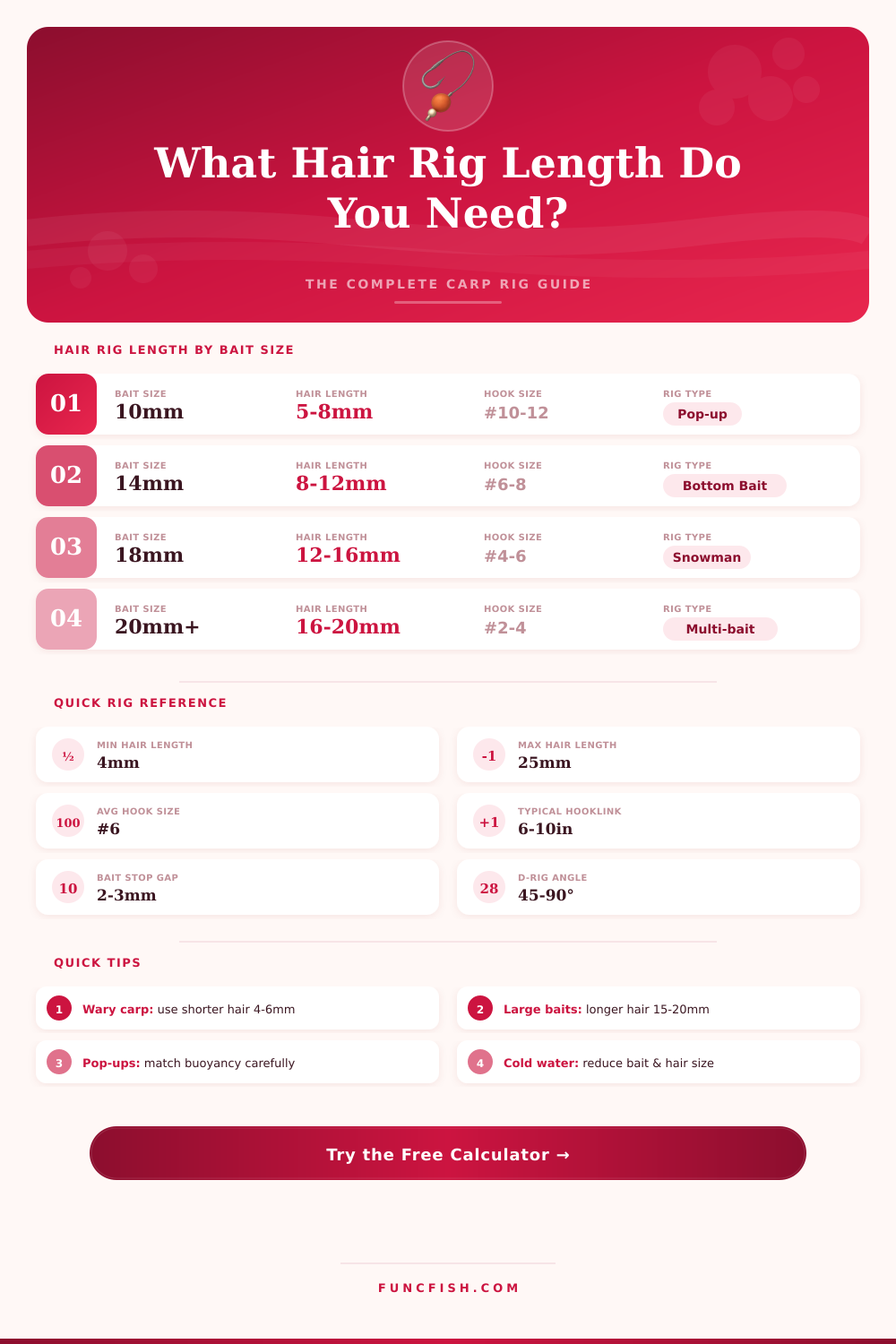
| Hook Size | Small Bait (6–12mm) | Standard Bait (12–18mm) | Large Bait (18mm+) |
|---|---|---|---|
| Size 2 | — | 12–16mm (0.47–0.63in) | 16–22mm (0.63–0.87in) |
| Size 4 | — | 10–14mm (0.39–0.55in) | 14–20mm (0.55–0.79in) |
| Size 6 | 6–10mm (0.24–0.39in) | 10–14mm (0.39–0.55in) | 12–18mm (0.47–0.71in) |
| Size 8 | 5–8mm (0.20–0.31in) | 8–12mm (0.31–0.47in) | 10–14mm (0.39–0.55in) |
| Size 10 | 4–7mm (0.16–0.28in) | 6–10mm (0.24–0.39in) | 8–12mm (0.31–0.47in) |
| Size 12 | 3–6mm (0.12–0.24in) | 5–8mm (0.20–0.31in) | — |
| Size 14 | 3–5mm (0.12–0.20in) | — | — |
| Species | Typical Weight | Recommended Hook | Hair Length |
|---|---|---|---|
| Common Carp | 5–25kg (11–55lb) | Size 4–8 | 10–18mm (0.39–0.71in) |
| Mirror Carp | 5–30kg (11–66lb) | Size 4–6 | 12–20mm (0.47–0.79in) |
| Grass Carp | 4–20kg (9–44lb) | Size 4–8 | 10–18mm (0.39–0.71in) |
| Tench | 0.5–4kg (1–9lb) | Size 8–12 | 4–8mm (0.16–0.31in) |
| Barbel | 1–8kg (2–18lb) | Size 8–12 | 5–10mm (0.20–0.39in) |
| Bream | 0.5–5kg (1–11lb) | Size 10–14 | 4–8mm (0.16–0.31in) |
| Rig Type | Best For | Hair Length Modifier | Hooklink Length |
|---|---|---|---|
| Bottom Bait | General carp fishing | Baseline (x1.0) | 15–30cm (6–12in) |
| Pop-Up / Critically Balanced | Weedy / silty bottoms | +15–25% longer | 15–25cm (6–10in) |
| Snowman | Pressured carp | +10–20% longer | 15–30cm (6–12in) |
| Chod Rig | Debris / weed beds | +5–10% longer | 3–10cm (1–4in) |
| Zig Rig | Mid-water feeding | Standard | 60–300cm (2–10ft) |
| D-Rig | Wary / pressured fish | Baseline (x1.0) | 10–20cm (4–8in) |
Hair length are another critical component of a hair rig. Hair length determine whether the hook can rotate when the fish takes the bait. If the hair is too short, the bait will cover the hook point and prevent the hook from turning.
If the hair is too long, it may look unnaturaly to a fish, and the fish may reject the bait. You must get the position of the bait relative to the hook geometry just right. The gap between the bend on the hook at the bottom of the bait is the most important measurement on a hair rig.
How to Set the Hair Length on a Hair Rig
You want this gap to be approximately one-third of the opening of the hook. Depending on the shape of the hook, the length of the hair will have to be different. Hooks with wide gaps on the hook will require more hair than a hook with a more curved shank because the wide gap hook has a more aggressive angle to the bait so the hook can flip over, whereas a curved shank hook will rotate more quick.
The type of lakebed you are fishing in will also affect the length of the hair on the rig. For example, if the lakebed is soft silt, the hook may bury in the lakebed, and if the hook cannot turn, it will not be able to catch the fish. The compression of the bait and the position of the stop on the hair will also affect the length of the hair.
For example, if the bait is a soft wafter, it may compress slightly on the hair. The stop on the hair prevents the bait from move on the hair; however, it must not mask the hook point. Additionally, if a kicker is used, the angle of the kicker will change the effective gap of the hook.
Thus, you will also have to adjust the length of the hair on the rig for the angle of the kicker. Many people makes the mistake of measuring the length of the hair from the base of the bait instead of from the position of the stop on the hair. The stop, the knot on the hook, or the tail rubber will all create an overhang to the bait that must be accounted for in the calculation of the length of the hair.
The length of the hair may also have to be adjusted according to the type of lakebed in which the fishing will take place. For instance, on gravel beds, short length of hair will work best because the hook will not get buried in the lakebed. However, on deep silt beds, longer length of hair will prevent the hook from getting buried in the lakebed.
Depending on the type of bait that you will use in the fishing rig, the length of the hair will have to be adjusted. For instance, bottom baits will work best with a tight and direct length of hair when the lakebed is hard. Wafters will work best with a more open presentation of the hair for silt beds.
Snowman rigs require longer length of hair because the top bait will lift the rig off the lakebed. However, hard baits will work best with a short and tight length of hair because the baits will not lift off the lakebed. Before putting the hair bait on the fishing line and going to fish the lakes, the hair bait should be test.
To test the hair bait, fold the bait over to the bend on the hook on a damp towel to ensure that the point of the hook is clear. Additionally, the bait should be dropped into a sample of the lakebed to ensure the hook will not get buried. Testing the hair bait will ensure that all the components will work in harmony for the hook to be able to catch the fish when the fish encounter the bait.