Haywire Twist Length Calculator
Estimate the extra single-strand wire needed for haywire wraps, barrel wraps, loop size, tag handling, and finished leader length before you cut a wire blank.
Measured as the usable loop opening around the hook, swivel, split ring, or lure eye.
Adds bend path for thicker hooks, swivels, snaps, or solid rings.
| Wire class | Approx strength | Diameter | Common use |
|---|---|---|---|
| #3 | 27 lb / 12 kg | 0.012 in / 0.30 mm | Small spoons, light mackerel rigs |
| #5 | 44 lb / 20 kg | 0.016 in / 0.41 mm | Kingfish live bait and bluefish leaders |
| #7 | 69 lb / 31 kg | 0.020 in / 0.51 mm | Barracuda plugs and heavier tooth leaders |
| #9 | 105 lb / 48 kg | 0.024 in / 0.61 mm | Wahoo, heavy lure, and trolling leaders |
| #12 | 174 lb / 79 kg | 0.031 in / 0.79 mm | Small shark and heavy offshore connections |
| Connection style | Haywire wraps | Barrel wraps | Length effect |
|---|---|---|---|
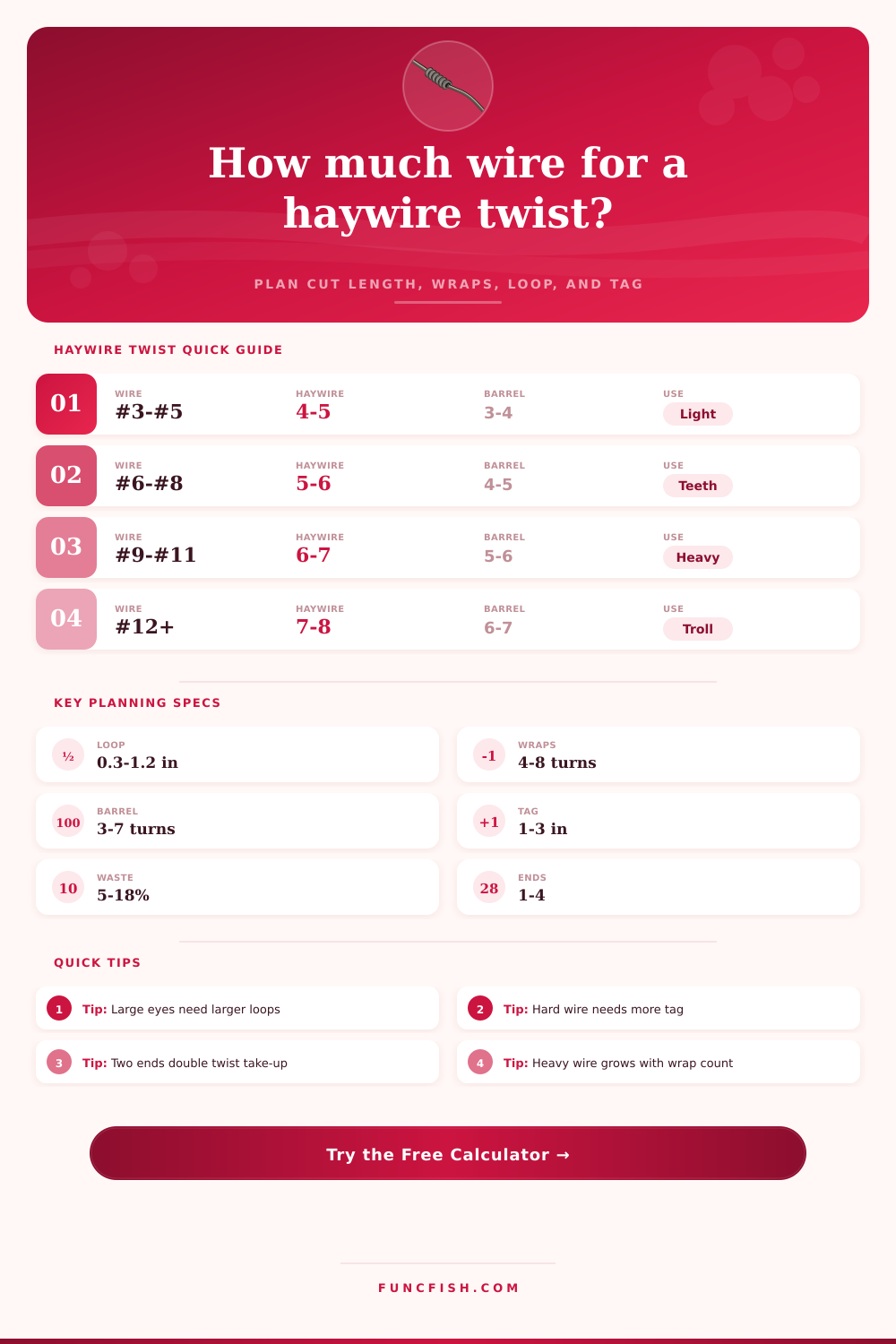
| Compact live bait loop | 4-5 | 3-4 | Shortest twist body; best with light wire and small eyes. |
| Standard tooth leader | 5-6 | 4-5 | Balanced length for hook and swivel ends. |
| Heavy lure loop | 6-7 | 5-6 | More wire consumed because both wire diameter and pitch rise. |
| Practice or rough water rig | 6-8 | 5-7 | Extra blank length leaves room for rework and broken tags. |
| Loop target | Inside opening | Terminal eye | Planning note |
|---|---|---|---|
| Small hook eye | 0.25-0.35 in / 6-9 mm | 0.08-0.12 in / 2-3 mm | Keeps live bait rigs short and clean. |
| Swivel or small solid ring | 0.35-0.55 in / 9-14 mm | 0.12-0.20 in / 3-5 mm | Good default for two-ended wire leaders. |
| Plug or lure eye | 0.55-0.85 in / 14-22 mm | 0.18-0.30 in / 5-8 mm | Lets the lure swing without binding. |
| Heavy circle hook | 0.75-1.25 in / 19-32 mm | 0.25-0.45 in / 6-11 mm | Needs more loop path and more tag to hold pliers. |
| Material behavior | Cut allowance | Wrap spacing | Best calculator setting |
|---|---|---|---|
| Bright stainless | Moderate | Predictable | Standard hand twist with 8-12% waste. |
| Hard tooth-proof wire | Higher | Can spring open | Practice allowance and longer tag. |
| Monel trolling wire | Moderate-high | Smooth but stiff | Open wraps for heavy trolling leaders. |
| Single-strand titanium | High | Elastic recovery | Longer tag and fewer aggressive bend-backs. |
A working connection to your tackle requires piece of wire the right length so you cut the leader down accordingly. Anglers waste fish due to measuring only ultimate distance from eye to eye. You forget there is real wire in the twist needed to go from a straight line to a curve. Haywire twist is all about geometry.
Do math wrong and end up buying a spool too large. If you have right input data, the calculator up top will do the math for you. Simply select species or rig load for which you want to build leaders. That will establish basic parameters of wire class and twist density.
How to Measure Wire for Leaders Correctly
The physical requirements placed on the metal can be completely different; a heavy trolling leader for wahoo is a very different set of parameters than live baits for king mackerels. Also, using the proper material makes a difference. Titanium, monel and stainless steel behaves differently when subjected to tension. Hard tooth-proof wire springs back and requires more tag allowance. This helps you keep a good grip with your pliers while closing the loop and fighting to get it done.
The trick is, that’s where folks mess it up. A five-wire wrap isn’t simply five times circumference of the strand. Pitch matter. As you choose twist spacing in the tool, you’re taking into account how close or far apart those coils sits from one another. Close wraps save wire but need a little more skill when using your pliers. Open wraps = forgiving if your hands shake at dusk, but eats up blank length fast. That’s what the reference tables on the page spell out.
A big diameter and a big pitch (for a heavy lure loop) mean more metal is used, not only because of increased diameter but also because of the increased pitch. You can’t simply add some arbitrary inch for good measure. You have to calculate it based off the actual loop size you need for your terminal tackle. Take for instance the eye of the swivel or hook you choose. Some hooks like a little offset bait hook has a tiny eye. They need a very tight loop that doesn’t add much length to the whole setup. Then compare that to a wide-gaped big trolling plug with a fat metal eye. The eye is big enough that the wire needs to wrap all the way around it. Then, it begins to twist back onto itself. All that is just the path the bend travels on. That’s dead weight in your leader. So if you don’t think about the diameter of terminal eye input, you’re going to wind up with a leader two inches shorter than it needs to be. This result in a broken hook eye or a weak connection when a toothy fish gets interested.
And don’t forget the tag. For every twist, you must leave enough excess wire to act as a tail that can be tucked snugly back into the barrel wrap. If too little, it will pop free when under pressure or fray away. If too much, you’ll get drag in the water or pick up the tail in the guide rings. With the pliers, you’re able to work on tag length to get amount of wiggle room you desire. The tougher, stiffer classes like number nine or twelve requires additional tags to ensure they tuck in securely. It is a small thing, but it makes the difference between your rig lasting in the salt or falling apart after one run.
The last variable that tells the frustrated angler apart from the prepared angler is waste. Yes, you are going to mess it up on the first twist. Perhaps even the next. By adding 10-15% to your cut length for rework and cutting errors, you ensure yourself not running out of wire in the middle of the session. That 10-15% compounds when you’re batch building a bunch of leaders. The calculator tells you a batch total as well as how long a cut blank should be each time. Mark your spool accordingly then head out.
The haywire twist isn’t something that’s learned by brute force. It’s a subtle art form that has a lot more to do with thoughtful planning than muscle power. Once you figure out what happens when you wrap it around this loop or tuck that tag against the wraps, all that guesswork stops. Instead, you begin measuring deliberatley. And your leaders are going to be cleaner, stronger, and exactly as long as you want them to be. Stop wasting time bumbling with pliers and spend more time on the water slinging lead.
Let’s face it. That’s what we’re really doing when we leave the dock anyway. You should of known that.