🧊 Ice Fishing Line Calculator
Find the ideal line weight, length & type for any ice fishing setup
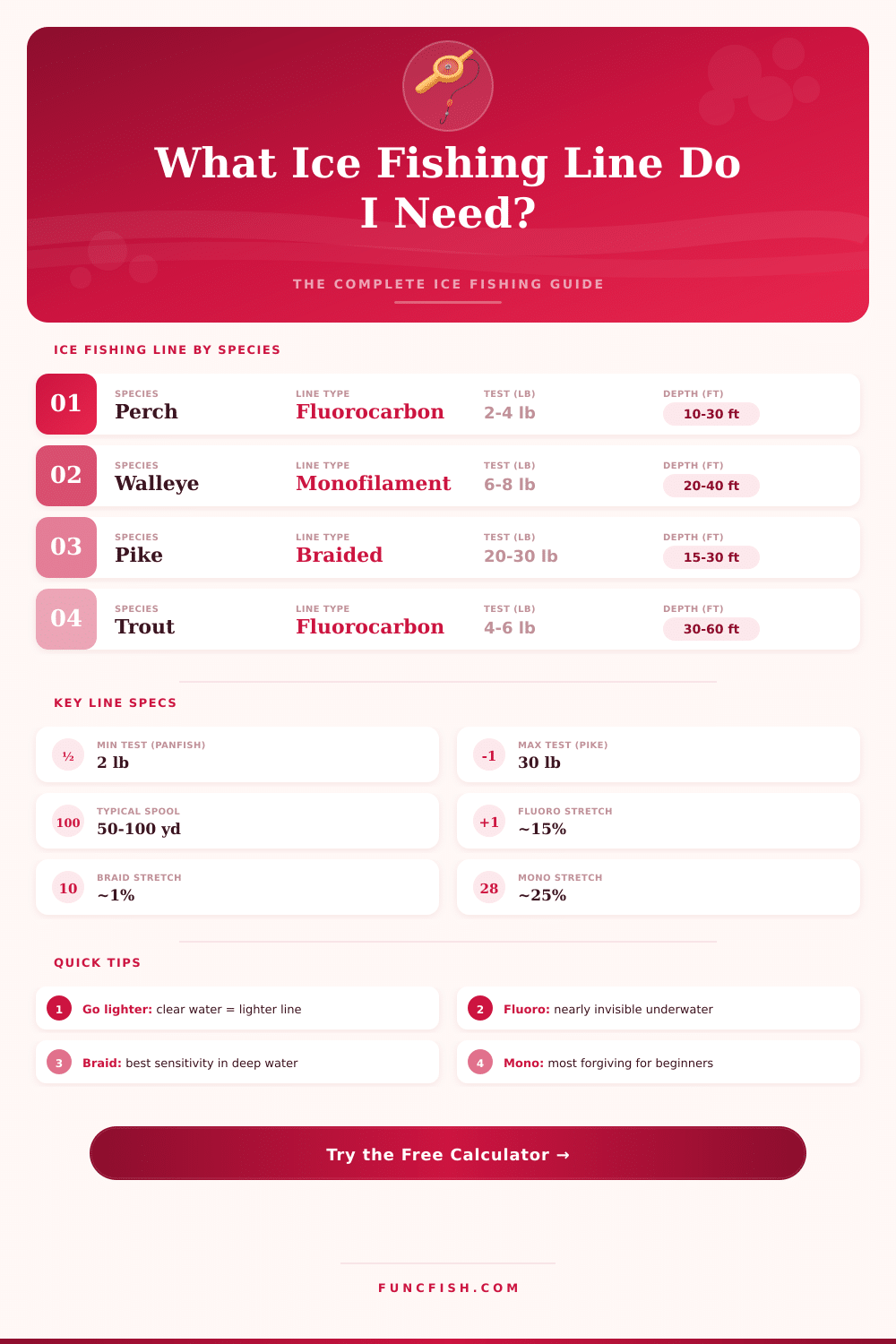
| Species | Line Type | Recommended Test | Avg Weight (lb) | Depth Range (ft) |
|---|---|---|---|---|
| Yellow Perch | Fluorocarbon | 2–4 lb | 0.3–1.5 | 10–30 |
| Bluegill | Fluorocarbon | 2–4 lb | 0.25–1.0 | 8–20 |
| Crappie | Mono / Fluoro | 4–6 lb | 0.5–2.0 | 10–25 |
| Walleye | Monofilament | 6–10 lb | 1.5–8.0 | 15–40 |
| Rainbow Trout | Fluorocarbon | 4–8 lb | 0.5–5.0 | 15–50 |
| Lake Trout | Braid + Leader | 10–20 lb | 5–25 | 40–150 |
| Kokanee | Mono / Fluoro | 4–6 lb | 0.5–3.0 | 30–80 |
| Smallmouth Bass | Fluorocarbon | 6–10 lb | 1.0–5.0 | 10–30 |
| Burbot | Braided | 10–20 lb | 2–10 | 25–80 |
| Northern Pike | Braided + Wire | 20–50 lb | 5–30 | 10–30 |
| Test (lb) | Mono Dia. (in) | Fluoro Dia. (in) | Braid Dia. (in) | Metric Test (kg) |
|---|---|---|---|---|
| 2 lb | 0.005" | 0.004" | 0.003" | 0.9 kg |
| 4 lb | 0.007" | 0.006" | 0.004" | 1.8 kg |
| 6 lb | 0.009" | 0.008" | 0.005" | 2.7 kg |
| 8 lb | 0.010" | 0.009" | 0.006" | 3.6 kg |
| 10 lb | 0.011" | 0.010" | 0.007" | 4.5 kg |
| 15 lb | 0.014" | 0.013" | 0.009" | 6.8 kg |
| 20 lb | 0.016" | 0.015" | 0.011" | 9.1 kg |
| 30 lb | 0.022" | 0.019" | 0.013" | 13.6 kg |
| Technique | Spool Length | Leader Length | Stretch % |
|---|---|---|---|
| Jigging (Panfish) | 25–50 yd | None | 15–25% |
| Deadstick Rod | 50–75 yd | 12–18 in | 15–25% |
| Tip-Up (Pike) | 75–150 yd | 12–24 in wire | 1–5% |
| Deep Jigging (Laker) | 100–200 yd | 24–36 in | 1–15% |
| Bobber / Float | 30–50 yd | 6–12 in | 15–25% |
Choosing the right Ice Fishing Line can be hard because there are so many options. In freshwater settings one uses mainly three kinds: monofilament, braided line and fluorocarbon. Each of them has its own benefits that depend on the conditions.
Monofilament probably stays the most liked all-around option. It gives great stretch and strength, which works well for tricky bites. As only one kind of Ice Fishing Line one would choose probably it thanks to its easy use and broad usage.
How to Choose the Right Ice Fishing Line
One likes monofilament also during fishing outside through holes. Usually one takes 4 to 6 pounds of test for normal walleye, and one goes up to 8 pounds when one expects bigger prey. For panfish 3 pounds of test work well, while 4 to 5 pounds fully work for walleye fishing.
Fluorocarbon lines almost never show in the water. That makes them ideal for very clear surroundings and for getting bites from nervous fish. Fluorocarbon resists much better than braid or mono against wear from fish teath and rubbing of the line at the edges of the ice hole.
Many anglers choose fluorocarbon as a leader instead of as a main line.
Braided line has no stretch and belongs to the most sensitive options. It lies the most directly, even with small weights. Even so, in cold settings it can cause problems, because it keeps water, which can make it freeze in the rings or on the spool.
When the temperature reaches 25 degrees or when one fishes inside a shelter, braid works surprisingly. But one must use a fluorocarbon leader, because braid shows badly under water and fish flee nervously from it. Softener four lines can help some against freezing on braid.
When the cold drops to minus 20 degrees or colder, one switches to mono for fishing outside, which is a wise decision.
Some brands really stand out. The Berkley Professional Ice Line has low memory, strong sensitivity and good handling. It comes on a big diameter spool, which clearly reduces the memory.
The Sufix Advance Ice Monofilament was made specially for Ice Fishing Line use. The Icetamer Braid is built for below-zero conditions.
For tips, waxed line for the top of the rod is the way without trouble. Unwaxed dacron sticks to the ice, gets stiff and it always knots up while one pulls fish. Some anglers put fly line on their reel, because it does not curl up like dacron on the bottom.
Smaller hook means line with moregame, because ice rods are so short to absorb struggles.