Lake Sturgeon Length Weight Calculator
Estimate lake sturgeon weight from fork or total length, girth, body depth, sex or maturity clue, river or lake habitat, growth region, and measurement confidence.
📌Lake sturgeon measurement presets
⚙Length, girth, depth, and biology inputs
Model: the calculator converts fork and total length to a shared body-length anchor, blends girth and body depth, then applies lake sturgeon habitat, growth-region, maturity, and confidence adjustments.
Lake sturgeon length-weight estimate
Calculator output appears here after entering measurements.
Calculation breakdown
📊Body-shape data grid
Fork Length
Maximum Girth
Body Depth
Confidence
📏Lake sturgeon length/weight grid
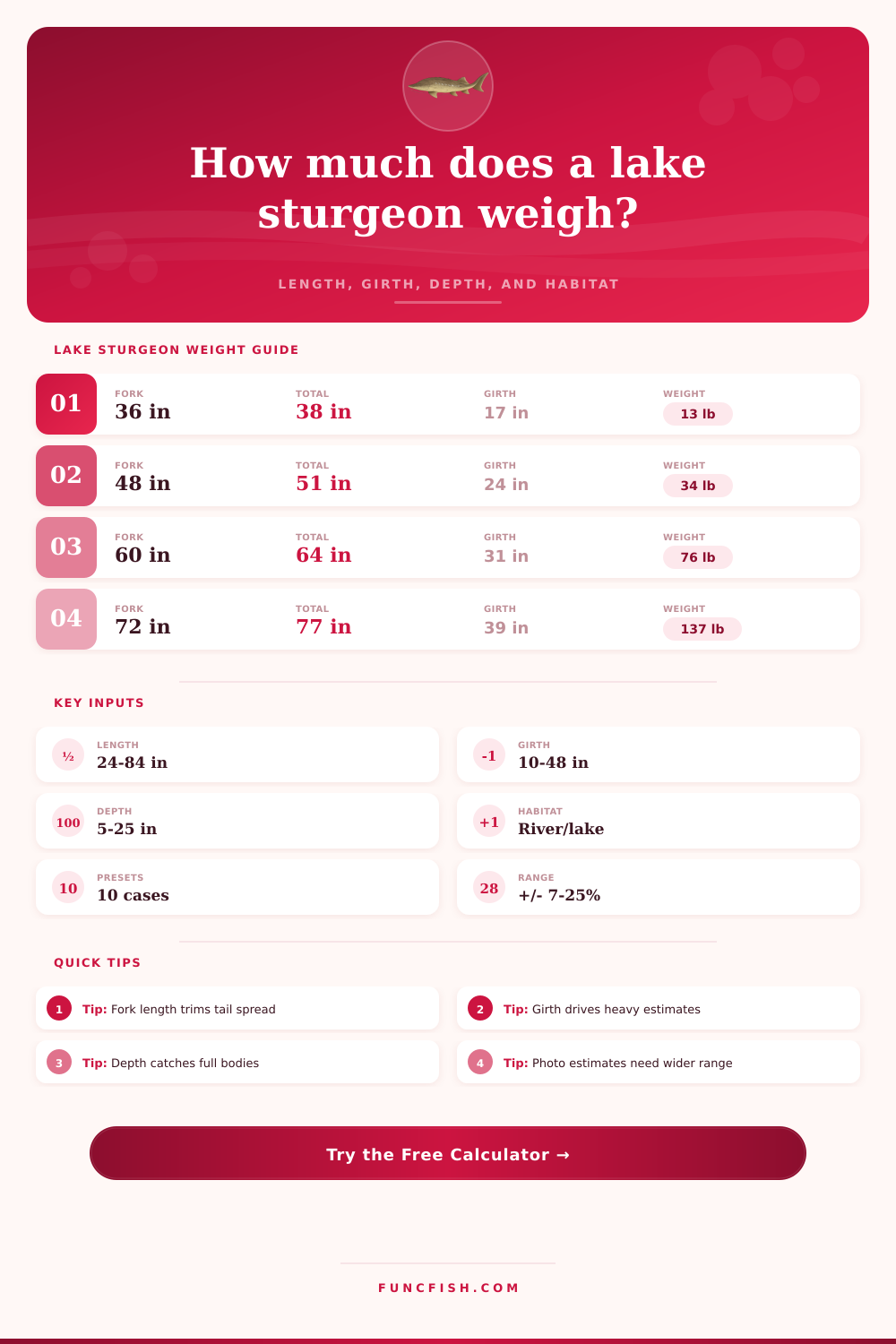
| Fork length | Total length estimate | Typical girth | Average weight clue | Age-band clue |
|---|---|---|---|---|
| 30 in / 76 cm | 32 in / 81 cm | 13-15 in / 33-38 cm | 7-11 lb / 3.2-5 kg | Juvenile, roughly 6-12 yr |
| 42 in / 107 cm | 45 in / 114 cm | 19-22 in / 48-56 cm | 20-31 lb / 9.1-14.1 kg | Maturing, roughly 12-22 yr |
| 54 in / 137 cm | 57 in / 145 cm | 26-30 in / 66-76 cm | 48-71 lb / 21.8-32.2 kg | Adult clue, roughly 20-38 yr |
| 66 in / 168 cm | 70 in / 178 cm | 34-38 in / 86-97 cm | 99-135 lb / 44.9-61.2 kg | Older adult, roughly 32-55 yr |
| 78 in / 198 cm | 83 in / 211 cm | 41-46 in / 104-117 cm | 170-235 lb / 77.1-106.6 kg | Large old fish, roughly 45-75 yr |
🌊Habitat and growth reference
| Habitat setting | Weight factor | Age clue | Body-shape signal |
|---|---|---|---|
| Great Lakes open water | 1.02 | Moderate to older | Long body with steady girth |
| Deep inland lake | 1.00 | Often slower growth | Balanced body depth |
| Large river channel | 0.98 | Broad age spread | Longer, slightly leaner body |
| Productive river reach | 1.06 | Younger at same length | Fuller girth when feeding is strong |
| Cold northern lake or river | 0.96 | Older at same length | Slow length gain, variable girth |
🔎Maturity and measurement reference
| Input cue | Calculator effect | Best supporting measure | Common bias |
|---|---|---|---|
| Immature fish | Caps age clue low | Fork length | Total length can read large |
| Adult male build | Neutral to lean condition | Girth plus depth | Overstating belly girth |
| Adult female build | Raises condition slightly | Depth at shoulder | Ignoring depth understates weight |
| Heavy mature female | Raises weight and range | Girth, depth, confidence | Treating all weight as length-based |
| Post-spawn or lean adult | Lowers condition | Measured girth | Length-only estimate too high |
| Confidence setting | Base range | Use when | Calculator note |
|---|---|---|---|
| High | 7% | Board, girth tape, depth measured | Narrowest practical estimate |
| Medium | 12% | Quick length and girth | Good field estimate |
| Photo | 18% | Scale reference or ruler board photo | Perspective can shift girth |
| Low | 25% | Memory or curved tape | Broad comparison only |
💡Measurement tips
Length tip: Fork length is the cleanest size anchor for lake sturgeon because total length changes with tail spread. If you only have total length, the calculator converts it before estimating body mass.
Body tip: Maximum girth changes the weight estimate faster than any other measurement. Body depth is the backup check that helps distinguish a long lean fish from a full-bodied adult.
Lake sturgeon is fish that grow slow and live for many decades. Due to the slow growth of lake sturgeon and the fact that they lives for many decades, the body shape of an lake sturgeon changes as the age and feeding habits of that lake sturgeon change over time. As a result of the change in body shape with age, the weight of a lake sturgeon can be difficult to estimate using only the length of the lake sturgeon.
The weight of a lake sturgeon can also change according to it’s girth (the circumference of the body around the middle), the depth of the shoulders of the lake sturgeon, and the habitat of the lake sturgeon. The calculator that is provided in this report use mathematics to estimate the weight of a lake sturgeon based off the various measurements of that lake sturgeon. The fork length (the length of the body from the tip of the snout to the center of the tail divided into two equal parts) of the lake sturgeon should be used as the length of that fish, as this measurement is stable along the life of the lake sturgeon, as opposed to the total length of the lake sturgeon, which can change with the angle of the tail of the fish.
How to Estimate Lake Sturgeon Weight and Age
The girth of the lake sturgeon is important in determining the weight of the sturgeon, as the girth of a lake sturgeon contribute the majority of the weight of that fish, as the volume of the fish increases at a faster rate then the length of the sturgeon. Additionally, you should also input the body depth of the lake sturgeon into the calculator to provide a second means of determining the body shape of the lake sturgeon, as body depth can reveal if the female lake sturgeon is carrying egg, or if that lake sturgeon has broad shoulders. Additionally, the habitat of the lake sturgeon should be inputted into the calculator, as well as the growth region of the lake sturgeon; lake sturgeon in productive rivers will be of a greater mass than lake sturgeon of the same length that live in cold northern lake.
Additionally, its sex can determine the maturity of the lake sturgeon; heavy female lake sturgeon will contain more mass than adult male lake sturgeon of the same length. Additionally, the age of the lake sturgeon can determine the maturity of the lake sturgeon again; a female lake sturgeon will shed its eggs after spawning, and, therefore, will appear to contain less mass than other lake sturgeon of the same length. While many may attempt to use only the length of the lake sturgeon to determine its weight, this data may work well for lake sturgeon that is of average build and age.
However, using only the length of the lake sturgeon will not provide accurate data regarding the weight of lake sturgeon with extreme body compositions. For instance, a long and skinny lake sturgeon will have less mass than a shorter and deeper lake sturgeon. Data regarding the weight of a lake sturgeon can be gained through the use of condition scores for that fish; a score near 100 represents the expected weight of the lake sturgeon for its length and habitat.
Scores below 90 indicate a lean or recovering lake sturgeon; scores above 110 indicate a full-bodied lake sturgeon that may be carrying eggs. Age estimates for a lake sturgeon are calculate in a similar way that the weight of a lake sturgeon is calculated. Using only the length of the sturgeon provides a rough estimate of the age of that fish.
However, additional data regarding the growth region of the lake sturgeon and the maturity of the lake sturgeon will lead to a more accurate estimate of the age of the lake sturgeon. For instance, a lake sturgeon of a certain length can be several years old in a lake sturgeon that is known to be prone to slow growth, as compared to a lake of the same length in a warm and productive river system. Additionally, the report provides the age of the lake sturgeon as an age-band rather than the actual age of the lake sturgeon, as the age of the lake sturgeon may vary according to the life story of that individual lake sturgeon.
For instance, a lake sturgeon with a high age-band may be a maturing subadult lake sturgeon, as compared to a lake sturgeon with a low age-band that is an older adult lake sturgeon. The quality of the measurements that are provided for the lake sturgeon will impact the reliability of the weight estimate of that lake sturgeon. For example, utilizing a straight board to measure the length of the lake sturgeon, as well as utilizing a snug tape measure to measure the girth of the lake sturgeon will result in the most narrow range of possible error.
However, estimating the length of the lake sturgeon from photographs will result in a wider range of possible error than utilizing physical measuring tools. The same is true for estimating the girth or depth of the lake sturgeon based upon memory of its physical form, or utilizing a curved tape measure. These different methods of measuring the lake sturgeon will impact the confidence level in the data regarding the weight of the lake sturgeon, which is one reason that the calculator incorporates these confidence levels for the different measurements.
Various individuals can benefit from the calculator. For instance, field biologists who monitor the health of lake sturgeon populations can utilize the condition score of the lake sturgeon to determine the health of the lake sturgeon population; healthy populations will have mostly scores near 100, as compared to populations with scores that are below 90 or above 110. Additionally, these biologists can use the maturity of the lake sturgeon to determine if the habitat is reproductively productive for the species; a high number of mature lake sturgeon indicates a healthy lake and lake sturgeon population.
Finally, anglers can use this calculator to gather data regarding the lake sturgeon that they have harvested from the lake, but without harming the lake sturgeon species. The data inputs are important in that each input reflect some aspect of the biology of the lake sturgeon species. For instance, the habitat input indicates the feeding opportunity of the lake sturgeon, as lake sturgeon in productive lakes and rivers will contain more mass than those that live in lakes with less productivity in the river systems.
Additionally, the maturity input of the calculator indicates the reproductive status of the lake sturgeon, as a female lake sturgeon with high reproductive status will have higher mass than a male of the same length, and a post-spawn lake sturgeon will have less mass than an adult sturgeon of the same length. Common mistakes can be made when determining the weight of a lake sturgeon. For instance, ignoring the habitat of the lake sturgeon will result in inaccurate data for the age of the lake sturgeon.
A lake sturgeon that is determined to have a certain length in a less productive lake will be underweighted in relation to other lake sturgeon of the same length from different habitats. Additionally, if the depth of the lake sturgeon is skipped in measurement, the mass of the lake sturgeon will be understated; especially if the lake sturgeon is a female with broad shoulders. Additionally, if the total length of the lake sturgeon is used in place of the fork length measurement, the mass of the lake sturgeon will be inaccurately measured, and the error will increase with the size of the lake sturgeon.
The calculator will correct these errors for the lake sturgeon, so that the individual need not remember these common errors. The size of a lake sturgeon is not the same as its age. For instance, a lake sturgeon that measures 70 inches in length may be 40 years old if it grew up in a cold northern lake, but may be only 60 years of age if it lived in a warm lake with abundant food resources for the lake sturgeon.
However, if the length, girth, depth, and location of the lake sturgeon can be accurately recorded, information regarding the strength of each year-class of lake sturgeon can be gained without having to kill any of the sturgeons for determination of their age. The value of the calculator is based upon the fact that the body of the lake sturgeon may vary based upon the season of the year, the sex of the lake sturgeon, and the location of the lake sturgeon. Additionally, because the calculator incorporates elements of the habitat, growth region, and maturity of the lake sturgeon, the estimate of the weight of the lake sturgeon is likely to be close to the actual weight of the lake sturgeon.
Thus, the measurements of the lake sturgeon are more valuable with the use of this calculator, as it accounts for the biology of the species.