🐟 Lake Trout Weight Calculator
Estimate lake trout weight from length & girth — imperial & metric supported
| Length (in) | Length (cm) | Avg Girth (in) | Est. Weight (lb) | Est. Weight (kg) | Classification |
|---|---|---|---|---|---|
| 14 | 35.6 | 8 | 1.1 | 0.5 | Sub-Legal |
| 16 | 40.6 | 9 | 1.6 | 0.7 | Small |
| 18 | 45.7 | 10 | 2.3 | 1.0 | Small |
| 20 | 50.8 | 11 | 3.0 | 1.4 | Average |
| 22 | 55.9 | 12 | 4.0 | 1.8 | Average |
| 24 | 61.0 | 13 | 5.2 | 2.4 | Good |
| 26 | 66.0 | 14 | 6.4 | 2.9 | Good |
| 28 | 71.1 | 15 | 7.9 | 3.6 | Good |
| 30 | 76.2 | 16 | 9.6 | 4.4 | Trophy |
| 32 | 81.3 | 17 | 11.6 | 5.3 | Trophy |
| 34 | 86.4 | 18 | 13.8 | 6.3 | Trophy |
| 36 | 91.4 | 19 | 16.2 | 7.4 | Big Trophy |
| 40 | 101.6 | 21 | 22.1 | 10.0 | World-Class |
| Formula Name | Formula | Best For | Accuracy |
|---|---|---|---|
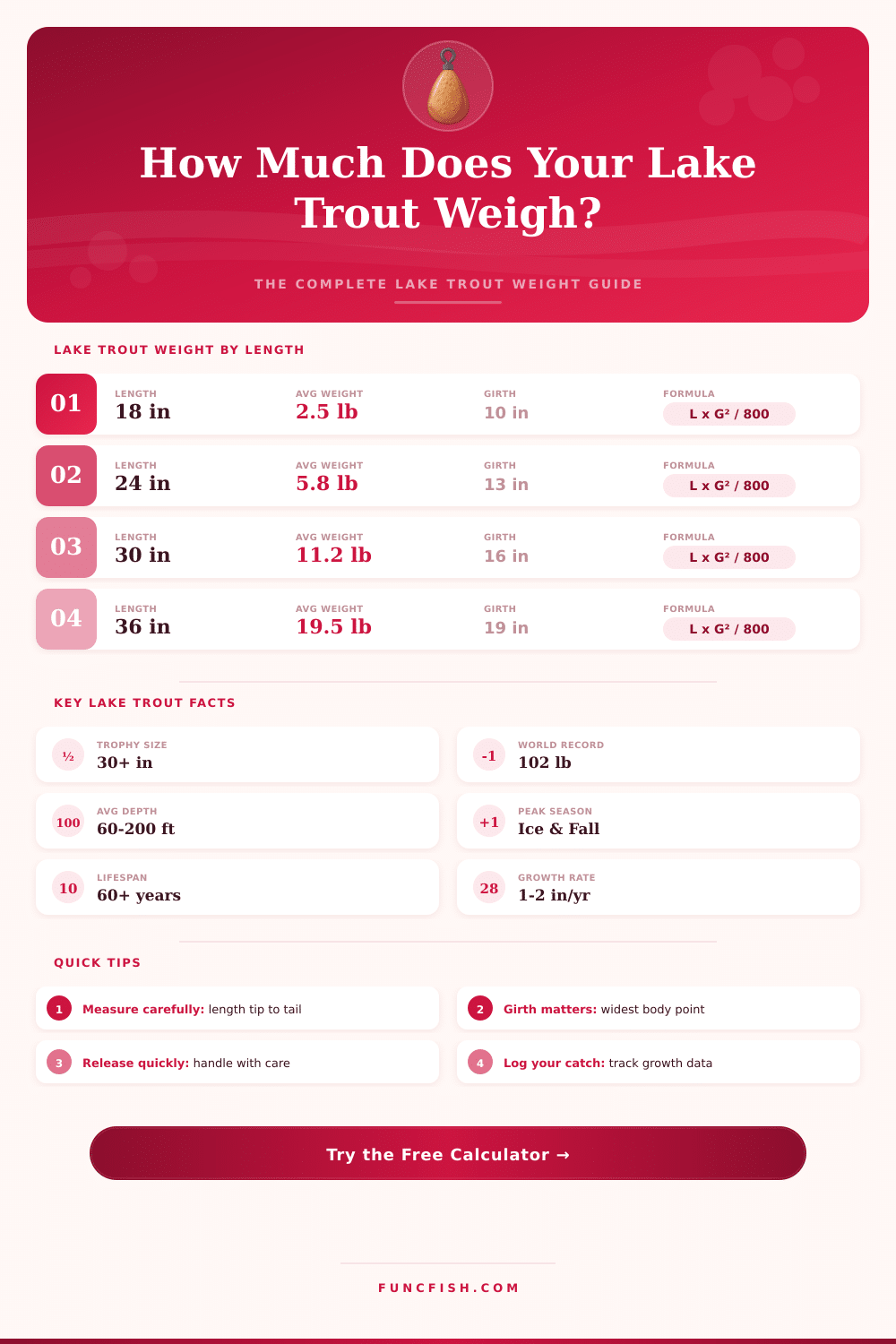
| Standard Girth Formula | L × G² / 800 | Lake Trout (standard) | ±5% |
| Length-Only (Regression) | 0.000304 × L³ | No girth available | ±15% |
| Fork Length Girth | FL × G² / 750 | Fork measurement | ±7% |
| Slim Body Factor | L × G² / 900 | Lean/post-spawn fish | ±6% |
| Chunky Body Factor | L × G² / 700 | Fall/heavy fish | ±6% |
| Juvenile Formula | 0.00028 × L³ | Fingerlings (<12 in) | ±10% |
| Species | Typical Weight | Formula Divisor | Trophy Weight | Depth Range |
|---|---|---|---|---|
| Lake Trout | 3–15 lb | 800 | 30+ lb | 60–200 ft |
| Rainbow Trout | 1–5 lb | 900 | 15+ lb | 5–40 ft |
| Brown Trout | 1–8 lb | 850 | 20+ lb | 5–60 ft |
| Brook Trout | 0.5–3 lb | 950 | 8+ lb | 5–30 ft |
| Chinook Salmon | 10–30 lb | 775 | 50+ lb | 30–150 ft |
| Coho Salmon | 5–15 lb | 800 | 25+ lb | 20–100 ft |
| Arctic Char | 2–10 lb | 820 | 20+ lb | 40–120 ft |
Get crisp skin on fish is a task harder than one could believe. When the fish touches the hot pan, it right away starts curling up what causes uneven cook and skin, that becomes soft instead of crisp. Here the fish press helps well.
It presses the whole fish against the surface of the pan and holds it there, allowing the skin to cook evenly during the inside of the meat cooks steady. Like this the pressure spreads above every part, something what you can not reach simply by hand or spatula. Outside the fish press like that for hamburgers.
Make fish skin crisp and weigh your fish
A good option is the model from stainless steel of Josh Niland, that one can get quickly in United States or Canada. Some folks even used little iron weights as a quick replacement… Because in the end it only is a heavy metal plate with handle.
Even so here is the key: real fish presses are heavy built for their size thus simpler to wash after use.
Now guessing the weight of fish truly is an entirely other thing. Here is a simple formula that works well for Lake Trout. Take the length, multiply it by the girth, later multiply that again by the girth, and divide the result by 800.
Both those measures must be in inches, and the result gives the weight in pounds. For instance, if you caught a fish of 29 inches long with 15-inch girth, put thsoe values in the formula. According to how the fish that you caught are heavier or lighter than average, you can change the number 800 a bit upward or down.
No girth measure ready? Do not matter. You can guess it by 0.58 times the length of the fish.
This method also counts for sea species like tarpon. Even so, those calculations not always work out. Long and slim fish could cause too high a guess compared too the real weight, and the length not always match exactly with what the weight shows.
To weigh fish truly, most people use scales with a built-in lip grip. You simply hook it right in the center of the bottom jaw of the fish. If your scale only has hooks, you can add a separate lip grip and later subtract its weight from the whole.
Other good option is born hanging digital scales… Some of them have lit screen and small buttons for more easy use.
Here is something important to note: fish lose weight after one takes it from the water. Blood loss, vomiting or damage are causes, but usually drying is the main reason. Fish naturally manage their internal water through body balance, so the weight during capture can differ from the weightlater.
Because of that, the length sometimes gives a more reliable idea for certain species… It stays the same, while weight can range.