Planer Board Offset Calculator
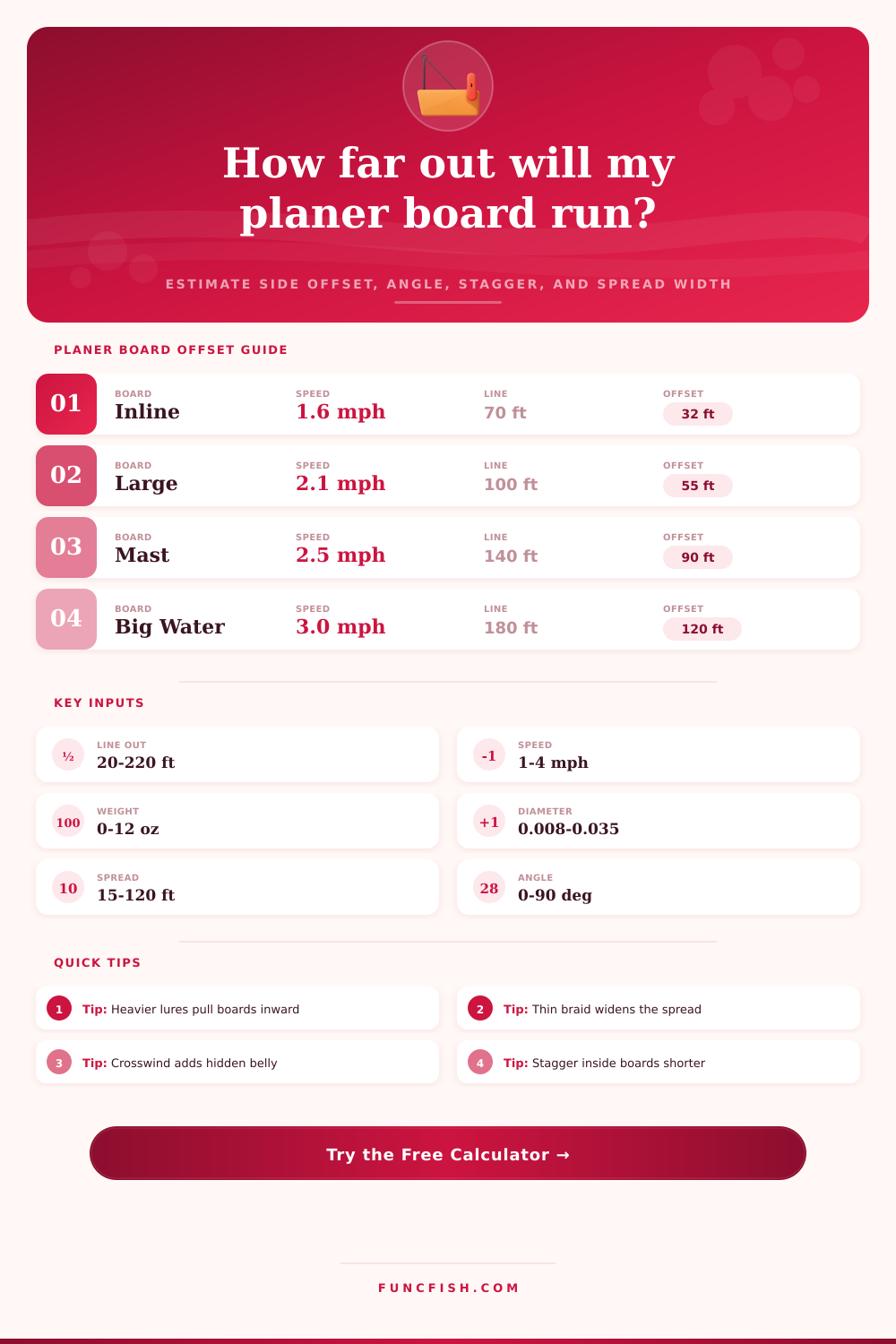
Estimate planer board side offset, tow angle, lure stagger, and total trolling spread width from line out, speed, board size, lure drag, weight, current or wind angle, line diameter, and rod position.
📌Trolling spread presets
⚙Board, line, lure, and spread inputs
Planer board spread estimate
Side offset, tow angle, stagger, and spread width will appear here.
Detailed breakdown
📊Board, line, and lure comparison grid
Standard Inline
Large Inline
Mast Board
Thin Braid
📐Reference tables
| Board type | Pull factor | Practical line out | Typical use |
|---|---|---|---|
| Micro inline board | 0.62 | 20-70 ft / 6-21 m | Crappie, kokanee, trout in calm water |
| Standard inline board | 1.00 | 45-115 ft / 14-35 m | Walleye, trout, small salmon spreads |
| Large inline board | 1.24 | 70-155 ft / 21-47 m | Leadcore, snap weights, crankbaits |
| Dual-keel board | 1.38 | 80-175 ft / 24-53 m | Rough water or heavier inside loads |
| Large mast board | 1.72 | 120-260 ft / 37-79 m | Big-water salmon, trout, striper spreads |
| Line material | Drag factor | Diameter cue | Offset effect |
|---|---|---|---|
| Braided line | 0.72 | 0.008-0.014 in / 0.20-0.36 mm | Runs widest because water drag is low |
| Monofilament | 1.00 | 0.010-0.024 in / 0.25-0.61 mm | Baseline spread with forgiving stretch |
| Fluorocarbon | 1.08 | 0.010-0.026 in / 0.25-0.66 mm | Slightly narrower when used as main line |
| Wire line | 1.18 | 0.015-0.030 in / 0.38-0.76 mm | Can pull hard and reduce board angle |
| Lead core or copper | 1.35-1.52 | Weighted trolling line | Needs larger boards and more stagger |
| Lure or rig | Drag factor | Weight range | Spread note |
|---|---|---|---|
| Spoon, fly, or small minnow bait | 0.80-0.95 | 0-1 oz / 0-28 g | Best for wide outside lanes |
| Crawler harness or shallow crank | 1.05-1.18 | 0.5-2 oz / 14-57 g | Good middle board load |
| Deep crankbait or flasher | 1.28-1.48 | 1-4 oz / 28-113 g | Shorten line or use bigger board |
| Umbrella rig or large musky plug | 1.70-1.95 | 2-12 oz / 57-340 g | Often belongs on inside or mast line |
| Target spread | Per-side offset | Board setup | Stagger cue |
|---|---|---|---|
| Narrow boat pass | 15-25 ft / 5-8 m | Micro or standard inline | Inside 10-20 ft shorter |
| General walleye spread | 30-50 ft / 9-15 m | Standard or large inline | Middle 20-35 ft behind outside |
| Open-water salmon spread | 55-90 ft / 17-27 m | Large inline or mast board | Outside farthest, inside shortest |
| Big-water search spread | 90-140 ft / 27-43 m | Mast or tournament board | Leave big turns and wave clearance |
💡Offset calculation tips
Heavy-load cue: If the calculator shows a low tow angle with a heavy lure, move that rod inside, shorten the board line, or step up to a larger board so outside lanes still clear during turns.
Wind and current cue: A cross push can make the downwind board look wide while adding belly behind the boat. Use the adjusted spread width for spacing, not the apparent surface track alone.
There are many different small choices that you can make while trolling with planer boards. Each of these small choices compounds quickly. For instance, you must choose your lines, the speed at which you troll, and how far each planer board will run from the boat.
A planer board that travels thirty feet from the boat will cover a different area of the water than a planer board that travels sixty feet from the boat. Each of these factors impact how many fishing rod you can carry, how tight of a turn you can make with your boat, and how the crosswind may impact your trolling lanes. In order to calculate the offset of each planer board, two forces must be balance against one another.
How to Set Up Planer Boards
One of these forces is the planer board itself, which naturaly wants to plane the boat and the line outward from the boat. The other of these forces is the lure and the line itself, which naturaly want to pull the planer boards and the line back towards the boat tracks. The increased speed of the boat will increase the force of the planer board more quick than it will increase the drag of the line.
Therefore, the same planer board and the same lure will produce different results at two miles per hour compared to three miles per hour. The angle of the planer board is the result of these two forces, and the line length multiplied by the sine of the angle of the planer board after accounting for the belly of the line represents the distance of the planer boards travel. The lines that you use for trolling will impact both the calculation of the offset of the planer board and the distance that the lure will travel.
Braided lines will cause less belly than lines that is made of monofilament or fluorocarbon. Lines that have more weight to them, such as lead core lines, will require more distance from the boat to the planer board to balance the forces between the boat, the line, and the lure. Additionally, thicker lines will impact the offset of the planer board due to the increased resistance that it will have while trolling.
Both wind and current will complicate the planer board setup. Crosswinds will not only move the planer boards, but they will also add belly to the line behind the boat. The belly of the line will make it so that the line appears to have a larger spread on the water than the trolling lure itself.
The calculator of the planer board offset will adjust for this belly of the line because otherwise, the result will be surprising when the boat begins to turn. Therefore, by adjusting for the belly of the line, the calculator will present to the angler an offset that will work well with the trolling gear and wont require surprises from the angler. The distance between the trolling lures is another important distance to calculate.
Each lure will travel in different angle, so there must be enough distance between each lure for the inside lures to clear the outside lures during turns in the water. The cosine of the angle at which the planer board will travel multiplied by the setback of each rod from the boat calculates the distance between each lure. This distance can be used to decide whether to move one rod forward or another rod backward from the boat.
Another decision that must be made is the size of the planer board. One might opt for a larger planer board for situations where snap weights or deep cranks is use. Alternatively, a smaller planer board is lighter and more responsive to changes in the trolling gear, but will collapse in the water if the drag of the bait is too strong relative to the force of the planer board.
Therefore, the angler should of choose a size for the planer board that matches the gear that will be used, which can be determined from reference table. The spread of the planer boards on the ramp will change once the boat is moving through the water. The speed of the boat and the conditions in the water will change the spread of the planer boards.
One should use the result of the calculator as a starting point for trolling with the planer boards. One should never use the calculator as a fixed map of the water that will be trolled. Instead, one should make a pass with the boat, watch the spread of the planer boards, and adjust one variable at a time.
The calculator allows anglers to remove guesswork from trolling with planer boards by explaining to them how each variable impact each other. Getting the offset of the planer boards just right is important for trolling. If the spread is too wide, the planer boards will collapse on the inside of the turn.
Additionally, the spread of the lines may cause them to tangle. A spread that is too narrow for the boat and trolling gear wastes water and reduces the area of the water that can be covered during a single pass of the boat. Getting the offset right allows the boat to efficient work a section of the water, and it ensures that the angler does not have to continually manage the gear and the spread of the planer boards.