🐟 Saltwater Fly Leader Calculator
Build a perfectly tapered leader for any saltwater species — butt, mid, and tippet sections calculated instantly
| Diameter (in) | Diameter (mm) | Approx lb (Fluoro) | Approx lb (Mono) | Common Use |
|---|---|---|---|---|
| 0.017 in | 0.43 mm | 8 lb | 8 lb | Light tippet (bonefish) |
| 0.019 in | 0.48 mm | 10 lb | 10 lb | Bonefish / permit |
| 0.021 in | 0.53 mm | 12 lb | 12 lb | Bonefish / redfish |
| 0.023 in | 0.58 mm | 16 lb | 15 lb | Permit / redfish |
| 0.025 in | 0.64 mm | 20 lb | 18 lb | Striped bass / snook |
| 0.030 in | 0.76 mm | 30 lb | 25 lb | Cobia / heavy tippet |
| 0.040 in | 1.02 mm | 60 lb | 50 lb | Shock tippet (tarpon) |
| 0.050 in | 1.27 mm | 80 lb | 70 lb | Shock tippet (tarpon) |
| 0.060 in | 1.52 mm | 100 lb | 90 lb | Shock (billfish) |
| Species | Typical Weight | Leader Length | Tippet (lb) | Shock Tippet | Fly Line wt |
|---|---|---|---|---|---|
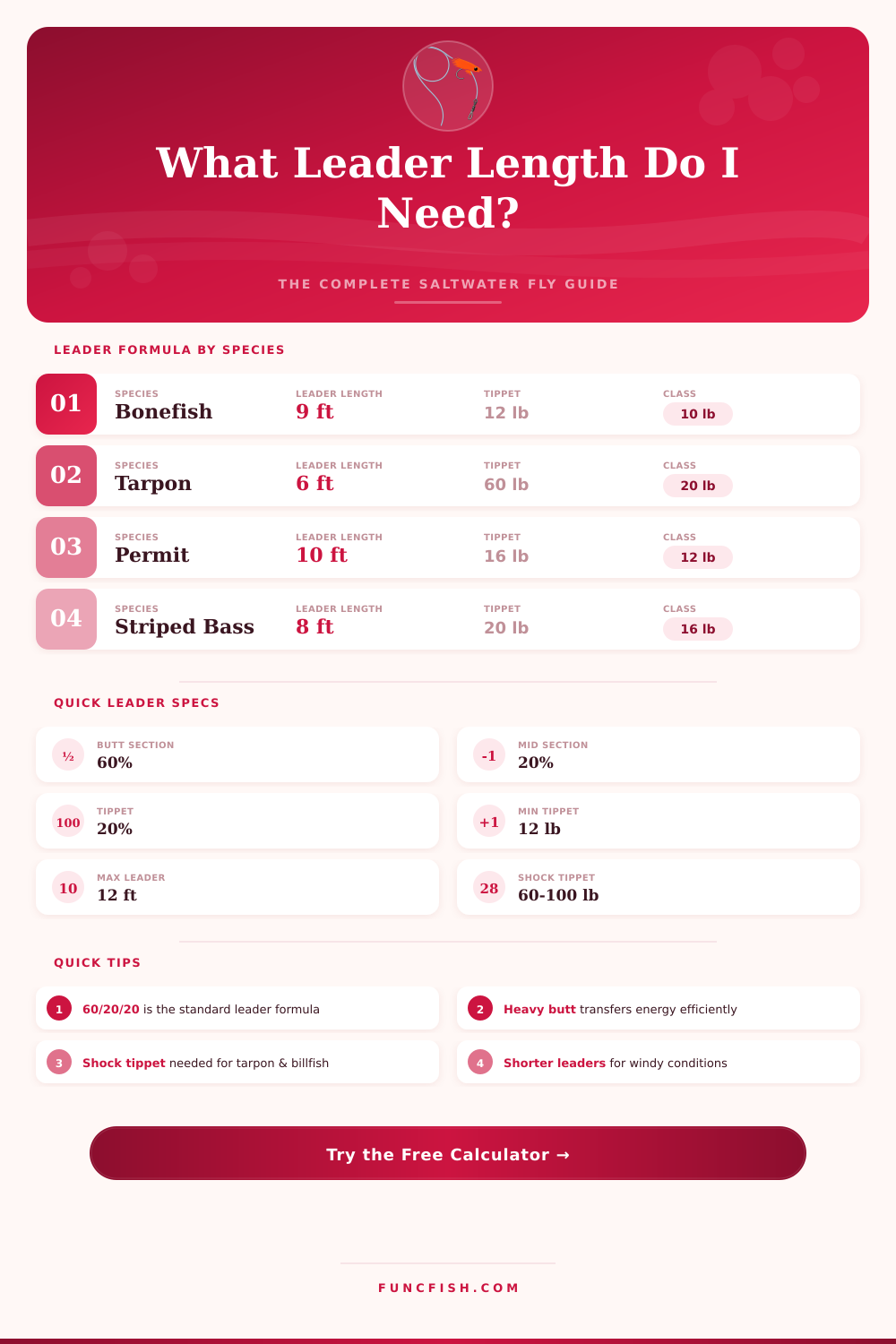
| Bonefish | 2–12 lb | 9–12 ft | 10–12 lb | None | 7–9 wt |
| Tarpon (large) | 50–200 lb | 5–7 ft | 40–60 lb | 60–100 lb | 11–12 wt |
| Tarpon (baby) | 5–30 lb | 8–9 ft | 20 lb | None–40 lb | 8–9 wt |
| Permit | 5–40 lb | 9–12 ft | 12–16 lb | None | 8–9 wt |
| Redfish | 3–20 lb | 7–9 ft | 12–20 lb | None | 7–9 wt |
| Snook | 5–30 lb | 7–9 ft | 16–20 lb | None–30 lb | 8–10 wt |
| Striped Bass | 5–60 lb | 7.5–9 ft | 16–25 lb | None | 8–10 wt |
| Sailfish | 40–150 lb | 6–8 ft | 50–80 lb | 80–100 lb | 12–14 wt |
| Mahi-Mahi | 5–50 lb | 7.5–9 ft | 16–25 lb | None | 9–11 wt |
| Cobia | 10–60 lb | 7–9 ft | 25–40 lb | None | 9–11 wt |
| Bluefish | 2–20 lb | 6–8 ft | 20–30 lb | Wire (45 lb) | 8–10 wt |
| Fly Line wt | Butt Dia (in) | Butt Dia (mm) | Butt Strength (approx lb) | Recommended Butt Material |
|---|---|---|---|---|
| 6 wt | 0.019–0.021 | 0.48–0.53 | 10–12 lb | Nylon Mono |
| 7 wt | 0.021–0.023 | 0.53–0.58 | 12–16 lb | Nylon Mono |
| 8 wt | 0.025–0.030 | 0.64–0.76 | 20–25 lb | Hard Mono |
| 9 wt | 0.030–0.035 | 0.76–0.89 | 25–30 lb | Hard Mono |
| 10 wt | 0.035–0.040 | 0.89–1.02 | 30–40 lb | Hard Mono or Stiff Fluoro |
| 11 wt | 0.040–0.045 | 1.02–1.14 | 40–50 lb | Hard Mono |
| 12 wt | 0.045–0.055 | 1.14–1.40 | 50–60 lb | Hard Mono |
A saltwater leaders is a piece of fishing line that connects a fly fishing rod to a fly. When anglers go fishing, a saltwater leader is important to have in place between the fishing rod and a fly. If the saltwater leader are constructed incorrectly, the fish will escape when it is being strike by the saltwater fish.
Saltwater fishing environments are more difficult than freshwater fishing environments because saltwater environments often features high winds, skittish fish, and various type of abrasive rocks or coral. A saltwater leader is comprise of different sections of fishing line. The first section of a saltwater leader is the butt section.
How to Build a Saltwater Leader
The butt section is the thickest part of a saltwater leader. The butt section transfer the energy from the fishing line to the fly. If the anglers are use large flies or fishing in high winds, the butt section of the saltwater leader should be thicker.
Using a thicker butt section will allow the butt section of the saltwater leader to turn the fly over in the air. Using a thin butt section can cause the fly to collapse due to the wind. For example, if the anglers are using a four-inch baitfish fly, it will need to be cast in fifteen mile per hour winds, the butt section will need to take up approximately 30 percent of the total length of the saltwater leader.
Depending on the type of fishing the anglers will be doing in specific areas, called presentation lanes, the saltwater leader will be divide into sections differently. If the anglers are fishing on long flats, the class section will need to be longer so that the fly will enter the water in a delicate fashion. In this case, the class section should make up 40 percent of the total length of the saltwater leader.
However, if the anglers are fishing near mangroves or bridges, the butt section will need to be heavier with a shorter class section of the saltwater leader. This is because there will be more strength require to fight the fish when they are near the mangroves or bridges near there roots. For example, if the anglers are fishing for bonefish, the saltwater leader will be 11 feet with a light tippet.
However, if the anglers are fishing for tarpon, the saltwater leader will be 10 feet with a 60-pound shock. The type of material used in the saltwater leader will change the stiffness of the saltwater leader as well as how visible the saltwater leader will be in the water. The two most common materials for saltwater leaders are nylon and fluorocarbon.
Nylon is supple, which allow it to turn over well when the anglers are fishing in warm weather. Fluorocarbon is very clear in the water; however, fluorocarbon is more difficult to use when there is high wind because the material is stiffer than nylon. If the anglers are fishing for fish species that has teeth, such as bluefish, anglers must use wire tippets because wire tippets are resistant to the teeth of the fish while fluorocarbon is not.
Additionally, if the anglers are fishing near oyster bars or rock jetties, the anglers must increase the shock strength of the saltwater leader because these areas are abrasive and tend to saw through the saltwater leader. The clarity of the water and the size of the fish will also dictate how the anglers build their saltwater leaders. In very clear water, the class section of the saltwater leader will need to be longer with a lighter test so the saltwater leader will not spook the fish.
In cases of stained or murky water, where the fish will not be able to see the saltwater leader in the water, the saltwater leader do not need to be as thin as in clear water. In this case, the saltwater leader will be shorter and stouter. The size of the fish is another factor in building a saltwater leader.
Because a large fish will place more pressure on the saltwater leader than a small fish, the anglers must appropriately scale the shock strength of the saltwater leader according to the size of the fish and the environment in which it lives. Many anglers makes the mistake of only fixing one part of the saltwater leader when an entire saltwater leader system needs to be balance. For instance, if the wind is causing the anglers to have problems with their fishing line, they should not just shorten the class section of the saltwater leader.
Shortening the class section can cause the fly to make alot of noises when it enters the water. Instead, they should beef up the butt section and the midsection of the saltwater leader. The anglers should also ensure that the shock section is not too long because the shock section that is too long will cause the big flies to collapse.
Finally, using a strong knot, such as blood knot or uni knots, will ensure that the saltwater leader does not break when the fish begin to pull on the line.