🎣 Pole Rig Elastic Rating Calculator
Find the perfect elastic grade for your pole fishing setup — match species, method & bung depth instantly
| Grade | Diameter (mm) | Max Fish Weight | Typical Use | PTFE Bush |
|---|---|---|---|---|
| Grade 1–3 | 0.5–0.8 | Up to 4 oz (113g) | Bleak, small roach, delicate bites | #2–#3 |
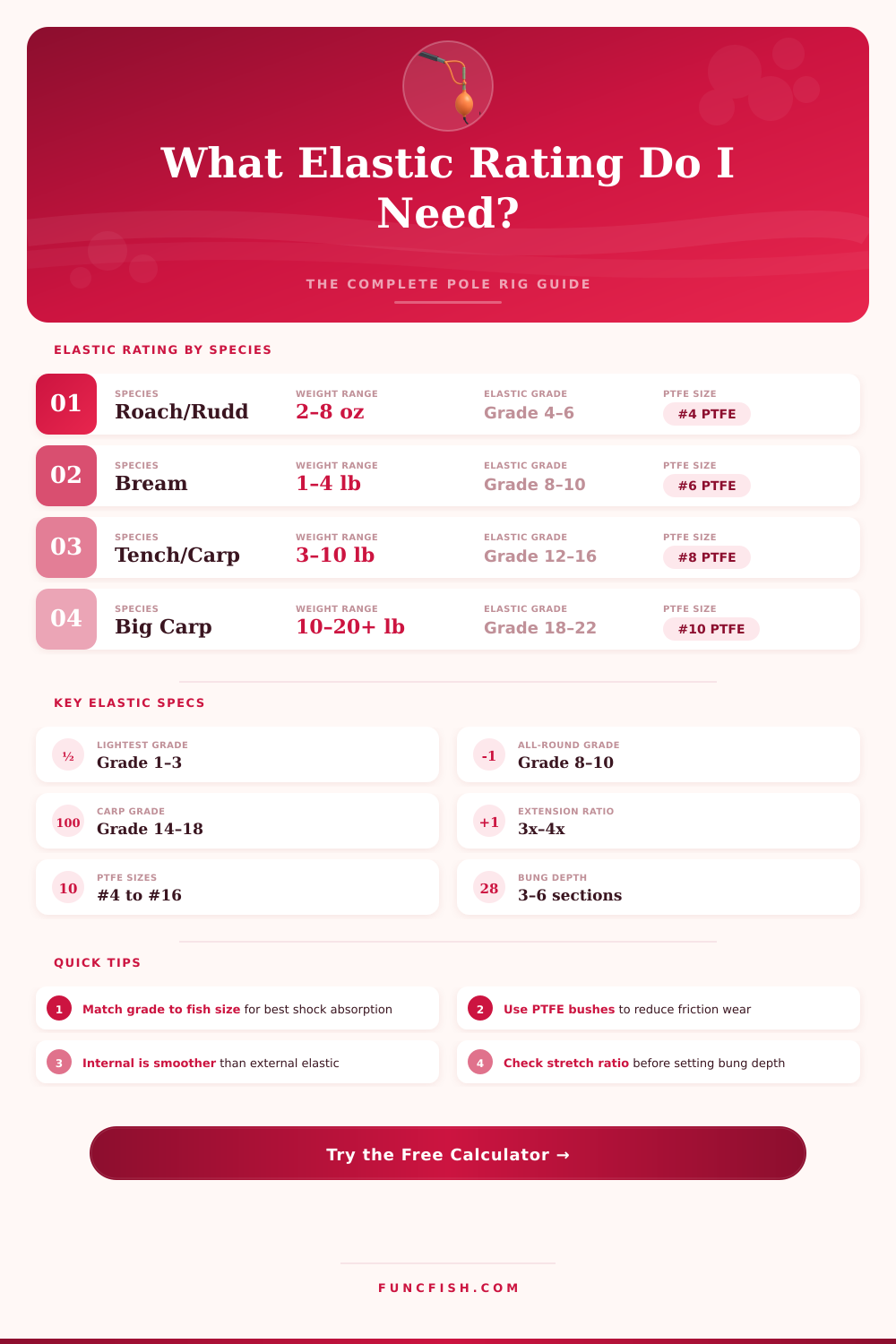
| Grade 4–6 | 0.9–1.2 | 4 oz–1 lb (113–454g) | Roach, rudd, dace, gudgeon | #4 |
| Grade 6–8 | 1.2–1.6 | 1–2 lb (454–900g) | Bream, skimmer, perch | #4–#6 |
| Grade 8–10 | 1.6–2.0 | 2–4 lb (0.9–1.8kg) | Tench, chub, hybrid, F1 | #6–#8 |
| Grade 10–12 | 2.0–2.4 | 4–7 lb (1.8–3.2kg) | Carp to 7 lb, barbel, large tench | #8 |
| Grade 12–14 | 2.4–2.8 | 7–10 lb (3.2–4.5kg) | Carp 7–10 lb, commercial carp | #8–#10 |
| Grade 14–16 | 2.8–3.2 | 10–14 lb (4.5–6.4kg) | Double-figure carp, barbel | #10–#12 |
| Grade 16–18 | 3.2–3.5 | 14–18 lb (6.4–8.2kg) | Large carp, river fishing, big barbel | #12–#14 |
| Grade 18–22 | 3.5+ | 18 lb+ (8.2kg+) | Specimen carp, power fishing | #14–#16 |
| Species | Typical Weight | Elastic Grade | Line Strength | Hook Size |
|---|---|---|---|---|
| Bleak | 0.5–2 oz | Grade 1–3 | 1–2 lb (0.45–0.9kg) | 20–22 |
| Roach / Rudd | 2 oz–1 lb | Grade 4–6 | 2–3 lb (0.9–1.4kg) | 16–20 |
| Dace | 2–8 oz | Grade 3–5 | 2–2.5 lb (0.9–1.1kg) | 18–20 |
| Skimmer Bream | 4 oz–1 lb | Grade 5–7 | 2.5–3 lb (1.1–1.4kg) | 14–18 |
| Bream | 1–5 lb | Grade 8–10 | 3–5 lb (1.4–2.3kg) | 10–16 |
| Perch | 4 oz–2 lb | Grade 6–8 | 3–4 lb (1.4–1.8kg) | 14–18 |
| Tench | 2–6 lb | Grade 8–12 | 4–6 lb (1.8–2.7kg) | 10–14 |
| Chub | 1–5 lb | Grade 8–12 | 4–6 lb (1.8–2.7kg) | 12–16 |
| F1 Carp | 1–4 lb | Grade 8–12 | 4–6 lb (1.8–2.7kg) | 14–18 |
| Common Carp | 4–20+ lb | Grade 10–22 | 6–12 lb (2.7–5.4kg) | 8–14 |
| Barbel | 2–12 lb | Grade 12–18 | 6–10 lb (2.7–4.5kg) | 10–14 |
| Elastic Type | Grade Range | Stretch Ratio | Best For | Friction Level |
|---|---|---|---|---|
| Solid Fine | 1–6 | 3.5–4.5x | Silverfish, delicate work | Low |
| Internal Hollow | 4–16 | 3x–4x | All-round carp & bream | Low–Med |
| External | 6–22 | 2.5x–3.5x | Big fish, strong current | Med–High |
| Hollow | 8–20 | 3x–4x | Commercial carp | Low |
| Hydro | 10–20 | 2x–3x | Big carp, powerful runs | Low |
| Bungee | 12–22 | 2x–3x | Specimen carp, barbel | Med |
| Power Elastic | 16–22 | 2x–2.5x | Very large carp, heavy fish | Med |
| Latex | 4–10 | 3x–4x | General match fishing | Low |
Choosing the correct elastic are necessary when setting up for pole fishing because the elastic determine both how much control you have over the fish and how much cushions you have during the fight between the fish and the fishing rig. Using an elastic that is too stiff can cause the fish to shake free from the hook due to lack of stretch in the elastic. Using an elastic that is too soft can cause the fish to swim into cover due to the excessive stretch of the elastic.
Therefore, you must select the correct elastic for the situations in order to successfuly land your fish. One of the first factors to consider when choosing the correct elastic is the weight of the fish. For instance, a small fish like a roach that weighs around 50 grams will require an elastic with less restraint than a large carp that can weigh 2 kilograms.
How to Choose the Right Elastic for Pole Fishing
The weight of the fishing float also play a role in the elastic choice because the heavier the fishing float the more power is required to lift the float, thus reducing the window of forgiveness that the elastic has. Additionally, the diameter of the fishing line can play a role in determining the correct elastic because thicker fishing lines will make it more dificultly for the elastic to provide a cushioning effect. Finally, the environment in which the fishing will occur can play a role in the type of elastic that you should choose; for example, environments with cover that the fish can escape into requires a stronger elastic to prevent the fish from escaping the fishing rig.
Depending on the type of fishing that you will be doing, there are different types of elastic that is designed to serve specific purposes. For example, anglers typically use solid elastic bands for fishing with fine hooks for small fish like roach. Hollow elastic bands are thicker and have more strength so they are better for carp fishing.
Additionally, hybrid elastics are designed to smooth out the recovery of the elastic after the fish pulls on it so they are used in commercial fishing environments. The thickness of the hook wire also have an impact on the elastic that should be used; for example, if the fish have fine hook wires, it is better to use a softer elastic to avoid injuring the mouth of the fish. However, if the hook wires are heavy, it is better to use a firmer elastic to keep the fish from knocking into cover.
It is also necessary to test the different types of elastic in a variety of different conditions. For instance, a fishing setup that works for deep lakes may not work for rivers due to the different rates of water flow. Additionally, a fishing technique that works for still waters may not work for the margins of ponds where the fish use the cover to escape from the anglers.
In these situations, it is better to make incremental changes to the elastic of the pole fish setup rather than making large changes to the elastic. For instance, you can test a different elastic in only half of the fishing lane before you have to change the elastic for the entire fishing setup. Additionally, the temperament of the fish will dictate the type of elastic that you use.
For instance, roach require a softer elastic so that you can easily feel the bite when the fish bite on the line. Bream fish move in a steady pattern so an elastic that can help to rein the fish in a straight line is best. Chub fish tend to turn towards snags so using a firmer elastic can help to provide control in these situations.
In addition to these fish, there are also different elastic presets for other fish. For instance, canal roach and commercial carp each has elastic presesets that can be followed to find the elastic that works best for these fish. Furthermore, there are different levels of control that can be beneficial in different situations.
High levels of control are beneficial for fishing near snags because it will allow the elastic to grip the fish even if the fish move in strong surges of water. Low levels of control are beneficial in areas with light bites because it will allow the elastic to provide more forgiveness when the fish bites the line lightly. However, each elastic setup has its own hardware specifications; using the appropriate sizes for PTFE bushes, side pullers, and beads when using heavy hollow elastic.
Additionally, always leave wraps in the top kit of the fishing pole because they will provide a buffer between the elastic and the fish that can prevent certain disaster that can occur during fishing. Common mistakes with elastic include underestimating the context of the fishing environment. For instance, if an angler chooses an elastic that is too soft for the situation, the fish may bump into the hooks and cause the fish to escape the fishing line.
Additionally, if an angler chooses an elastic that is too powerful, it will not provide enough cushioning for fish with thin hook lengths. In both of these situations, however, it is important for the angler to consider the venue in which the fishing will occur and the conditions of the water. The venue and water conditions will dictate the strength of elastic that is required for the fishing situation.
Therefore, if an angler can find a balance between the cushion of the elastic and the command of the elastic, the angler will be successful in landing the fish.