⛵ Pontoon Boat Weight Calculator
Calculate total load weight, passenger capacity, and safe operating limits for your pontoon boat
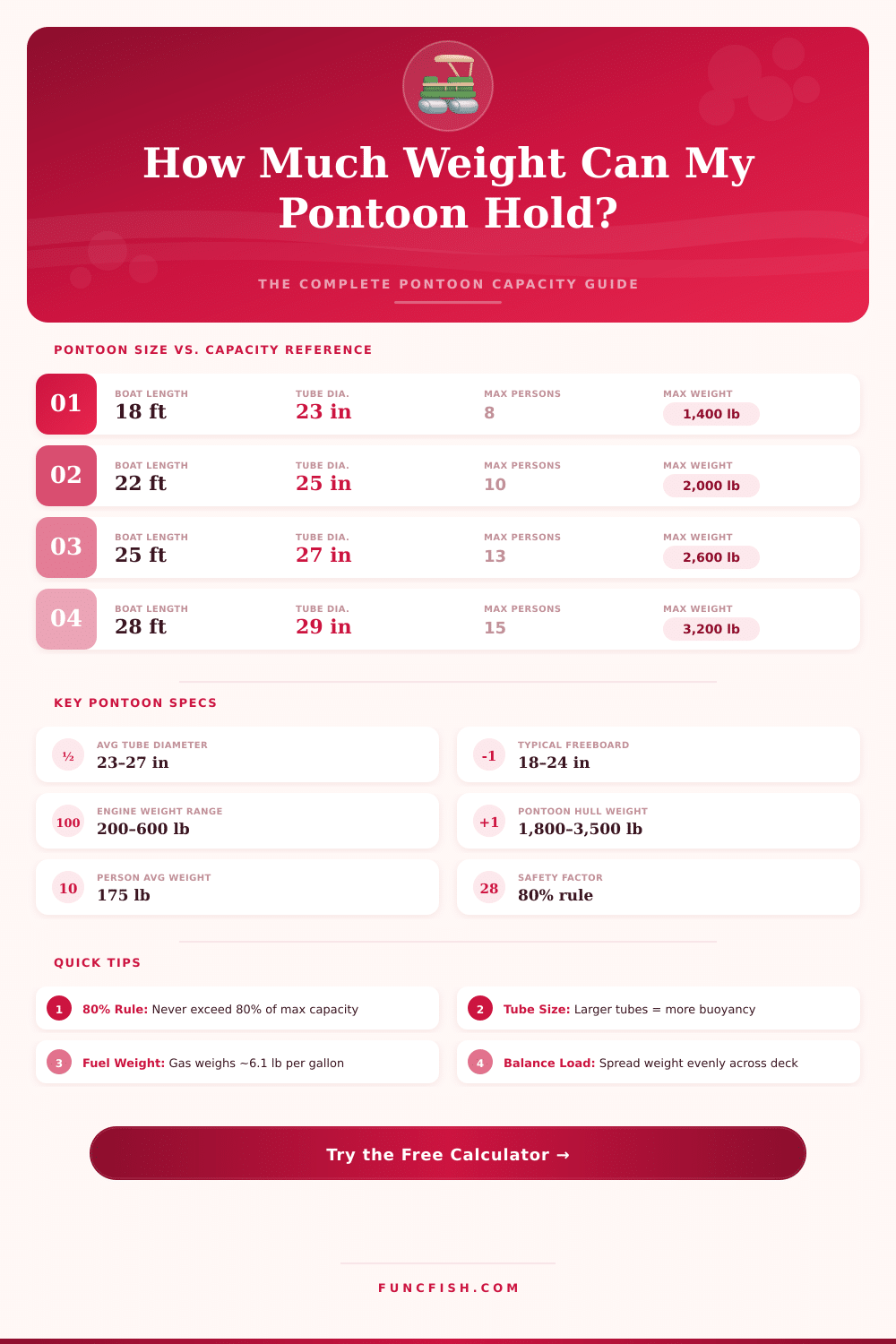
| Boat Length | Tube Dia. | # Tubes | Max Persons | Max Weight (lb) | Max Weight (kg) | Hull Weight (lb) |
|---|---|---|---|---|---|---|
| 16 ft (4.9 m) | 20 in | 2 | 6 | 1,000 | 454 | 1,100 |
| 18 ft (5.5 m) | 21 in | 2 | 8 | 1,200 | 544 | 1,400 |
| 20 ft (6.1 m) | 23 in | 2 | 9 | 1,600 | 726 | 1,700 |
| 22 ft (6.7 m) | 25 in | 2 | 10 | 2,000 | 907 | 1,900 |
| 24 ft (7.3 m) | 25 in | 3 | 12 | 2,400 | 1,089 | 2,200 |
| 25 ft (7.6 m) | 27 in | 3 | 13 | 2,700 | 1,225 | 2,500 |
| 28 ft (8.5 m) | 27 in | 3 | 15 | 3,200 | 1,452 | 2,900 |
| 30 ft (9.1 m) | 29 in | 3 | 17 | 3,800 | 1,724 | 3,400 |
| Item | Weight (lb) | Weight (kg) | Notes |
|---|---|---|---|
| Outboard 40 HP | 200 | 91 | Yamaha / Mercury class |
| Outboard 60 HP | 250 | 113 | Common on 18–20 ft |
| Outboard 90 HP | 320 | 145 | Mid-range power |
| Outboard 115 HP | 380 | 172 | Most popular size |
| Outboard 150 HP | 440 | 200 | High performance |
| Outboard 200 HP | 510 | 231 | Tritoon standard |
| Outboard 250 HP | 600 | 272 | Premium/luxury |
| Electric Trolling Motor | 80 | 36 | Bow-mount style |
| Fuel (per gallon) | 6.1 | 2.77 | Regular gasoline |
| Fuel (per liter) | 1.61 | 0.73 | Regular gasoline |
| Adult Person (avg) | 175 | 79 | ABYC standard used |
| Anchor (typical) | 20–35 | 9–16 | Depends on size |
| Cooler (full, large) | 50–80 | 23–36 | Ice + beverages |
| Life Jackets (set of 8) | 16 | 7 | ~2 lb each |
| Boat Length | Min HP | Recommended HP | Max HP | Typical Speed |
|---|---|---|---|---|
| 16–18 ft | 25 HP | 40–60 HP | 90 HP | 18–22 mph |
| 19–21 ft | 40 HP | 60–90 HP | 115 HP | 20–26 mph |
| 22–23 ft | 60 HP | 90–115 HP | 150 HP | 22–28 mph |
| 24–25 ft | 90 HP | 115–150 HP | 200 HP | 24–30 mph |
| 26–28 ft | 115 HP | 150–200 HP | 250 HP | 26–32 mph |
| 29–30+ ft | 150 HP | 200–250 HP | 300+ HP | 28–35 mph |
Pontoon boats show everywhere on the lakes during the summer, and their weight genuinely deserves attention before one buys or drags one of them. Most of those boats reach between 2,000 and 3,000 pounds when they are empty. Without fuel, without passengers, without any gear.
Matter to well recall this heavy number. For a typical pontoon boat when one counts the engine, it weighs around 2,200 pounds dry.
How Much Do Pontoon Boats Weigh?
Here is a good way to imagine that: those boats most commonly weigh between 100 and 120 pounds for every foot of length. So, if one wants a 24-foot model, one can expect 2,400 to about 2,880 pounds, according to the extras and gear that comes with it. That fits quite well with the general range of 2,000 to 3,000 pounds, before one lays anything extra on the boat.
Now about Bennington pontoon boats, they usually weigh between 2,500 and 3,000 pounds for the small and mid-size versions. When one moves to the biggre model with extra features, the weight passes 6,000 pounds. Again, that concerns only the boat itself, not the trailer or any extra burden that one drags.
Talking about trailers, one can expect that one of them weighs around 1,200 pounds dry. I met an owner with a 21-foot pontoon boat, set up with a 150-horsepower engine, and after adding fuel, batteries, tools and the trailer, the whole reached 4,000 pounds. For instance, a 22-foot Manitou tritoon with the same 150-horsepower engine, 20 gallons of fuel, two batteries and various items weighed around 5,000 pounds with the trailer.
The boat itself measured around 2,550 pounds empty, where the engine added roughly around 530 pounds to the total.
What genuinely determines those heavy values? Several things play a role. The size matters in the calculation, but the used materials affect likewise a lot.
Aluminium and fiberglass do not have the same weight. In addition come the chairs, electronics, engines. Everything that moves the balance upward.
Notable fact: tritoons way around thirty percent more than average two-tube pontoon boats, so the extra mass can limit the effect of a more mighty engine.
Most pontoon boats can bear around 2,000 pounds of burden, when one is on it with their stuff. That means that a fully loaded pontoon boat easily passes the 4,000-pound limit. The spread of weight is not as tricky on pontoon boats as on other boats.
The ideal for towing is to have around 2,500 pounds more towing skill than one genuinely needs, which makes turns, hills and windy roads safer. Before one attaches anythingand sails, always check the exact heavy specs for your boat.