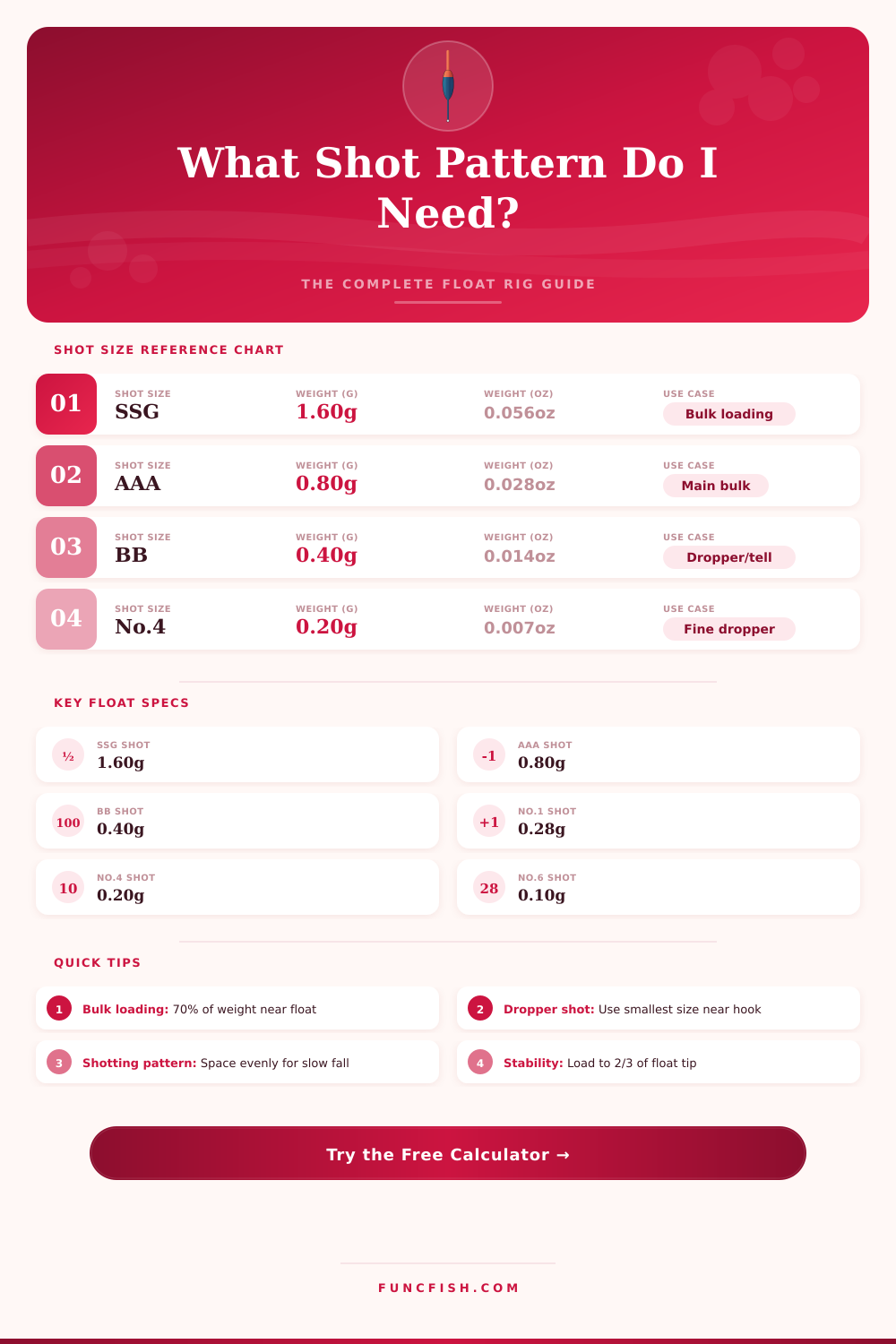
🎣 Quill Float Shot Pattern Calculator
Calculate the ideal shot size, weight distribution, and placement for any quill float rig
| Pattern Style | Bulk % of Capacity | Bulk Position | Dropper Position | Best Use |
|---|---|---|---|---|
| Bulk & Dropper | 70–75% | 60–70% of depth | 15–20cm above hook | Still/slow water, most species |
| Spread (Even) | N/A – equal spacing | Evenly from float | Last shot 20cm above hook | Shy biting, perch, tench |
| Olivette & Dropper | 80–85% | 50–60% of depth | 2–3 small shots below | Fast flow, deep water |
| Shirt Button | N/A – small equal shots | Evenly below bulk | Decreasing to hook | Carp, big tench, delicate takes |
| Species | Float Capacity | Hook Length | Recommended Pattern | Sensitivity |
|---|---|---|---|---|
| Roach | 0.5–2g | 10–20cm | Bulk & single dropper | High |
| Bream | 3–6g | 25–40cm | Bulk & 2 droppers | Standard |
| Tench | 2–4g | 15–25cm | Spread / shirt button | High |
| Perch | 1.5–3g | 15–30cm | Spread | Standard |
| Chub | 2–5g | 20–35cm | Olivette & dropper | Standard |
| Crucian Carp | 0.3–1g | 10–15cm | Shirt button | Ultra High |
| Dace | 0.5–2g | 10–20cm | Bulk & dropper | High |
| Barbel | 4–8g | 30–50cm | Olivette & dropper | Standard |
| Carp (margin) | 2–5g | 15–25cm | Shirt button / bulk | High |
| Gudgeon | 0.5–2g | 10–20cm | Spread | High |
| Float Capacity | Suggested Shot Combo | Total Weight (g) | Dropper |
|---|---|---|---|
| 0.5g | 2x No.4 + 1x No.8 | 0.46g | 1x No.8 |
| 0.75g | 1x BB + 1x No.6 | 0.50g bulk + tell | 1x No.10 |
| 1.0g | 1x BB + 1x No.4 + 1x No.6 | 0.70g + 0.10g | 1x No.6 |
| 1.5g | 1x AAA + 1x No.1 + 1x No.4 | 1.08g + 0.20g | 1x No.4 |
| 2.0g | 2x BB + 1x No.1 + 1x No.4 | 1.80g + dropper | 1x No.4 |
| 3.0g | 1x SSG + 1x BB + 1x No.4 | 2.60g + 0.20g | 1x No.4 |
| 4.0g | 2x SSG + 1x No.1 + 1x No.4 | 3.80g + dropper | 1x No.4 |
| 5.0g | 3x SSG + 1x BB + 1x No.4 | 4.80g + 0.20g | 1x No.4 |
| 6.0g | 4x SSG – olivette + 2x No.4 | 6.00g bulk | 2x No.4 |
Always load a quill float to within 1–2mm of the bristle top in still water. In flowing water, load it slightly lighter (85–90% capacity) to allow the current to sink it to the correct position. Use the smallest possible dropper shot — a No.8 or No.10 — to detect the most delicate bites.
For bulk & dropper rigs, place the bulk shot at 65–70% of the rig depth from the float. This gets bait down quickly through unproductive water. The dropper shot (15–20cm above hook) slows the final descent and acts as a visual bite indicator when a fish intercepts the falling bait.
A quill float is a fishing tool used to detect when a fish bite a hook. For the quill float to effectively respond to small movement in the water, it should be balance correctly. If not balanced correct, the quill float may sink to deep into the water or remain to high above the water.
A correctly balance quill float will take into account the weight of the bait, the weight of the fishing line, and the weight of the sinker. The balance of a quill float will take into account the weight of the bulk of the quill float, the dropper, and the lock shot. The bulk of the quill float is the main part of the float.
How to Balance a Quill Float
This bulk portion will need to be heavy enough to hold the fishing rig in place, but light enough for the quill float to rise when a fish move the bait. Dropper are small weights placed onto the fishing line to control how fast the bait fall into the water. Finally, lock shot is another weight component used for stability of the fishing rig.
Lock shot will help to prevent the fishing line from moving too much due to the current in the water. If you are fishing in a canal with still water, you should use a light quill float. For instance, if you are fishing for roach in a canal, you can use a 0.6 gram crow quill float.
Because the water in the canal is still, you can use a shirt button pattern. With this fishing pattern, the bulk of the quill float will account for 50 to 58% of the total weight of the fishing rig. In this instance, use four or five light dropper to allow the bait to fall slowly into the water.
Slowly falling bait is important when fishing for roach because the fish will easy be spooked by fast movement in the water. If you are fishing in a river, the water will move faster. Thus, the balance of the quill float will be different.
For instance, if you are fishing for dace in a river, the bulk of the quill float should be 70% of the total weight of the fishing rig. Additionally, because rivers has currents, using a thicker type of quill float, like an Avon quill float, would be useful. Fewer dropper would also be used when fishing in rivers because the current would otherwise pull the fishing hook away from the bottom of the river if there were too much dropper.
Different type of fish will require different types of quill float patterns. For instance, bream require that the bulk of the quill float is heavier, between 65 and 72% of the total weight of the fishing rig. Chub require that the bait fall quickly so compact bulk can be used for the quill float.
Crucian carp require that the bait fall very slow so light bulk and fine dropper can be used when fishing for this type of fish. Grayling will require that bulk of the quill float is medium high in weight and that there are two shots of lock shot to hold the fishing rig in the water. Finally, perch require that the bulk of the quill float has a steady density of weight so that the fishing rig pause in the water when the fish bites at the bait.
The weight of the bait will also have to be considered. If double maggots is used as the bait, the weight will be approximately 0.08 grams. This weight will help to pull on the quill float.
If the bait is heavy, then the bulk of the quill float will need to be heavy to keep the entire fishing rig from sinking. Another factor to consider is the weight of the wind. Strong wind will pull on the fishing line and the quill float.
Thus, if the wind is strong, you will need to increase the weight of the lock shot to keep the fishing rig from moving. Many people make mistake when balancing their quill float. For instance, if there is too much bulk to the quill float, the float will not rise when the fish bites at the bait.
Additionally, if there is too much weight to the dropper, the bait will fall too fast for some fish species to be able to eat the bait. To avoid these type of mistakes, always retrim the quill float if changing the bait or sinker. Additionally, always ensure that a small amount of the tip of the quill float is above the water.
If the tip of the quill float is above the water and moves when the fish bites, then the quill float is balance correctly.