🐟 Rainbow Trout Growth Rate Calculator
Estimate trout size by age, predict weight from length, and assess condition factor for any growth scenario
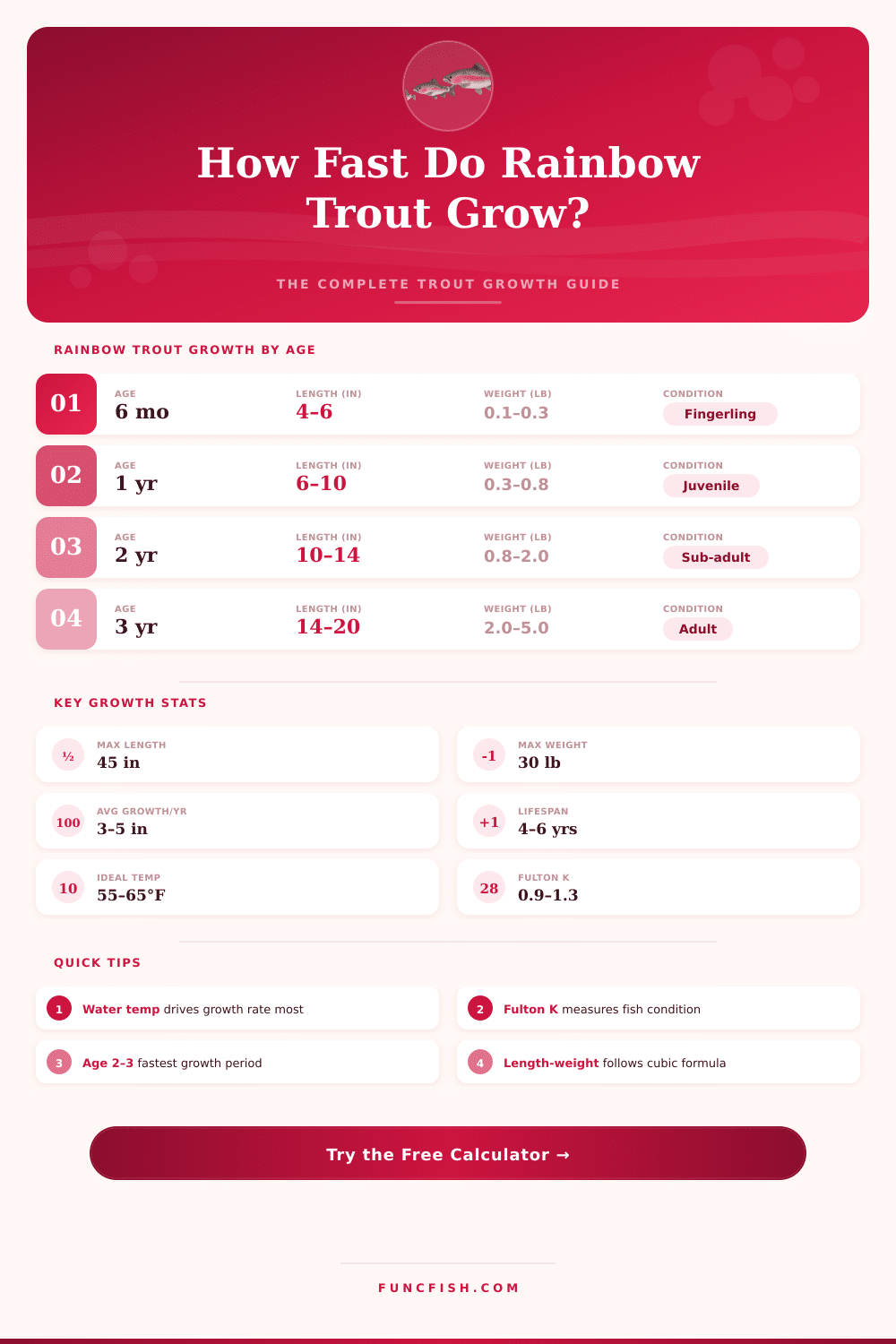
| Age | Length Range (in) | Length Range (cm) | Weight Range (lb) | Weight Range (kg) | Typical Growth Type |
|---|---|---|---|---|---|
| 6 months | 4–6 in | 10–15 cm | 0.1–0.3 lb | 0.05–0.14 kg | Fingerling / stocked |
| 1 year | 6–10 in | 15–25 cm | 0.3–0.8 lb | 0.14–0.36 kg | Wild juvenile |
| 1 year | 10–14 in | 25–36 cm | 0.5–1.5 lb | 0.23–0.68 kg | Hatchery yearling |
| 2 years | 10–16 in | 25–41 cm | 0.8–2.5 lb | 0.36–1.13 kg | Wild 2-year-old |
| 2 years | 14–18 in | 36–46 cm | 1.5–3.5 lb | 0.68–1.59 kg | Hatchery 2-year-old |
| 3 years | 14–20 in | 36–51 cm | 2.0–5.0 lb | 0.91–2.27 kg | Wild adult |
| 4 years | 17–24 in | 43–61 cm | 3.0–8.0 lb | 1.36–3.63 kg | Wild / lake adult |
| 5 years | 20–30 in | 51–76 cm | 5.0–14 lb | 2.27–6.35 kg | Lake / tailwater |
| Temp Range (°F) | Temp (°C) | Growth Modifier | Notes |
|---|---|---|---|
| Below 40°F | Below 4°C | 0.1–0.2x | Near dormant |
| 40–50°F | 4–10°C | 0.3–0.5x | Slow growth |
| 50–60°F | 10–15°C | 0.7–0.9x | Good growth |
| 60–65°F | 15–18°C | 1.0x | Optimal |
| 65–70°F | 18–21°C | 0.7–0.85x | Warm stress |
| Above 70°F | Above 21°C | 0.1–0.3x | Harmful |
| K Value | Condition | Meaning |
|---|---|---|
| Below 0.8 | Poor | Thin, under-fed |
| 0.8–0.95 | Fair | Below average |
| 0.95–1.1 | Good | Healthy, average |
| 1.1–1.25 | Very Good | Well-fed |
| 1.25–1.4 | Excellent | Superior condition |
| Above 1.4 | Exceptional | Trophy quality |
| Species | 1-yr Length (in) | 3-yr Weight (lb) | Max Weight (lb) | Ideal Temp (°F) | Growth Rate vs Rainbow |
|---|---|---|---|---|---|
| Rainbow Trout | 8–14 in | 2–5 lb | 30 lb | 55–65°F | Baseline (1.0x) |
| Brown Trout | 6–12 in | 1.5–4 lb | 40 lb | 54–63°F | 0.85–0.95x |
| Brook Trout | 5–9 in | 0.8–2 lb | 14 lb | 52–60°F | 0.6–0.75x |
| Lake Trout | 5–8 in | 1–3 lb | 100 lb | 45–55°F | 0.5–0.7x |
| Cutthroat Trout | 6–11 in | 1–3.5 lb | 41 lb | 50–62°F | 0.8–0.9x |
| Tiger Trout (hybrid) | 8–15 in | 2–6 lb | 20 lb | 52–65°F | 1.05–1.15x |
| Trout Length | Est. Weight | Line (lb test) | Hook Size | Rod Action | Leader Tippet |
|---|---|---|---|---|---|
| Under 10 in (25 cm) | Under 0.5 lb | 2–4 lb | #10–#14 | Ultralight | 6X–7X |
| 10–14 in (25–36 cm) | 0.5–1.5 lb | 4–6 lb | #8–#12 | Ultralight–Light | 5X–6X |
| 14–18 in (36–46 cm) | 1.5–3 lb | 6–8 lb | #6–#10 | Light–Medium | 4X–5X |
| 18–24 in (46–61 cm) | 3–6 lb | 8–12 lb | #4–#8 | Medium | 3X–4X |
| 24–30 in (61–76 cm) | 6–12 lb | 10–15 lb | #2–#6 | Medium–Heavy | 2X–3X |
| Over 30 in (76 cm) | Over 12 lb | 15–20 lb | #1–#4 | Heavy | 0X–1X |
Rainbow Trout don’t all grow at the same speed, really it depends on the place where they live on what they eat and on the area. The differences come from the habitat, from their age and from the access to food, whether about amount or about quality. Here is what makes it hard to set one fixed plan for the Growth Rate.
In controlled hatcheries, where the water stays at the right temperature and the food never lacks, those fish reach 25 to 38 centimeters during the first year. In the second year they commonly arrive at 50 centimeters and weigh around 3 to 4 pounds. That shows good progress when everything works for them.
Why Rainbow Trout Grow at Different Speeds
Water that hovers around 16 degrees during the whole year, together with good feeding, usually gives about 30 centimeters of growth in that frist period.
Temperature has big weight. Rainbow Trout process food best when the water is around 15 degrees Celsius. Go outside that range and the Growth Rate slows soon.
If the temperature falls under 10 degrees in winter, everything slows clearly.
To reach trout up to sold size, around one kilo, which matches to 2.2 pounds, requires between 12 and 18 months in perfect conditions. After they pass that stage, the Growth Rate becomes slower compared too the explosive gains of earlier. Here is an interesting point: one study followed Rainbow Trout that weighed around 5.2 kilos in 26 months, and when they reached breeding age, the curve of growth flattened.
Rainbow Trout have a name among the fastest growers in the world of trout. Brown trout follow them quite closely. When they first hatch, one calls them sac fry or young fish.
After two weeks or so, they use up the yolk sac and the fry start to hunt little zooplankton.
The situation changes if one moves trout to sea water. Fish moved to ocean cages at around 70 grams can reach 3 kilos in less than 18 months. Those systems handle high density of biomass, we talk about 30 to 40 kilos per square meter.
Sexual maturity comes around the third year, regardless of the real size. They most commonly live three to five years, although populations in lakes sometimes last longer. One rarely finds trout above 8 years old.
The bigger and stronger ones seem to have more luck to reach old age, which maybe explains why some fish seem to rush toward the finish.
Fall stocked trout reach useful size sooner in the next summer than their relatives stored in spring six months before. Fed fish clearly beat those without food. Young fish can need around 3 years to reach 25centimetres.
It matches to something around 10 centimeters yearly for those who succeed, although predators like cormorants can totally overturn the situation quickly.