🐟 Rainbow Trout Stocking Density Calculator
Calculate ideal fish counts, biomass limits, and oxygen requirements for ponds, raceways & tanks
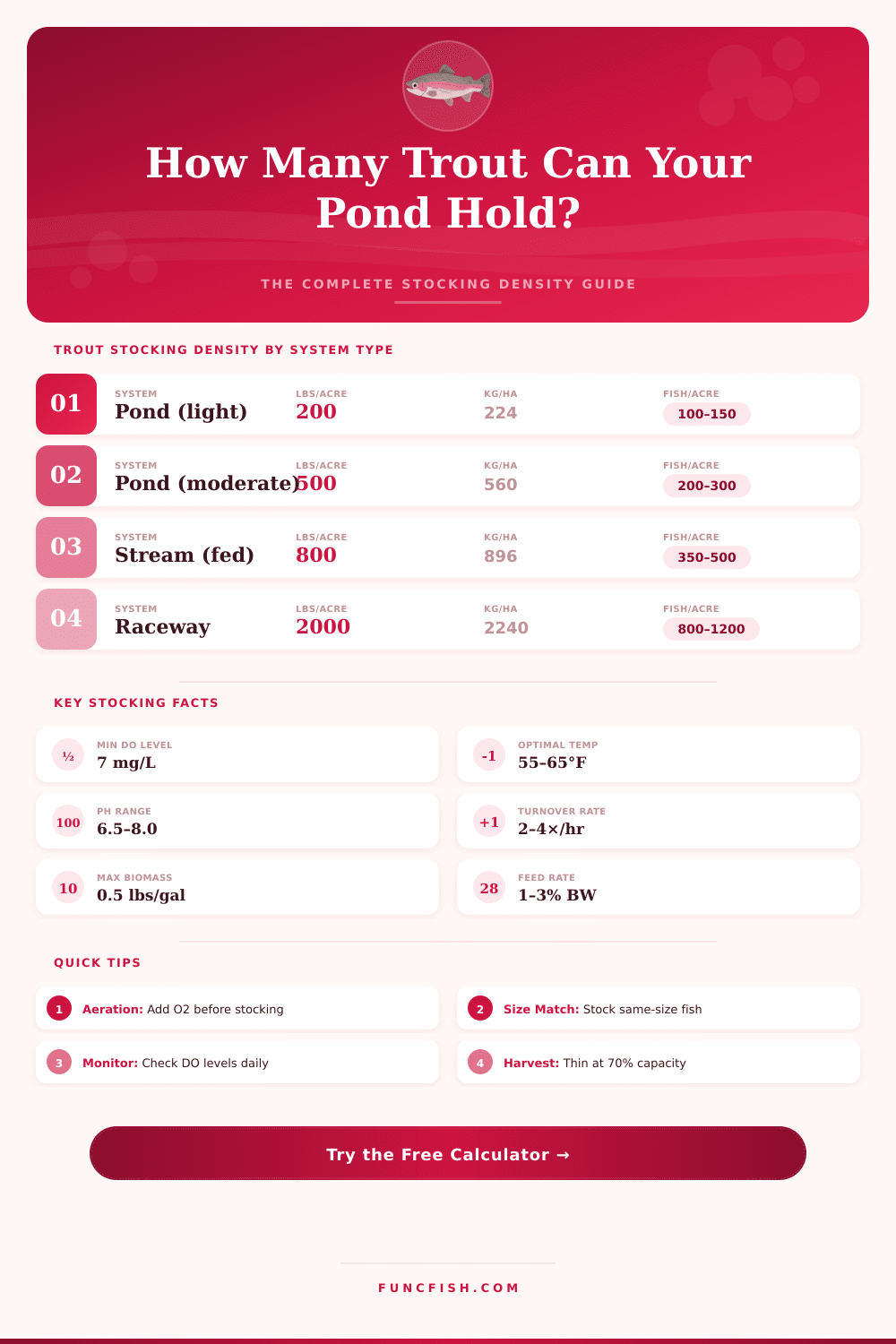
| System Type | lbs/acre (lbs/gal tank) | kg/ha (kg/m³ tank) | Fish/Acre (0.5 lb avg) | Key Requirement |
|---|---|---|---|---|
| Pond — No Aeration | 100–200 lbs/acre | 112–224 kg/ha | 200–400 | Natural DO only |
| Pond — Paddlewheel | 400–600 lbs/acre | 448–672 kg/ha | 800–1,200 | 7+ mg/L DO |
| Pond — O₂ Injection | 600–1,000 lbs/acre | 672–1,121 kg/ha | 1,200–2,000 | 9+ mg/L DO |
| Raceway — Flow-through | 1,500–2,500 lbs/acre | 1,682–2,803 kg/ha | 3,000–5,000 | Continuous flow |
| Raceway — Supplemental O₂ | 2,500–5,000 lbs/acre | 2,803–5,605 kg/ha | 5,000–10,000 | Pure O₂ + flow |
| RAS Tank — Standard | 0.2–0.35 lbs/gal | 24–42 kg/m³ | N/A | Biofilter + aeration |
| RAS Tank — Intensive | 0.35–0.5 lbs/gal | 42–60 kg/m³ | N/A | O₂ injection req. |
| Spring-Fed Stream | 150–400 lbs/acre | 168–448 kg/ha | 300–800 | Spring inflow |
| Fish Age / Stage | Typical Length | Typical Weight (Imperial) | Typical Weight (Metric) | Recommended Space |
|---|---|---|---|---|
| Fingerling (3 mo) | 3–4 in / 7–10 cm | 0.05–0.1 lb | 23–45 g | 5,000–10,000/acre |
| Sub-adult (6 mo) | 6–8 in / 15–20 cm | 0.25–0.5 lb | 113–227 g | 1,500–3,000/acre |
| Catchable (9–12 mo) | 10–12 in / 25–30 cm | 0.5–1.0 lb | 227–454 g | 500–1,200/acre |
| Pan Size (12–18 mo) | 12–15 in / 30–38 cm | 1.0–2.0 lb | 0.45–0.9 kg | 250–600/acre |
| Trophy (2–3 yr) | 18–24 in / 46–61 cm | 3.0–8.0 lb | 1.4–3.6 kg | 50–150/acre |
| Brood Stock (3+ yr) | 24–30 in / 61–76 cm | 8.0–20.0 lb | 3.6–9.1 kg | 25–75/acre |
| DO Level (mg/L) | Temperature Range | Density Multiplier | Notes |
|---|---|---|---|
| Below 5 mg/L | Any | 0 (do not stock) | Lethal within hours |
| 5–6 mg/L | 45–54°F (7–12°C) | 0.4× base density | Stress zone, emergency only |
| 6–7 mg/L | Any | 0.7× base density | Suboptimal, monitor closely |
| 7–8 mg/L | 55–65°F (13–18°C) | 1.0× base (standard) | Ideal operating range |
| 8–9 mg/L | 55–65°F (13–18°C) | 1.3× base density | Good production conditions |
| 9–12 mg/L | 55–65°F (13–18°C) | 1.6× base density | Pure O₂ injection required |
| Above 72°F (22°C) | Any DO | 0× (reduce to 0) | Temperature stress — fatal zone |
Get the right Stocking Density in fish farming is not easy, it is probably the biggest challenge for modern farms. With Rainbow Trout, one must always balance between the maximising of the production and the issue about the health of the fish. Too many fish in one tank create serious troubles while less than required simply mean to lose money for nothing.
This is what makes Rainbow Trout like this attractive: they belong to the more social species between the trout. Hence they last bigger groups than many of their relatives. Here why they became the usual choice for large farmings.
How Many Rainbow Trout to Keep in a Tank or Pond
Coming from the coast of the Pacific Ocean, they spread through North America and adapted surprisingly well in various places.
Scientists tested Rainbow Trout in different densities during almost nine decades. They tried levels around 10, 40 and 80 kilos each cubic metre in common water. The results were clearly evident: fish in 40 kilos each cubic metre grew much more slowly than those in only 20 kilos each cubic metre.
Here so, higher densities slow the increase. Moreover, crowded fish eat less, convert their food badly and start to develop problems with flesh at the nets.
Crowding genuinely stresses this species extremely. It is not simply a guess, various studies proved that for many fish, between them golden fish, halibut and others. Fish in high densities react to stress otherwise then those in more spacious conditions.
Experiment compared two levels of Stocking Density. 100 and 200 fish each cage, during 140 days. The cages with low density gave around 35 kilos in harvest, what was almost half of the 61 kilos from the fuller cages.
Although each individual fish grew more slowly, the whole biomass in those crowded cages resulted much more big. In simple aquaponic systems, Rainbow Trout reached final weight circa 17 kilos each cubic metre, and raising the density here also expanded the whole production of biomass.
For organic farmings, final density of around 30 kilos each cubic metre did not harm the welfare of the fish, one study advised that as a good target. A piece of research showed, that trout, that started in around 6,6 or 8,6 kilos each cubic metre, had to receive decrease under 36 kilos each cubic metre after almost 240 days of intensive increase.
Even so, the science always has unclear areas. None yet specified the weakest minimal Stocking Density or counted, that density optimises the conversion of food and the rates of increase. If you store trout in a pool, that already has basses, carp, sunfish and other inhabitants, you must consider the whole capacity of the surroundings.
One guideline from the industry offers around 300 trout each acre as astarting point. Its real impact depends only on the right species and amount for your own pool.