
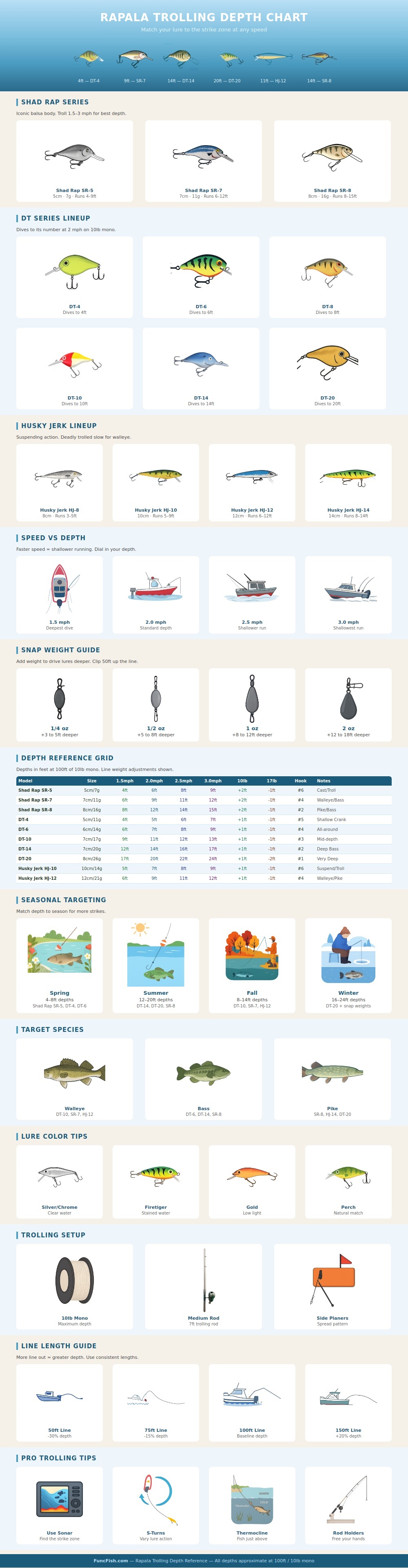
Trolling involve moving a boat at a steady speed, pulling the lures behind the boat through a water. To troll effective, you need to ensure that the depth of the lure match the depth of the fish in the water column. If the depth of the lure does not match the depth of the fish in the water column, the lure will move through water that dont contain any fishes.
To troll effectively, you must understand how balsawood crankbaits behaves at different speeds. The faster the boat moves, the crankbait will behave at varying depths in the water column. The speed of the boat determine the depth of the crankbaits.
How to Troll and Match Lure Depth to Fish
The faster the boat moves, the more higher the crankbaits will rise towards the surface of the water. By decreasing the speed of the boat, the crankbaits will dive deeper into the water. Thus, the speed of the boat can control the depth of the crankbaits.
If the anglers want to fish in shallow waters, they should increase the speed of the boat. If they want to fish in deep waters, the angler should decrease the speed of the boat. The design of the crankbaits will also determine the depth of the lures.
There are crankbaits with small lips that is specifically designed to stay in shallow waters. These crankbaits are used when the fish is in shallow waters, especially in warmer months when fish move into deep waters. Crankbaits with aggressive lips will force the bait to dive deeper into the water.
These types of crankbaits are used when fishing in the cooler parts of the year when fish live in deep waters. Many types of crankbaits can be used at the same time by using a spread of fishing rods. Using a spread of fishing rods will allow anglers to fish the top, middle, and bottom of the water column at the same time.
The type of fishing line and the weight of the bait also affect the depth of the lure. If the angler uses thinner fishing line, the bait will cut through the water more easy and reach deeper depths. If the fishing line used is heavier, the line will float higher in the water, and the lure will stay close to the surface of the water.
Using snap weights can also increase the depth of the lure. A snap weight is a sinker that gets clip onto the fishing line. The weight will push the lure deeper into the water without stopping the movement of the lure.
Fish change depth in different seasons in search of ideal temperature. To troll effectively, anglers must change the depth of their lures according to the different seasons of the year. During spring, fish go to shallow waters to spawn.
During the summer, fish go to deep waters to escape the heat of the warm sun. In the fall, fish live in the middle of the water column. The color of the lure can also affect trolling.
Anglers should use natural color of the bait when fishing in clear waters. In muddy waters, bright and loud colors of the lures are preferred. Silver colors work best in areas with alot of sunlight.
If fishing for perch, using perch pattern colors of the lure will increase the chance of success. By using a lure that matches the environment in which the fish live, the chances of the fish striking the lure will increase. To troll effective, anglers should first use a sonar to determine the depth of the fish.
Once the sonar devices have identified the depth of the fish, the anglers can select the lure and boat speed that will allow the lure to reach the depth where the fish are located. Following these steps will ensure that the lures move through the same part of the water where the fish live.